Bottle feeding sounds straightforward until you are actually standing in a baby store staring at an entire wall of bottles, nipples, sterilizers, and accessories, all claiming to be essential, all looking slightly different, none of them coming with clear instructions for your specific baby. It is a lot. And that is before you have even gotten to the actual feeding part: the holding position, the flow rate, the burping, the worrying about whether your baby is getting enough.

This guide covers the bottle feeding basics in a way that is actually useful: what equipment matters and what does not, how to prepare milk safely, how to feed in a way that is comfortable for your baby and works with their natural cues, and how to troubleshoot the things that commonly go sideways. Whether you are exclusively bottle feeding, combining with nursing, or just preparing for when someone else needs to feed your baby, this is the practical stuff that helps.
Breast Milk in a Bottle vs. Formula: A Quick Word
Before anything else, the feeding choice you have made is fine. Bottle feeding looks different for different families: some are giving expressed breast milk, some are using formula, and some are doing a combination. All of those are valid, and most of what you will read here applies equally across all three. The CDC reports that while around 84% of infants start out receiving some breast milk, that number drops in the months that follow, not because families do not care but because life is genuinely complicated; work, supply challenges, medical situations, mental health, and personal preference are all reasons families end up bottle feeding, and none of them require justification. The AAP acknowledges that while breastfeeding has unique benefits, formula is a safe and healthy alternative. What matters most is that your baby is fed consistently, safely, and with someone present who is paying attention to them. That is what nourishes a baby, the milk and the person holding them.
Choosing the Right Bottle and Nipple
There is no universally best bottle. Babies have preferences you will not know until you try, which is why buying one of several options before committing to a full set makes more sense than loading up on a single brand. Plastic bottles are the most common and most practical for everyday use, lightweight, unbreakable, and easy to find; make sure they are labeled BPA-free (now standard for infant use), and know they scratch over time and need replacing eventually. Glass bottles are heavier but do not degrade or scratch and are easier to sterilize thoroughly, so many parents use them at home and switch to plastic for outings. Silicone bottles are newer and genuinely useful, lightweight, naturally antimicrobial, and easy to squeeze for paced feeding, though they cost more. Beyond material, you will see wide-neck versus standard, angled bottles, and complex venting systems claiming to reduce colic; the honest answer is that research on anti-colic bottles is mixed, so if your baby is struggling with gas and you have already worked on technique, trying a vented bottle is reasonable, but it is not where to start.
Choosing the Right Nipple
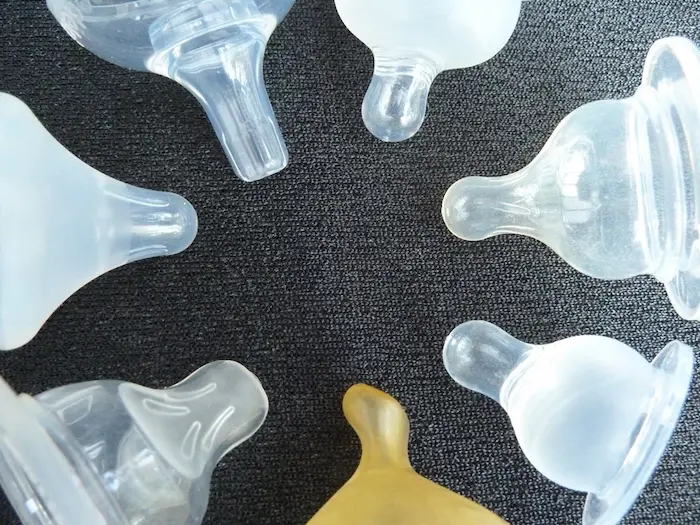
Flow rate is what matters most with nipples, and it is the detail most parents do not think about until something goes wrong: too fast and the baby chokes, gulps air, and overfeeds; too slow and they work so hard they exhaust themselves and give up frustrated. As a general guide by age, use slow flow for newborns up to about 3 months, medium flow around 3 to 6 months, and fast flow from 6 months on, though these are approximations, so watch your baby, not the label. Signs the flow is too fast include milk dripping from the corner of the mouth, choking or coughing mid-feed, and gulping sounds; signs it is too slow include the baby working hard and barely getting anything, the nipple collapsing inward, and fussing or giving up before finishing. For material, silicone nipples are firm, clear, and easy to clean, while latex is softer and more flexible (some babies prefer it, but it degrades faster). Always buy nipples new, since they cannot be adequately cleaned between babies and they wear out.
What You Actually Need to Get Started
The short list: a dedicated bottle brush with a nipple-cleaning attachment, a way to sterilize (boiling, a steam sterilizer, or microwave steam bags), a few bottles to rotate, and, if you are using formula, a divided formula dispenser that saves a lot of fumbling during nighttime feeds. A bottle warmer is convenient but not necessary, since a bowl of warm water does the same job. What is not optional: never use a microwave. The Mayo Clinic is clear on this, because microwaves create uneven hot spots that can burn a baby’s mouth even when the bottle feels fine on the outside, and the heat destroys some of the beneficial properties in breast milk.
How to Safely Prepare Bottles
Getting preparation right matters more than most parents realize, especially in the newborn months when immune systems are still developing.
Expressed Breast Milk
Wash your hands before handling pumped milk every time, and this is not a rule you can relax once you are tired. Use clean, sterilized storage containers and label each with the date expressed so you always use the oldest milk first. To thaw frozen milk, move it to the fridge the night before or hold the container under warm running water; room-temperature thawing is not recommended, and once milk has thawed, do not refreeze it. To warm refrigerated milk, set the bottle in a bowl of warm water for a few minutes and test it on your wrist, where it should feel warm, not hot, then swirl gently to mix the fat that separates during storage rather than shaking hard, which can break down some proteins. Per the CDC, freshly expressed milk is good at room temperature for up to 4 hours, in the fridge for 4 days, and in the freezer for 6 to 12 months (best within 6); once your baby has fed from a bottle, use or discard within 2 hours. For a full breakdown, our guide to pumping and storing breast milk covers the details.
Preparing Formula Safely
Powdered formula is not sterile, which a lot of parents do not know. The CDC and WHO both recommend specific steps to protect against Cronobacter, a rare but serious bacterial infection that can affect newborns.
- Wash your hands and make sure bottles and nipples are clean and sterilized.
- Boil fresh tap water, then let it cool for about 5 minutes until it reaches at least 158°F (70°C). This is hot enough to kill Cronobacter but cool enough to preserve nutrients, and the WHO specifically recommends this temperature for powdered formula.
- Pour the correct amount of water into the sterilized bottle first.
- Add the powder using the scoop from the container; do not pack or heap it, just level it off with a clean knife.
- Cap the bottle and swirl or roll it between your hands to mix. Bubbles are fine; let them settle before feeding.
- Cool the bottle quickly under running cold water or in an ice bath until it is warm but not hot.
- Test on your wrist; it should feel warm, not hot.
Never dilute formula beyond the package instructions. It seems like it would stretch things further, but it actually causes serious health problems. Prepared formula is good at room temperature for 2 hours and in the fridge for 24 hours, and you should discard anything left after a feed.
How to Bottle Feed: The Technique That Matters
How you feed your baby is as important as what is in the bottle. The way you hold them, how fast milk flows, and whether you are reading their cues all shape how comfortable and connected the feed is.
Paced Bottle Feeding
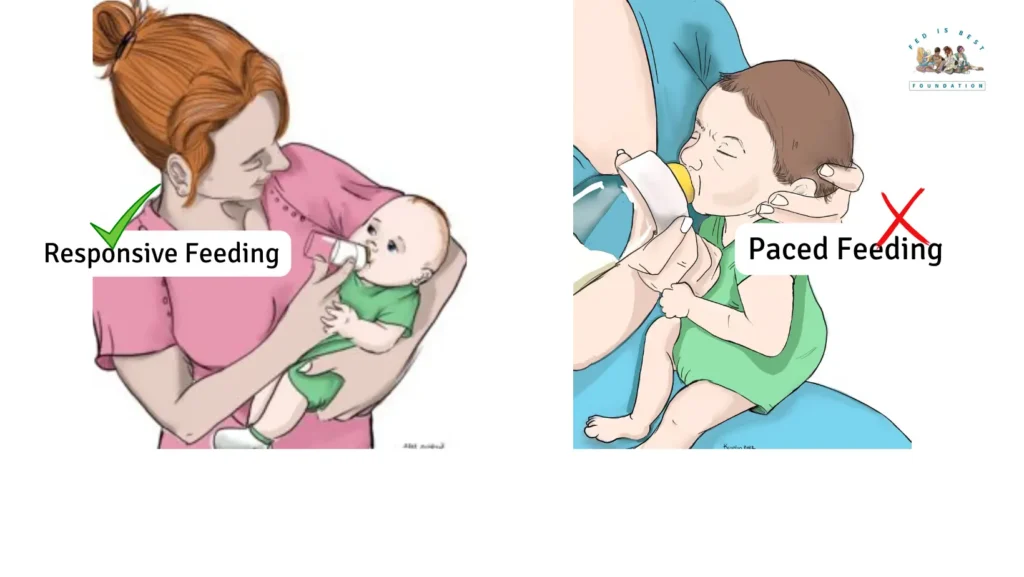
Paced bottle feeding is the method most pediatric feeding specialists recommend, and once you understand why, it is hard to go back to just tilting the bottle and waiting. The idea is to mimic the rhythm of breastfeeding, where a baby has to work a little to get milk and controls the pace, rather than having milk flow freely and quickly. This helps prevent overfeeding, reduces gas, and gives your baby’s fullness signals time to catch up with their stomach.
- Hold your baby semi-upright, not flat on their back and not fully sitting, somewhere in between, supported and close to you.
- Touch the nipple to their upper lip and wait for them to open wide and draw it in; do not push it into their mouth.
- Keep the bottle nearly horizontal, just enough tilt that milk covers the nipple opening, so your baby has to actively suck rather than just swallow what flows in.
- Every 20 to 30 seconds, tilt the bottle down or gently remove it for a brief pause, mimicking the natural pauses in breastfeeding and letting your baby catch their breath.
- Watch for fullness cues and stop when your baby shows them, even if there is milk left in the bottle.
- Burp mid-feed and again at the end.
A paced feed typically takes 15 to 20 minutes. It feels slower at first, but babies fed this way tend to have less gas, less overfeeding, and more settled periods afterward. It is especially important for breastfed babies who receive bottles occasionally, since paced bottle feeding helps keep them from developing a preference for the bottle’s faster flow over nursing.
Reading Hunger and Fullness Cues
This is one of the most important skills in feeding a baby, and it applies whether you are nursing or bottle feeding. Early hunger cues include rooting (turning the head with an open mouth), sucking on hands, smacking lips, and increased alertness and movement; crying is a late hunger cue, so try to catch the earlier signals when you can. Fullness cues include slowing or stopping sucking, turning the head away from the bottle, hands relaxing open, the body going loose, and falling asleep. When you see these, stop, and do not encourage your baby to finish the last half ounce, since babies know when they have had enough and pushing past those signals is how overfeeding happens. Learning to read baby hunger and fullness cues in more detail is worth the read if this is new territory.
Burping During Bottle Feeding
Bottle-fed babies tend to swallow more air than breastfed babies, which is why burping matters. The standard approach is to burp around the halfway point and again at the end. You do not need to spend ten minutes patting; a minute or two of gentle upward strokes on the back, with your baby over your shoulder or sitting upright supported in your lap, is usually enough. Some babies burp easily and others need more time, but if nothing comes up after a couple of minutes, it is fine to move on.
Making the Feed More Than Just Feeding
The Mayo Clinic notes that feeding time is prime time for connection and early social development, regardless of what is in the bottle. Make eye contact, talk softly, and hold your baby close; switching sides partway through a feed gives visual variety and is good for eye development too, and putting the phone down helps. And let other people feed the baby, since partners, grandparents, and trusted caregivers can all bond during feeds in a way nursing alone does not allow, which is one of bottle feeding’s real advantages.
Common Challenges, and What Actually Helps
Gas and fussiness often gets labeled as colic when it is really just air swallowed during feeds, so start with technique before buying new bottles: paced feeding, burping mid-feed, keeping your baby upright for 20 to 30 minutes after eating, and checking that the nipple flow is not too fast will address most of it, and only if your baby is still uncomfortable does an anti-colic vented bottle make sense. Our guide to infant gas relief covers approaches beyond feeding technique. Spitting up is often normal, since the muscle between the esophagus and stomach is still maturing, and the AAP notes most reflux resolves on its own by 12 to 18 months; smaller, more frequent feeds, keeping your baby upright, and gentle regular burping all help, but if your baby seems in pain, arches their back during feeds, or is not gaining weight well, call your pediatrician.
A breastfed baby refusing the bottle is genuinely stressful, especially near a return-to-work deadline. It helps to have someone other than the nursing parent offer the bottle (a baby can smell the nursing parent and hold out for the real thing), to try different temperatures and a bit of movement while feeding, and to go slowly with different nipple shapes, touching the nipple to the lip and waiting for the baby to open. Introduce bottles around 3 to 4 weeks if you know your baby will need one, since waiting too long makes the transition harder; most babies do eventually accept it with patience. And if you are combining breast milk and formula, protect your supply by replacing missed nursing sessions with pumping, breastfeeding first when you can, and keeping night feeds going since prolactin is highest overnight; our guide to combo feeding covers the specifics.
Cleaning and Sterilizing Bottles
Proper cleaning matters most in the newborn months, when babies are most vulnerable. The CDC’s guidance is clear: thoroughly clean after every feed, and sterilize regularly for babies under 3 months, premature infants, or babies with weakened immune systems. After each feed, disassemble the bottle completely, rinse in cool water to remove milk residue, then wash all parts in hot soapy water with a dedicated bottle brush, including poking through the nipple holes with a small cleaning brush; rinse thoroughly and air dry on a clean rack rather than a dish towel, which can transfer bacteria. For sterilizing, boiling in water for 5 minutes works fine, electric steam sterilizers are faster for daily use, and microwave steam bags are handy for travel; any method is fine as long as you are consistent in those early weeks, while for healthy older babies, thorough washing is usually sufficient between sterilization sessions.
Frequently Asked Questions
General ranges from the AAP: newborns to 2 weeks take about 1 to 2 ounces per feed, 2 weeks to 2 months around 2 to 4 ounces, 2 to 4 months around 4 to 6 ounces, and 4 to 6 months around 6 to 8 ounces. These are approximations, since some babies take more and some less. Your pediatrician tracks weight gain to confirm your baby is getting enough, so watch cues more than numbers.
A feed that takes about 15 to 20 minutes with no milk dripping from the mouth and no choking or gulping is a good sign. If milk leaks from the corner of the mouth or your baby coughs mid-feed, go down a flow level; if they work hard, the nipple collapses, or they fuss and give up before finishing, go up a level. Age labels are starting points, not rules.
Yes. Prepare the formula separately per package instructions first, then add it to the breast milk. Once mixed, follow formula storage guidelines: use within 2 hours at room temperature or 24 hours refrigerated. Some lactation consultants suggest keeping them separate and offering breast milk first, so if your baby does not finish, you have not wasted both together. Either approach works.
Per CDC guidelines, use within 2 hours at room temperature. Refrigerated, use within 24 hours for formula and within 4 days for freshly expressed breast milk. Once your baby has fed from a bottle, discard anything remaining within 2 hours, since saliva introduces bacteria that speed spoilage. Thawed breast milk should be used within 24 hours and never refrozen.
Glass bottles, yes, as long as they are in good condition and sterilized thoroughly before use. Plastic is trickier, since it scratches over time and scratches harbor bacteria that are hard to clean out, and older plastic may contain BPA that is no longer used in new bottles. Inspect used plastic carefully and replace anything worn or cloudy. Nipples should always be bought new, since they degrade and cannot be reliably sterilized between babies.
Start with technique before equipment. Are you pacing the feed and giving breaks? Is the flow rate appropriate rather than too fast? Are you burping mid-feed and keeping your baby upright afterward? Most bottle-related gas comes from swallowing air, and adjusting technique addresses it more reliably than switching bottles. If you have worked through all of that and your baby is still clearly uncomfortable, an anti-colic bottle is worth trying.
One Last Thing
Bottle feeding is a skill, for you and for your baby. The first few feeds might be awkward, and you will gradually figure out what temperature your baby prefers, how long they like feeds to take, when they want breaks, and how they signal fullness; that knowledge builds over time and starts to feel automatic. Some feeds will go smoothly and some will not, and that is just feeding a baby. What matters is that you are there, paying attention, responding to them, and that they are growing and settled more often than not. The rest works itself out.
References
- American Academy of Pediatrics. (2023). Infant feeding and bottle guidelines. healthychildren.org
- Centers for Disease Control and Prevention. (2024). Formula feeding and bottle safety. cdc.gov/infant-toddler-nutrition
- World Health Organization. (2007). Safe preparation of powdered infant formula. who.int/publications
- Mayo Clinic Staff. (2024). Bottle-feeding tips for new parents. mayoclinic.org
- U.S. Food and Drug Administration. (2024). Cronobacter and powdered infant formula safety. fda.gov