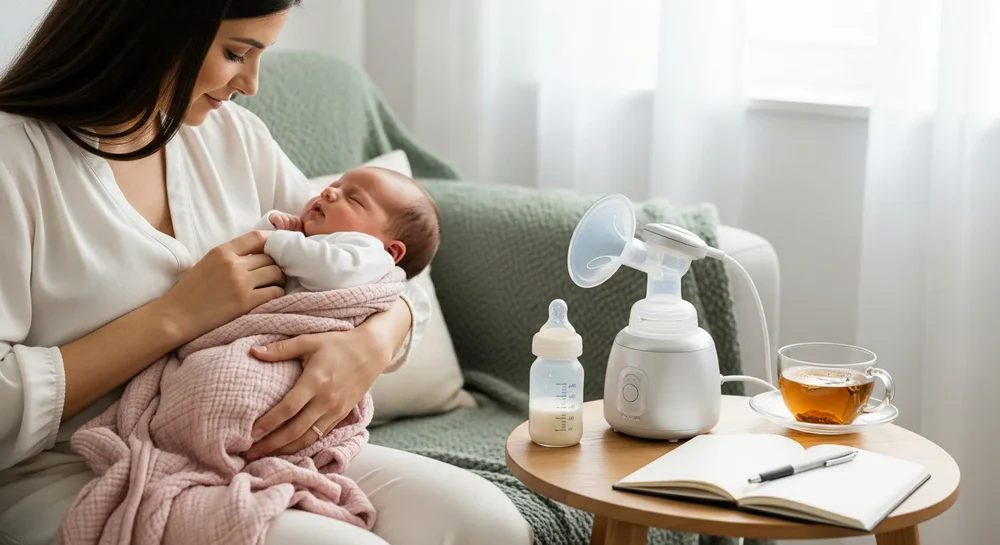
Returning to work after having a baby brings a unique mix of emotions — the part of you ready to engage your professional mind again, and the part that worries about every ounce of milk your baby will need while you’re apart. Pumping and storing breast milk is how you bridge that gap, and while it can feel daunting at first, it becomes a manageable rhythm. This guide walks through the whole pumping journey for a working parent: building a starter stash, setting up a pumping schedule at work, keeping milk safe, thawing it properly, troubleshooting supply and letdown, and handling the emotional side. For the finer details of storing and transporting milk safely, our companion guide on breast milk storage and transport goes deeper.
Before You Return: Building a Starter Stash
The weeks before going back to work can feel like a race against time — how do you build a stash while feeding a baby who seems constantly hungry? The reassuring news is that you need far less than most people fear.
When to start pumping
It’s generally best to wait until breastfeeding is well established — often around 3–4 weeks — before regularly introducing a pump. Pumping heavily too early can cause an uncomfortable oversupply, while waiting until the last minute leaves you scrambling. A gentle start is one pumping session a day, about an hour after your baby’s first morning feed.
The morning advantage
Prolactin, the milk-making hormone, tends to run highest in the early-morning hours, so many parents have their fullest supply in the morning. Pumping about an hour after that first feed signals your body to make a little extra — supply and demand in action.
How much do you actually need?
A useful guideline is roughly 1 to 1.5 ounces per hour you’ll be away. For a nine-hour day (including commute), that’s about 9–13 ounces. But you don’t need a freezer packed to the door before day one — you only need enough for that first day back. The milk you pump at work on Monday feeds your baby on Tuesday, and the cycle sustains itself from there.
Safe Storage Basics
Breast milk is remarkable stuff — full of antibodies and living cells — and storing it correctly protects those properties. The CDC’s storage guidelines for healthy, full-term babies are worth memorizing:
- Room temperature (up to 77°F/25°C): up to 4 hours.
- Refrigerator (40°F/4°C): up to 4 days.
- Freezer (0°F/-18°C or colder): 6 months is best, up to 12 months is acceptable. (A self-defrosting freezer compartment that cycles warmer shortens this, so store milk toward the back, not in the door.)
- Thawed (previously frozen): use within 1–2 hours at room temperature or 24 hours in the fridge, and never refreeze.
For containers, storage bags lay flat and save freezer space (double-bag to avoid leaks), while hard BPA-free plastic or glass bottles are reusable and leak-proof but bulkier. Leave a little headroom, since milk expands when frozen. Our storage and transport guide covers cooler transport, freezer organization, and daycare hand-off in detail.
Your Pumping Schedule at Work
Most parents need to pump about every three hours across the workday to protect their supply — roughly mimicking how often a baby would feed. An eight-hour day usually means two to three sessions; a ten-hour day, three to four. A sample rhythm:
- Just before leaving: nurse the baby.
- Mid-morning: first pumping session.
- Early afternoon: second session.
- Late afternoon: final session before heading home.
- At reunion: nurse the baby.
Consistency is what matters most — your body makes milk in response to regular removal, and pumping at similar times each day trains it to deliver then.
Your workplace rights
In the U.S., your right to pump at work is protected by federal law. The PUMP Act (which expanded the earlier “Break Time for Nursing Mothers” law in 2022) requires most employers to provide reasonable break time and a private space that is not a bathroom, for up to one year after birth. You don’t need to ask permission so much as coordinate logistics. A simple, professional heads-up works well — naming how long you’ll need, how often, and where, so it doesn’t clash with your workload.

Pumping Logistics: Kit and Cleaning
A well-stocked pump bag saves a lot of stress. Pack your pump with charged batteries or a backup power source, pump parts and valves (a spare set is invaluable), storage bottles or bags, a small cooler with ice packs, a hands-free pumping bra, wipes, and a photo or video of your baby to help trigger letdown.
On cleaning: the CDC recommends washing pump parts thoroughly after every use with hot, soapy water, then air-drying. Between sessions at a busy job, the most reliable way to manage this is simply to bring a second (or third) set of pump parts so you always have clean ones ready. Some parents refrigerate used parts between sessions (the so-called “fridge hack”) to avoid washing each time — it’s common, but it isn’t officially recommended, so a spare set is the safer bet. At day’s end, wash everything well.
Combining, Thawing, and Preparing Milk
Combining sessions. You can pool milk from different pumping sessions, with one rule: chill the freshly pumped milk in the fridge first, then add it to already-cooled milk — adding warm to cold raises the temperature and invites bacteria. Label the combined container with the date of the oldest milk in it.
Thawing. The gentlest method is to move frozen milk to the fridge the night before. When you need it faster, hold the container under warm running water or set it in a bowl of warm water. Never thaw or warm breast milk in the microwave — it creates scalding hot spots and damages the milk’s protective proteins.
Swirl, don’t shake. The fat naturally separates and rises; a gentle swirl remixes it. Freezing in small portions (2–4 ounces) means you thaw only what you need and waste less.
When thawed milk smells soapy or metallic
Some parents have naturally high levels of the enzyme lipase, which keeps breaking down fats during freezer storage and can give thawed milk a soapy, metallic, or fishy smell. The milk is completely safe to drink, though some babies refuse it. Offer it first before assuming rejection. If your baby won’t take it, you can scald future milk before freezing — heat fresh milk to about 180°F (just until small bubbles form at the edges), then cool it quickly — which deactivates the lipase, or mix high-lipase milk with fresh milk to soften the taste.
How Much to Send to Daycare
Start with the 1–1.5 ounces per hour rule, but let your baby fine-tune it. Sending 3-ounce bottles is a sensible starting point: if your caregiver reports the baby finishing and still seeming hungry, bump up to 3.5 or 4; if milk regularly comes back, ease down. Ask your caregiver to use paced bottle feeding — a slow-flow nipple, held more horizontally, with pauses — so the baby doesn’t overeat and it’s easier to switch back and forth with the breast.
Troubleshooting Common Challenges
A supply dip is common in the first weeks back — stress, less frequent removal, and being away from your baby all play a part. Try adding a “power pumping” session on a day off (pump 20 minutes, rest 10, pump 10, rest 10, pump 10 — mimicking cluster feeding), look at photos or videos of your baby while you pump, stay well hydrated and nourished, and check that your valves and membranes aren’t worn out — they need replacing roughly every 4–6 weeks and are a surprisingly common cause of dropping output.
Letdown can be stubborn in a sterile office. A blanket that smells like your baby, an audio or video clip of them, a few minutes of deep breathing, and warmth on the breasts can all help your milk release.
A clogged duct — a tender, firm lump — is more likely when your pumping frequency changes. Keep milk moving with regular nursing or pumping, apply gentle (not aggressive) massage and a little warmth before a session, and rest. Importantly, if a painful lump comes with fever, chills, or flu-like body aches, that can signal mastitis and warrants a call to your doctor.
The Emotional Side
Beyond the mechanics, this transition carries real feelings. Many parents worry that bottle-feeding pumped milk will loosen their bond, that their baby will prefer the bottle, or that wanting both a career and breastfeeding means shortchanging one. None of that is true. The milk you pump still carries your antibodies and your nourishment, and your baby is no less yours because someone else gives a bottle while you’re at work. The reunion at the end of the day — nursing them close as they settle against you — is still exactly where it always was. And whatever amount you manage to provide, alone or alongside formula, genuinely counts. Some days you’ll forget a pump part or spill a hard-won bottle; other days you’ll look at your stash and feel unstoppable. Both are part of the season.

Frequently Asked Questions
For a healthy, full-term baby: about 4 hours at room temperature, up to 4 days in the fridge, and 6 months (up to 12) in the freezer. Once frozen milk is thawed, use it within 1–2 hours at room temperature or 24 hours refrigerated, and never refreeze it.
Usually once breastfeeding is well established, around 3–4 weeks. Begin gently with one session a day, about an hour after the first morning feed when supply tends to be highest. You only need enough milk for your first day back, not a packed freezer.
Yes. Chill the freshly pumped milk in the fridge first, then add it to milk that’s already cooled — never add warm milk directly to cold. Label the container with the date of the oldest milk it contains.
It’s usually high lipase activity — an enzyme breaking down fats during storage. The milk is safe to drink, but some babies refuse it. Offer it first; if your baby won’t take it, scalding fresh milk before freezing (heating to about 180°F, then cooling quickly) prevents the change.
The CDC recommends cleaning parts after each use. If washing between sessions at work isn’t practical, the safest workaround is bringing extra sets of parts so you always have a clean one, then washing everything thoroughly at the end of the day.
The Bottom Line
Pumping as a working parent is a temporary season with a real learning curve, but it comes together with a few solid habits: build just a small starter stash, pump consistently every few hours, follow the storage rules, thaw gently, and troubleshoot supply early. Know your legal right to time and space, lean on a spare set of pump parts to make cleaning realistic, and be gentle with yourself on the hard days. Any amount of breast milk you provide is worthwhile — and your baby is thriving on your effort, one session at a time.
This article is for general information and is not a substitute for personalized medical or lactation advice.
References
- Centers for Disease Control and Prevention. Proper Storage and Preparation of Breast Milk.
- American Academy of Pediatrics (HealthyChildren.org). Storing and Preparing Expressed Breast Milk.
- Office on Women’s Health (U.S. HHS). Pumping and Storing Breastmilk.
- U.S. Department of Labor. Break Time for Nursing Mothers & the PUMP Act.
- Academy of Breastfeeding Medicine. Clinical Protocols.