It’s 2 a.m. in the soft glow of the nursery. Your newborn is scrunched up, legs drawing toward their tiny tummy, face red with effort, and a sharp cry escapes into a tense silence. Is it hunger? Tiredness? Pain? If that scene is familiar, you are likely in the thick of it with a gassy baby — and the good news is you have far more tools than you might think. Gas relief is not a mystery; it is a mix of understanding, gentle touch, and sometimes a little internal support.

First, some reassurance: a gassy infant is not a reflection of anything you are doing wrong. Their digestive system is brand new and learning to work in the outside world, and that learning curve often comes with pressure, bubbles, and spasms they cannot relieve on their own. This guide covers why babies are so prone to gas, the hands-on techniques that help (bicycle legs included), and a clear-eyed look at probiotics and gripe water.
Why Is My Baby So Gassy?
An infant’s digestive system is immature in a few key ways: their intestines are just learning to coordinate the wave-like motions (peristalsis) that move food and gas along; babies swallow a lot of air, both when crying and when feeding if the latch or bottle flow is not quite right; their gut microbiome is still building over the first months; and some babies simply have more sensitive systems that react to proteins in formula or, less often, passed through breast milk.
Gas-specific cues often include pulling the legs up sharply toward the belly, a hard or distended tummy, obvious relief after passing gas or a bowel movement, fussiness that peaks after feedings, and squirming or arching during or right after eating. That leg-drawing posture is your baby’s instinctive attempt to compress the abdomen and ease the pressure.
Know when it is more than typical gas. Contact your pediatrician promptly if your baby has a fever, vomiting (especially if green or bloody), bloody stools, refuses to eat, or is lethargic or unresponsive — these are red flags. If you have not chosen a pediatrician yet, our guide to choosing a pediatrician can help. Otherwise, here is what you can do at home.
Hands-On Relief: Physical Techniques
These use gentle movement, pressure, and gravity to move trapped gas through the intestines. The best time is when your baby is calm but showing early signs of discomfort, or as a routine after feedings.
Bicycle legs
- Lay your baby on their back on a firm, comfortable surface — a changing pad or blanket on the floor is perfect.
- Gently hold their ankles or lower calves, with their legs comfortably bent.
- Slowly move their legs in a smooth, rhythmic pedaling motion, like riding a tiny bicycle — fluid, not jerky.
- After several “pedals,” gently bring both knees up toward the belly, hold for a slow count of three, then straighten the legs back down. Repeat.
- Watch their face — you are often rewarded with audible gas relief and a calmer, more relaxed baby.
Aim for 3–5 minutes at a time, several times a day, and let your baby’s cues guide you — if they resist or cry harder, stop and try a different method.

Tummy massage (the “I Love U” stroke)
Massage stimulates the digestive tract and offers comforting touch — always wait at least 30 minutes after a feeding. Warm your hands with a little baby-safe oil (like plain, cold-pressed coconut oil), then work in a clockwise direction, which follows the natural path of the colon:
- Trace an “I” straight down your baby’s left side (your right) with gentle fingertip pressure.
- Make an upside-down “L” — across the top of the tummy from your left to right, then down.
- Make an upside-down “U” — up their right side, across the top, and down the left.
It is effective and a lovely way to bond.
Supportive positions and holds
- Knee-to-chest (frog-leg) hold: with baby on their back, gently press their knees into their belly — the mild compression helps expel gas.
- Tummy time: the gentle pressure of the floor on the abdomen during supervised tummy time works wonders. Start with short, frequent sessions (2–3 minutes), even for newborns — our guide to newborn wake windows helps you fit it into the day.
- The “colic carry” (football hold): lay your baby face-down along your forearm, head cradled in your hand, legs straddling your elbow, so your forearm applies gentle belly pressure as you walk or rock.
Prevention: feeding posture and burping
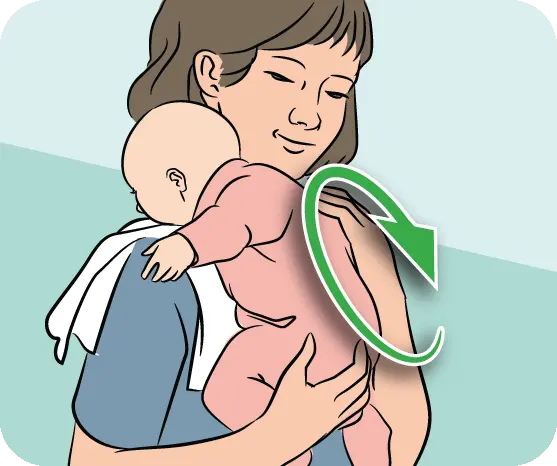
Preventing air intake is half the battle. Aim for a deep latch if breastfeeding, and for bottle-feeding, hold the bottle at an angle so the nipple stays full of milk — paced bottle-feeding helps too. Our breastfeeding basics guide covers latch in detail. When burping, do more than pat: try over-the-shoulder, sitting upright on your lap (supporting the chin and chest), or face-down across your knees, using firm upward strokes. Be patient — a good burp can take a few minutes, and if one position is not working after a minute or two, switch to another.
Internal Support: Probiotics and Gripe Water
Probiotics
Probiotics are live beneficial bacteria, and specific strains may help balance a developing gut. The evidence is most promising for Lactobacillus reuteri DSM 17938, which several studies show can reduce crying time in breastfed infants with colic; Bifidobacterium strains are also foundational for infant gut health. If you and your pediatrician decide to try one, look for a product that lists the full strain name (generic “lactobacillus” is not enough), around 1–5 billion CFUs, an easy liquid-drop format with a safe carrier oil, and third-party testing for purity and potency. Always check with your pediatrician first, especially for premature babies or those with medical issues.
One note: probiotics can briefly increase gas or change stool as the gut flora shifts, usually settling within a week. Starting with a half-dose for a few days can ease the transition.
Gripe water
Modern gripe water is usually an herbal supplement with ingredients like fennel and ginger (traditionally used to help expel gas), chamomile (gently calming), and sometimes sodium bicarbonate (an antacid many brands now omit). Keep in mind that it is a supplement rather than a regulated medicine, and the infant-specific evidence is limited, so treat it as one occasional tool, not a cure. If you choose to use it:
- Read the label: look for full ingredient transparency, no high-fructose corn syrup or excess sugar, and an explicitly alcohol-free formula from an established brand.
- Follow dosing exactly for your baby’s age and weight — more is not better.
- Never give gripe water to a baby under one month without explicit pediatrician approval, and check first if your baby has any health concerns.
Putting It All Together: A Gentle Daily Routine
Consistency helps. A gas-conscious day for a two-month-old might include a brief 2-minute tummy-time session after waking; holding baby upright for 10–15 minutes after each feed, then a thorough burp using two positions; a quick minute or two of bicycle legs and knee-to-chest holds during diaper changes; a calm 5-minute “I Love U” massage before the usual fussy period; a daily probiotic at the same time each day if you are using one; and, for acute fussiness, the colic carry, a warm bath to relax the belly, or — only if you and your pediatrician have agreed — a dose of gripe water. Watch how your baby responds; what works one week may shift the next, and your attentive observation is your most powerful tool.
Frequently Asked Questions
They work differently. Simethicone gas drops are an anti-foaming agent that breaks large gas bubbles into smaller ones so they pass more easily; they act locally in the gut and are not absorbed. Gripe water is typically an herbal supplement meant to soothe the digestive tract. Some parents try simethicone for immediate bubble relief and gripe water for more general fussiness — check with your pediatrician about either.
There is no blanket rule, but some babies react to proteins passed through breast milk — dairy is the most common culprit, followed by soy, eggs, and sometimes cruciferous vegetables. If you suspect a sensitivity, you can try eliminating one trigger (usually dairy) for 2–3 weeks while watching your baby’s symptoms, keeping your own nutrition balanced and checking with a lactation consultant or dietitian for guidance.
Most parents see clear improvement between 4 and 6 months, as abdominal muscles strengthen, the digestive tract matures, and the baby becomes more able to shift position to relieve pressure. The intense newborn gas is usually temporary.
About 3–5 minutes at a time, several times a day, following your baby’s cues. If they resist or cry harder, pause and switch to another soothing method rather than pushing on.
The Bottom Line
Intense infant gas is a phase. As your baby’s digestive system matures, their core muscles strengthen, and their microbiome stabilizes, the frantic, painful gas usually subsides around the 4–6 month mark. Until then you are far from powerless — you have a whole repertoire of gentle, drug-free techniques that ease the discomfort and deepen your connection. Trust your instincts, use these tools with loving hands, and remember to breathe through the tough moments.
References
- American Academy of Pediatrics (HealthyChildren.org). Colic and Crying.
- Mayo Clinic. Colic.
- NHS. Colic.