It’s the middle of the night, and you’ve just rocked, nursed, or bottle-fed your baby back to sleep for the third time since midnight. As you lower them into the crib, you tense up, hoping the transfer sticks — and then comes the whimper. If this cycle defines your nights and exhaustion defines your days, you’re not alone, and you have options. For many parents, the phrase “sleep training” conjures an image of a baby left to cry alone, which can feel at odds with their instincts. The good news: there’s a wide, compassionate middle ground between running on no sleep and any approach that doesn’t feel right to you. This guide walks through gentle, responsive sleep-training methods — how they work, when to start, and the exact steps — so you can make an informed choice that fits your family.
What Gentle Sleep Training Actually Means
First, a myth to dismantle: gentle sleep training is not “no-cry” sleep training. Any change can bring some protest, and the goal isn’t to eliminate all frustration — that’s an unrealistic standard that only sets parents up for guilt. It helps to think about the difference in terms of presence:
- Full extinction methods (classic “cry it out”): the child settles without a parent returning. Research finds these are safe and effective, and many families use them successfully — but they don’t suit every parent’s comfort level.
- Gentle, responsive methods: you stay present, offering touch, voice, and reassurance, and you gradually change how you help — moving from doing the sleeping for them (rocking all the way to sleep) toward supporting them as they settle themselves.
Neither is “right” or “wrong” — the evidence supports several approaches, and the best one is the one you can carry out consistently. This guide focuses on the gentler, higher-presence end of that spectrum. Think of it as the difference between carrying a child across a stream and holding their hand as they step across the stones.
When to Start: Readiness and Prerequisites
Timing matters. Gentle methods are generally most effective once a baby is developmentally ready, typically around 4–6 months (corrected for prematurity). By this stage, most neurologically typical babies can begin to self-settle and manage longer stretches without a feed. Signs of readiness include established weight gain with your pediatrician’s approval, more predictable sleep patterns (even if they’re currently “bad” ones), and the ability to be put down “drowsy but awake” for at least a moment.
Before you begin, three groundwork steps make all the difference:
- Rule out medical issues. Reflux, food sensitivities, or other problems should be addressed with your pediatrician first — you can’t “train” away pain or discomfort.
- Master the daytime. Make sure your baby is getting enough daytime calories and age-appropriate naps; an overtired baby fights sleep harder.
- Commit to consistency. Gentle doesn’t mean casual — it asks for patience and steady follow-through, often over a longer stretch than other methods.
One foundation underlies all of this: safe sleep. Whatever method you choose, always place your baby on their back to sleep, on a firm flat surface, in a bare crib with no pillows, blankets, or bumpers, in your room for at least the first 6 months.
Building the Foundation for Sleep
You wouldn’t teach someone to swim in a stormy ocean — first you find a calm pool. These supports are that calm pool for any age:
- A consistent, calming bedtime routine. A 20–30 minute sequence in the same order every night (for example: bath, massage, pajamas, book, song) is a powerful cue to the brain that sleep is coming, moving your child from alert to calm and sleepy.
- An optimized sleep environment. Make the room dark (blackout curtains help), use consistent white noise to mask household sounds, and keep it cool (around 68–72°F).
- An understanding of sleep associations. A sleep association is whatever your baby needs to fall asleep. Nursing, rocking, or a pacifier you reinsert repeatedly are “parent-led” associations; the aim is to gently add “self-led” ones (the feel of the crib, the white noise, their own hands) while still offering comfort — not breaking the old association cold turkey.
The Gentle Methods, Step by Step
The fading (chair) method
Core principle: over nights or weeks, you gradually reduce your physical presence in the room, giving your child time to adjust to each new level of independence. It’s predictable, offers visual and physical reassurance, and works well for transitioning from co-sleeping and for anxious toddlers. Adapt the timeline to your child’s pace:
- Nights 1–3: after the routine, place your child in the crib drowsy but awake and sit in a chair right beside it. Offer quiet verbal reassurance (“I’m here, you’re safe”) and a gentle hand on the back if they’re very upset, but keep interaction minimal — be a calm, “boring” presence. Stay until they fall asleep, and return to the chair for night wakings.
- Nights 4–6: move the chair halfway to the door. Offer verbal reassurance but no touch unless truly distressed.
- Nights 7–9: move the chair to the doorway, just inside the room, with brief verbal reassurance.
- Nights 10+: move to the hallway, just outside the door where you can still be heard, then gradually fade out.
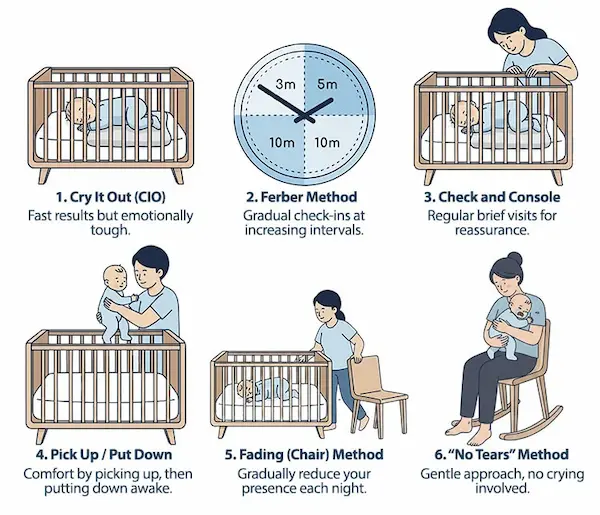
The pick-up/put-down method (PUPD)
Core principle: you interrupt the cycle of crying-to-sleep-in-arms by picking up to calm, then putting down immediately once calm — not asleep. The message is: “I’ll help you calm down, but you fall asleep in your bed.” It’s highly responsive and physical, which suits younger babies (roughly 4–8 months) who need close contact. The steps:
- After your routine, put your baby in the crib drowsy but awake.
- If they fuss, wait a moment to see if it’s a brief protest. If crying escalates, lean in, shush, and offer a gentle pat for a minute.
- If crying continues, pick them up. Hold them against your shoulder and soothe until they are completely calm — not drowsy, just calm and relaxed.
- The moment they’re calm (30 seconds or a couple of minutes), put them straight back down, awake.
- Repeat. You may pick up and put down many times the first night. The consistent lesson: crying brings comfort in your arms; calm means settling in the crib.
You’re acting as the regulator — helping their nervous system downshift while gently breaking the association that sleep happens on you. It’s physically demanding but can be very effective for persistent babies.
Other gentle approaches
- Bedtime fading: if your baby fights bedtime for a long time, their natural “sleep window” may be off. Set bedtime later (when they actually seem tired), let them fall asleep quickly, then move it earlier by about 15 minutes every few nights.
- Timed checks (a gentler graduated approach): you leave and check at set intervals (say 3, 5, then 10 minutes), but your checks are hands-on and calming and last a minute or two, not a quick 30-second peek. This offers predictability for families who want it.
Choosing, Adapting, and Succeeding
The fading method suits the parent who can be a calm, steady presence, and works well for older babies, toddlers, and children transitioning from co-sleeping. The pick-up/put-down method suits parents who don’t mind the physical repetition and younger babies who rage against the crib and need in-arms calming.
A few common hurdles:
- If your baby vomits: clean up calmly with minimal fuss and light, change the sheets, and continue. It’s usually a sign of extreme upset and, with consistency, typically doesn’t repeat.
- The 8–10 month separation-anxiety peak: expect some regression. Increase daytime connection, be extra patient at bedtime, and stay consistent — steadiness provides security during this cognitive leap.
- Early-morning wakings: the hardest to fix. Keep the room fully dark, avoid starting the day before 6 a.m., and use your settling method. Sometimes an earlier bedtime paradoxically fixes a too-early wake-up.
And a few mindsets that carry families through: consistency matters most — switching methods nightly or giving in after an hour teaches confusion, not sleep. Progress isn’t linear, so judge by the week’s overall trend, not a single rough night. Gentle doesn’t mean no tears — your role is to be the calm, loving container for protest, minimizing distress rather than eliminating all challenge. And remember that sleep training and night weaning are separate: you can teach independent sleep while still feeding once or twice overnight for a younger baby, and address feeds gradually and separately for older babies. Responsive, connection-first settling also supports your baby’s sense of secure attachment.

Frequently Asked Questions
Often, yes. Full extinction methods may show big results in a few nights, while gentle methods typically take 1–3 weeks to reach consolidated, independent sleep. The trade-off is a process many sensitive parents and babies find more emotionally sustainable.
Yes. Sleep training is about how your baby falls asleep, not about cutting feeds they genuinely need. Keep your night feeds, but try to separate feeding from the actual moment of sleep — do the last feed 20–30 minutes before putting down, and if they wake soon after, use your settling method rather than immediately re-offering the breast.
Very common. For the fading method, go over, calmly and wordlessly lay them back down with a reassuring pat, and return to your chair. For PUPD, pick them up to calm and lay them down. They’ll learn that standing doesn’t prolong the interaction — just avoid turning it into a game.
It’s never too late to teach healthy sleep habits. The methods adapt well — the chair method is effective for toddlers. You’ll lean more on verbal explanation (“I’m going to sit here while you sleep”) and consistency matters even more. Expect more spirited protest but also quicker comprehension.
Start with nights, which are biologically easier because sleep pressure is highest. For the first week or two, help your baby nap however you can (contact, stroller) to avoid severe overtiredness. Once nights are more settled, apply your chosen method to the first nap of the day, usually the easiest one.
The Bottom Line
Choosing a gentle path is one valid, evidence-supported option among several — and if it fits your instincts, it lets you teach independent sleep while staying present and responsive. It asks more of you in the short term: more patience, more presence, more emotional stamina. But the payoff is a child who falls asleep knowing their safe person is near, and a parent who rests without a heart full of conflict. Whichever approach you choose, consistency and safe sleep are what matter most — and there’s no single “right” way to help a baby learn to sleep.
This article is for general information and is not a substitute for personalized medical advice.
References
- American Academy of Pediatrics (HealthyChildren.org). Baby Sleep.
- American Academy of Pediatrics (HealthyChildren.org). A Parent’s Guide to Safe Sleep.
- Zero to Three. Sleep Resources for Families.