Let’s start with a fundamental truth: labor involves pain. It’s the physiological signal of powerful muscles working to open a passage and bring new life into the world. But how you experience that pain — and, more importantly, how you manage it — is deeply personal and full of choice. The cultural narrative often presents a false either/or: you either “tough it out” naturally or you “get the drugs.” That oversimplification does a disservice to every expecting parent, because modern labor pain management is a rich spectrum — a toolkit with more options than you might realize.
It’s not a linear path from “least” to “most” intervention, but a menu you can navigate based on your moment-to-moment needs, your birth philosophy, and how your unique labor unfolds. This guide walks through every major category — from breath and water to epidurals and beyond — with the how, the why, the pros, and the realistic considerations for each. The goal isn’t to commit to one option at 30 weeks, but to understand your choices so you can collaborate with your birth team from a place of confidence, not fear.
Reframing the Goal: From Eliminating Pain to Coping With It
Before the options, a mindset shift. For many, the goal of labor pain management isn’t necessarily to feel nothing (though that’s a valid choice with an epidural). For many, it’s to cope effectively — to reduce suffering, keep a sense of control, and conserve energy so you can be present for the birth. Labor pain isn’t like a broken bone; it’s purposeful, it comes in waves, and it ends with a baby. Your strategy can help you work with that process, not just fight it.
Category 1: Non-Pharmacological & Mind-Body Techniques
These methods use your body’s own resources, your environment, and your mind. They’re often combined and form the foundation of natural birth preparation.
Movement & position changes
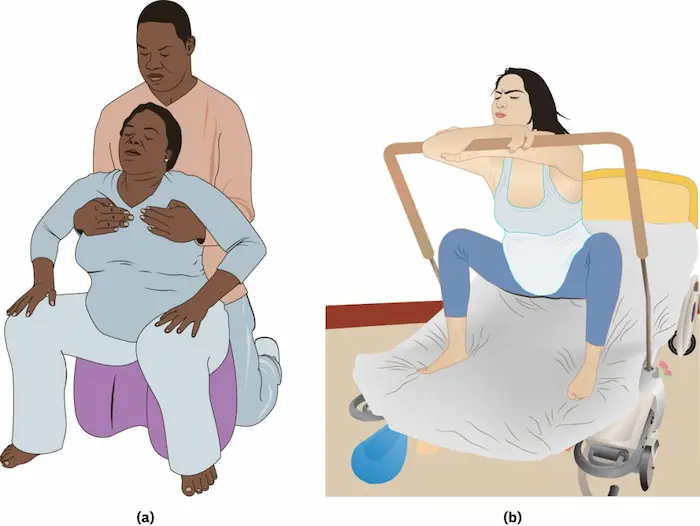
Your first and most powerful tool — gravity and mobility aren’t just for comfort, they’re biomechanical aids. Upright positions (standing, swaying, slow dancing) and asymmetrical poses (lunges, hip circles on a birth ball) use gravity to help baby descend and can change the shape of your pelvis to ease pain. Best for early to active labor, anyone wanting to delay or avoid medication, and back labor. Consider that it needs freedom to move, which can be limited by continuous monitoring or an epidural. Our guide to labor positions has specifics.
Hydrotherapy
Water is a remarkably effective comfort measure. Immersion in warm water (a deep tub or shower) promotes relaxation, encourages endorphin release, and provides buoyancy that takes pressure off joints and muscles, reducing the perception of pain. Best for active labor when contractions feel intense; the shower is great for focused back pain. Consider that it needs access to a deep tub or large shower, and some facilities have policies on when you can enter the water.
Touch & counter-pressure
The power of human touch shouldn’t be underestimated. A doula or partner applies firm, steady pressure to your lower back or sacrum during a contraction (especially for back labor); massage, light stroking (effleurage), and hip squeezes can interrupt pain signals and give a focal point. Best for anyone with a support person — it’s essential for back labor and a core part of doula support. Consider that your team should learn these techniques prenatally, and it can be physically demanding for them.
Breathwork & vocalization
Channeling energy and oxygenating your body. Deep, rhythmic “belly breathing” in early labor shifts to more focused breathing as intensity builds, and low moans or hums (jaw and throat loose) help you release tension instead of holding it. Best for all stages — it’s a portable tool you always have. Consider that practicing breathing techniques prenatally makes them automatic under pressure.
Heat & cold therapy
Simple, direct sensory input. A heating pad on your lower back or belly can soothe aching muscles; a cold pack on your neck or forehead can be invigorating and reduce nausea. Best for targeted back-pain relief, perineal warmth during pushing, or cooling for overheating and anxiety. Consider having both available, and never place ice directly on the skin.
TENS units
A small battery-powered device sends mild electrical pulses through pads on your lower back, which may help block pain signals and boost endorphins, especially in early labor. Best for early and back labor, and those who want a drug-free, self-controlled option. Consider that it can’t be used in water and works best when started early — our guide to a TENS machine for labor explains more.
Mindset & distraction
Pain perception is influenced by fear and focus. Hypnobirthing techniques use meditation and visualization to create deep relaxation, and focusing on a photo, mantra, or music can redirect your brain’s attention. Best for those who practice prenatally — excellent for early labor at home. Consider that it takes practice to be effective once active labor is intense.
Category 2: Pharmacological & Medical Options
These use medication to reduce or eliminate pain sensation and are typically given in hospital settings.
Nitrous oxide (laughing gas)
A self-administered, inhaled option growing in popularity in the US. You hold a mask and inhale a 50/50 blend of nitrous and oxygen during a contraction; it doesn’t eliminate pain but takes the edge off, reduces anxiety, and leaves your system quickly when you stop breathing it. Pros: you control it, no effect on baby, doesn’t slow labor, allows full mobility. Cons: can cause dizziness or nausea, may not be enough for transition, and not all hospitals offer it.
Opioid analgesics (IV/IM, e.g., fentanyl, nalbuphine)
Systemic medications given through an IV or injection that alter your brain’s perception of pain and can induce drowsiness, allowing rest between contractions. Pros: can provide meaningful relief for those not yet ready for an epidural, and work relatively quickly. Cons: cross the placenta and can cause drowsiness, nausea, or itching in you and baby, and may temporarily affect newborn breathing and feeding reflexes, so timing is careful — usually not given too close to delivery. Relief is often partial.
Epidural analgesia
The most effective pain relief available in labor. Local anesthetic (sometimes with an opioid) is delivered through a tiny catheter into the epidural space in your lower back, numbing the nerves from the abdomen down. Pros: the most complete relief, lets you rest and stay alert, and can be adjusted. Cons: it’s a medical procedure with possible side effects (a drop in blood pressure, fever, headache, itching, shivering), usually confines you to bed with a bladder catheter, and may lengthen the pushing stage and modestly increase the chance of a vacuum or forceps delivery (modern lower-dose “walking” epidurals have reduced this). Our full comparison of epidural vs. natural birth digs deeper.
Spinal block & combined spinal-epidural (CSE)
Often used for cesarean births or for very rapid relief. Medication is injected directly into the spinal fluid for immediate, dense numbness; a CSE gives that immediate spinal relief with an epidural catheter left in place for ongoing management. Pros: immediate, complete relief, and a CSE offers the benefits of both. Cons: a spinal is a one-time dose that can’t be topped up, with a similar side-effect profile to an epidural.
Building Your Flexible Plan
Your pain management plan should be a preference list, not a rigid contract. A way to think it through:
- Educate yourself: take a comprehensive childbirth class that covers all options — knowledge dispels fear.
- Know your “why”: is your priority full mobility? Avoiding medication effects on the baby? Maximum relief so you can be mentally present? There’s no wrong answer.
- Consider your labor context: an induction with Pitocin often means more intense contractions, and a fast labor may leave less time for certain options.
- Practice the non-pharmacological tools: even if you plan an epidural, practice breathing and movement — you’ll use them in early labor and if there’s any delay.
- Communicate with your provider: discuss preferences prenatally, and ask which options your birth place offers (like nitrous oxide) and how they handle timing.
- Consider a doula: research consistently shows continuous labor support reduces the use of pain medication and increases satisfaction — doulas are experts in the non-pharmacological toolkit. Record your leanings in a birth plan.
Frequently Asked Questions
Absolutely — this is the most important point. Planning for a natural birth but asking for an epidural after hours of back labor is a wise adjustment, not a failure. Planning for an epidural but finding you’re coping well is equally fine. Give yourself grace.
It can happen. Your care team may recommend Pitocin to strengthen contractions, and changing positions with a peanut ball between your legs can help labor keep progressing. Talk with your provider about what to expect for your situation.
Yes — counter-pressure is the MVP, along with hands-and-knees position, pelvic rocks, and the double-hip squeeze. Heat, a TENS unit, and epidurals are also very effective for back pain.
There’s medical timing and emotional timing. Current guidance holds that your request is a sufficient reason — you generally don’t have to reach a specific dilation, and modern evidence doesn’t support making you “wait” or worry that an earlier epidural raises your C-section risk. Emotionally, the right time is often when you feel you need more help than your current tools provide. Trust your instinct and your team’s assessment.
The Bottom Line
Pain management in labor isn’t a test of endurance — it’s a set of tools to help you have a safe, positive, empowered birth. The most effective plan is an informed and flexible one. You might use the shower for hours, then get an epidural to sleep. You might breathe through with nitrous oxide at transition. You might find that movement, breath, and your partner’s touch are all you need. All these paths are valid and can lead to a satisfying birth. Walk in knowing your options, pack your toolkit — your breath, your movement, your knowledge, and your support team — and in each moment, choose what brings you comfort and confidence.
This article is for general information and is not a substitute for personalized medical advice. Discuss your options and any medical considerations with your own provider.
References
- American College of Obstetricians and Gynecologists (ACOG). Medications for Pain Relief During Labor and Delivery.
- NHS. Pain relief in labour.
- American Society of Anesthesiologists. Labor and delivery pain management.