A single blood draw that can assess your baby’s chromosomes, with no needle anywhere near your belly. Non-invasive prenatal testing has genuinely changed prenatal screening since it arrived in 2011, moving from a specialist test for high-risk pregnancies to something offered routinely.
With that accessibility come real questions: what does it actually test for, how accurate is it in practice rather than in marketing material, and is it worth doing for you? This guide covers the science, the limitations that matter most, and the questions worth bringing to your provider.
How NIPT Works
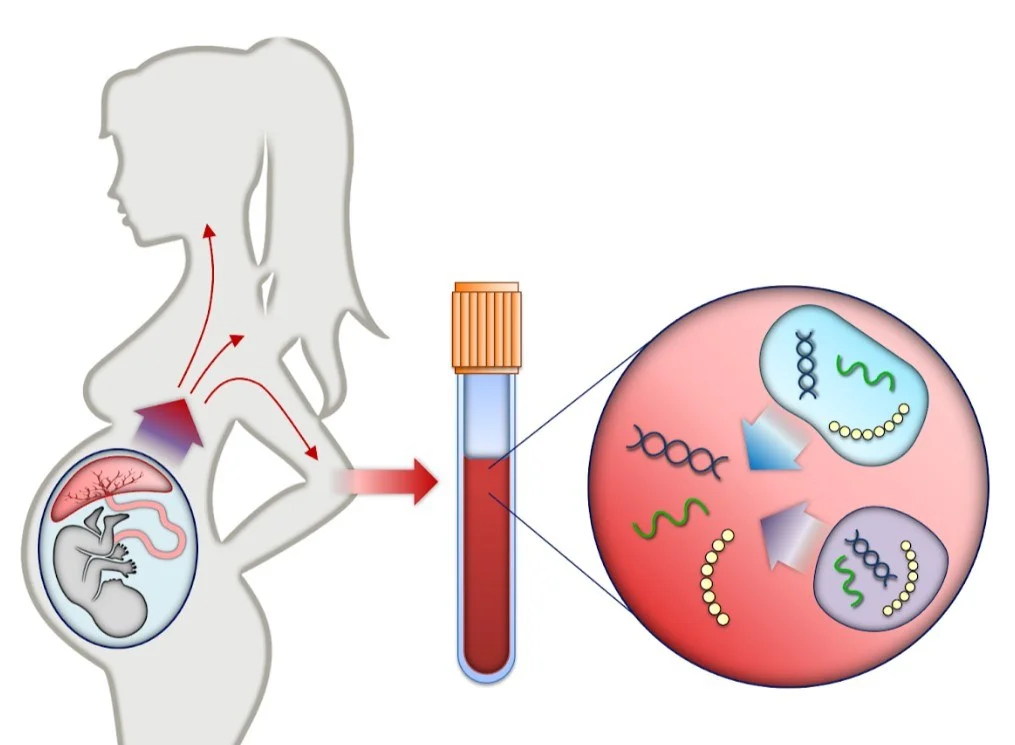
During pregnancy your bloodstream carries a mix of your own DNA and small fragments of DNA from the placenta, called cell-free fetal DNA. Those placental fragments are almost always genetically identical to your baby’s DNA. NIPT sequences that genetic material and looks for evidence of extra or missing chromosomes.
The word that matters throughout is screening. NIPT assesses probability. It does not diagnose anything, and that distinction drives everything else in this article.
What It Screens For
The main trisomies: Down syndrome (trisomy 21), Edwards syndrome (trisomy 18), and Patau syndrome (trisomy 13). These are what NIPT does best and what the accuracy figures generally refer to.
Sex chromosome conditions such as Turner syndrome and Klinefelter syndrome, and fetal sex, which it can determine by detecting the presence or absence of Y chromosome material.
Expanded panels offered by some labs add microdeletions, meaning small missing chromosome segments such as 22q11.2 deletion, and rarer trisomies. It is worth knowing that ACOG does not recommend routine screening for microdeletions, because their performance is considerably weaker than for the main trisomies and a positive result on these panels is far more likely to be wrong than right. If a lab offers an expanded panel, ask specifically what it adds and how reliable those additional results are.
Accuracy: The Part Most People Misunderstand
Detection Rate and False Positive Rate
Detection rate is how often the test correctly identifies a pregnancy that does have the condition: over 99% for Down syndrome, over 97% for trisomy 18, and around 90% for trisomy 13. Fetal sex is over 99% accurate when there is sufficient fetal DNA in the sample.
False positive rate is how often it flags high risk when the condition is not present: generally under 0.1% for the main trisomies, compared with around 5% for traditional serum screening. These numbers are genuinely impressive, and they are also not the number you actually want.
The Number That Matters: Positive Predictive Value
If your result comes back high risk, the question you care about is not “how often does this test get it wrong in general?” but “given this result, what is the chance my baby actually has the condition?” That is the positive predictive value, and it can be dramatically lower than the accuracy figures suggest.
The reason is arithmetic rather than any flaw in the test. These conditions are rare, and the rarer a condition is in the population being tested, the more of the positive results will be false ones even with an excellent test. For Down syndrome, positive predictive value is high in older women, where the baseline rate is higher, and considerably lower in younger women. For the rarer trisomies and especially for microdeletions, a positive result can be more likely to be wrong than right.
This is exactly why a high-risk NIPT result must be confirmed with diagnostic testing before any irreversible decision. It is also a specific question worth asking: what is the positive predictive value of this result for someone my age, for this specific condition? A genetic counselor can calculate it, and the answer is often far more reassuring than the phrase “positive result” sounds.
Fetal Fraction
NIPT needs enough placental DNA in the sample to work, usually at least 3 to 4%. Testing before 10 weeks, higher maternal weight, and certain medications or conditions can all result in insufficient fetal fraction.
A no-result or test failure report is usually this, and it does not mean something is wrong with your baby. The usual approach is a repeat draw a week or two later. Persistently low fetal fraction is occasionally associated with placental issues or certain chromosomal conditions, which is why your provider will want to follow it up rather than simply keep redrawing.
Why Discordant Results Happen
Because NIPT analyzes placental DNA rather than fetal DNA directly, results can occasionally reflect something other than the baby’s chromosomes. Confined placental mosaicism, where the placenta has a chromosomal difference the baby does not, is one cause. A vanishing twin can contribute DNA that skews the result. Rarely, the result reflects something in the mother’s own genetics. These are uncommon, and they are part of why confirmation matters.
Who Can Have NIPT
It was originally aimed at pregnancies considered higher risk: maternal age 35 or older at delivery, a previous pregnancy with a chromosomal condition, an abnormal traditional screening result, or particular ultrasound findings. Our guide to high-risk pregnancy covers what that designation involves more broadly.
Current guidance is that NIPT can be offered to all pregnant patients as a screening option regardless of age or risk profile, alongside a proper discussion of its benefits and limitations rather than as a default.
Twin pregnancies: NIPT is available but performs less well, and it generally cannot tell you which twin is affected. It does not screen for twin-specific complications such as twin-to-twin transfusion syndrome, which our twin pregnancy guide covers.
IVF and donor eggs: NIPT works, but your provider and the lab must know if a donor egg was used, since the genetic profile involved is the donor’s rather than yours and this affects interpretation.
Reasons to Have It, and Reasons Not To
In Favor
Results are available early, from around 10 weeks, giving time to process information and make decisions. For many people the high detection rate and low false positive rate offer genuine reassurance. It reduces unnecessary invasive procedures, since fewer people are pushed toward amniocentesis or CVS by a false alarm than with older screening methods. And where a result does turn out to be accurate, families have more time to prepare medically, emotionally, and practically.
Against
Cost. This is the most common practical barrier. Coverage varies enormously by insurer and by whether you meet particular criteria, and out-of-pocket prices range from modest to very high. Check with your insurer and ask the lab about self-pay pricing before agreeing, since the difference can be substantial.
It is still only a screen. Some people prefer to wait for the detailed anatomy ultrasound at 18 to 20 weeks, which finds structural issues NIPT cannot see.
Anxiety. For some people any screening generates more worry than reassurance, particularly given the possibility of ambiguous results, no-result reports, and the waiting between a high-risk screen and a confirmatory test.
You may not want the information. Some parents know they would continue the pregnancy regardless and would rather not carry the knowledge or the uncertainty through the remaining months. That is a legitimate position rather than avoidance.
What Happens After the Result
A Low-Risk Result
The most common outcome, and genuinely reassuring for the conditions screened. It is not a clean bill of health: NIPT does not screen for structural birth defects, neural tube defects, or most genetic conditions. Continue with your anatomy ultrasound and the rest of your prenatal care, which our guide to the prenatal appointment schedule lays out.
A High-Risk Result
The first thing to hold onto is that this is not a diagnosis, and given what positive predictive value actually means, there is a real chance it is not accurate. Do not make irreversible decisions on the basis of a screening result.
What follows is genetic counseling, where a counselor explains the specific result, calculates your individual positive predictive value, and outlines options. Then diagnostic testing, either chorionic villus sampling or amniocentesis, which analyze actual fetal cells and give a definitive answer. And usually a detailed ultrasound with a specialist to look for physical markers associated with the suspected condition.
Questions Worth Asking
Which lab do you use, and exactly what conditions does their panel cover? Does it include microdeletions, and if so, how reliable are those results? What would my positive predictive value be for the main conditions, given my age? What is likely to be covered by my insurance, and what are the self-pay options? If a result comes back high risk, what is your protocol and how quickly can I see a genetic counselor? And regardless of the NIPT result, which other screenings will I still need, particularly for neural tube defects?
That last one matters, since NIPT does not screen for neural tube defects and most providers will still recommend an AFP blood test alongside the anatomy scan. Our guide to prenatal blood work results covers how these tests fit together, and the first prenatal appointment covers when the conversation usually starts.
Frequently Asked Questions
The combined screen pairs a blood test measuring PAPP-A and hCG with an ultrasound measurement of nuchal translucency, giving roughly 85 to 90% detection for Down syndrome with about a 5% false positive rate. NIPT analyzes fetal DNA directly from a blood sample, with over 99% detection and a false positive rate under 0.1% for trisomy 21. NIPT performs better, but it costs more and is not always covered.
That depends on the condition and on your age, and it is the single most important question to ask. Because these conditions are rare, a high-risk result is often less likely to be accurate than the headline accuracy figures suggest, particularly for younger women and especially for microdeletions. Ask your provider or a genetic counselor for your specific positive predictive value, and do not make any irreversible decision before diagnostic testing confirms the result.
No. NIPT screens for specific whole-chromosome differences. Autism and most intellectual disabilities arise from complex causes that current prenatal genetic screening cannot detect. Any claim otherwise is inaccurate.
It is a personal decision. Chromosomal conditions can occur in any pregnancy, and NIPT still detects them accurately. The two things worth factoring in are cost, since coverage is often narrower for younger women, and that a high-risk result carries a lower positive predictive value at your age, meaning it is more likely to be a false alarm and to lead to a period of anxiety before confirmatory testing.
Usually insufficient fetal fraction, meaning not enough placental DNA in the sample for a reliable read. It is not a finding about your baby. The standard response is a repeat draw a week or two later. If it happens repeatedly, your provider will want to look into it further rather than keep repeating the test, since persistent low fetal fraction occasionally signals a placental issue.
Typically about 7 to 14 days from when the lab receives the sample, though some labs offer faster turnaround. If you are approaching a decision point where timing matters, ask about expected turnaround before the draw rather than after.
Yes, absolutely. The anatomy ultrasound checks physical development including the brain, heart, spine, kidneys, and limbs. NIPT does not screen for structural differences at all, and it does not screen for neural tube defects. The two give completely different information, and a low-risk NIPT tells you nothing about what the anatomy scan is looking for.
Deciding for Yourself
There is no universally correct answer here. For some people, early accurate information is genuinely valuable for peace of mind and preparation. For others, the cost, or the prospect of carrying a probabilistic result for weeks, makes it less appealing.
What matters is deciding with an accurate understanding of what the test does. NIPT is a strong screening tool for a specific set of chromosomal conditions. It is not a general assessment of your baby’s health, a positive result is not a diagnosis, and a negative one is not an all-clear. Have the conversation with your provider, ask about predictive value rather than just accuracy, and choose from there.
This article is for general information and is not a substitute for professional medical advice. Discuss prenatal screening options, and any results you receive, with your own healthcare provider or a genetic counselor.
References
- American College of Obstetricians and Gynecologists. (2020). Screening for fetal chromosomal abnormalities. acog.org/clinical
- American College of Obstetricians and Gynecologists. (2023). Prenatal genetic screening tests: FAQ. acog.org/womens-health
- U.S. Food and Drug Administration. (2022). Genetic non-invasive prenatal screening tests may have false results. fda.gov
- National Human Genome Research Institute. (2024). Non-invasive prenatal testing. genome.gov
- Mayo Clinic Staff. (2024). Prenatal cell-free DNA screening. mayoclinic.org
- Eunice Kennedy Shriver National Institute of Child Health and Human Development. (2023). Prenatal testing. nichd.nih.gov