Baby-led weaning (BLW) is an approach to starting solids that skips spoon-fed purées and instead offers your baby safe, graspable pieces of whole food to pick up and eat themselves, from around six months. The appeal is letting your baby explore food at their own pace — building fine motor skills, self-regulating on their own hunger and fullness, and joining family meals from the start. It can feel intimidating, mostly because of choking fears, so this guide focuses on doing it safely: readiness, the crucial gagging-versus-choking distinction, a phased list of first foods with safe shapes, allergen introduction, and simple meal ideas. BLW is one valid path through starting solids; if you’d prefer purées or a mix of both, our guides to starting solids and first spoon foods cover those routes.

Is Your Baby Ready?
BLW shouldn’t begin before 6 months, and your baby should show all the usual signs of readiness for solids:
- Can sit upright with minimal support and hold their head steady.
- Has lost the tongue-thrust reflex (no longer automatically pushes solids out with the tongue).
- Shows real interest in food — watching you eat, reaching for your plate.
- Can bring objects to their mouth with some coordination.
The Safety Foundation
Gagging vs. choking — know the difference
This is the single most important thing to understand, because it removes most of the fear. Gagging is a normal, noisy, protective reflex that moves food forward and away from the airway — your baby may cough, sputter, make sounds, and go red in the face. It’s part of learning, and the best response is to stay calm and let them work it out. Choking is different: it’s silent. The airway is blocked, the baby can’t make sound or cry, may look panicked, and the skin may turn blue. Gagging happens often in the early weeks and lessens with practice; true choking is rare with proper food prep, but every caregiver should take an infant CPR and choking-response course for confidence.
The non-negotiable rules
- Always supervise. Never leave your baby alone with food, not even for a moment.
- Upright posture. Baby must be sitting fully upright, strapped securely into a highchair — never reclining, and never eating in a car seat or on the move.
- Soft enough to mash. Every food should squash easily between your thumb and forefinger. If it doesn’t, it isn’t ready.
- Shape for the stage. Early on, offer large pieces a baby can hold in a fist with some sticking out the top; later, as the pincer grasp develops, move to smaller pieces.
Foods to avoid entirely
Some foods are choking hazards no matter how you prepare them, and a few aren’t safe for babies yet. Skip whole nuts and seeds, whole or halved grapes and cherry tomatoes (always quarter them lengthwise), popcorn, hard or raw crunchy vegetables (like raw carrot), chunks of hard fruit like raw apple, whole hot dogs or sausage coins, hard candy, marshmallows, and thick globs of nut butter (always thin it). Also hold off on honey until 12 months (risk of infant botulism), and keep added salt and sugar to a minimum — a baby’s kidneys can’t handle much salt.
The right mindset
Two phrases help enormously. First, “food is for fun until one”: breast milk or formula stays the main source of nutrition through the first year, so the early months of BLW are about exploration and skill-building, not calories. Second, embrace the mess — squishing and smearing is genuine sensory learning, and a big wipeable mat under the highchair saves your sanity. Your job is to offer safe options; your baby decides what and how much to eat.
First Foods, Phase by Phase
Think of this as a palette, not a checklist to race through. Introduce one new allergen at a time (see below), but otherwise mix familiar and new freely — always prepared to the safe textures and shapes described.
Phase 1: foundational firsts (6–7 months)
Large, easy-to-grasp shapes with soft textures. Prioritize iron-rich foods from the start, since a baby’s own iron stores begin to run low around six months.
- Soft-cooked vegetables: sweet potato spears, broccoli florets (the stem makes a handle), soft carrot sticks, zucchini wedges, butternut squash wedges.
- Ripe, soft fruit: banana (leave part of the peel on as a grip), a skin-on mango slice, very ripe pear, roasted apple wedge.
- Proteins: a thick strip of well-cooked, tender meat for gnawing, or flaked low-mercury fish like salmon pressed into a soft patty.
- Grains: thick oatmeal “fingers” (cooled until they hold together), or lightly toasted bread strips with a thin spread of mashed avocado or thinned nut butter.
Avocado is a classic first food and a slippery one: offer a quarter of a just-ripe avocado with a strip of skin left on, which gives your baby’s fist something to grip so the flesh doesn’t shoot away.
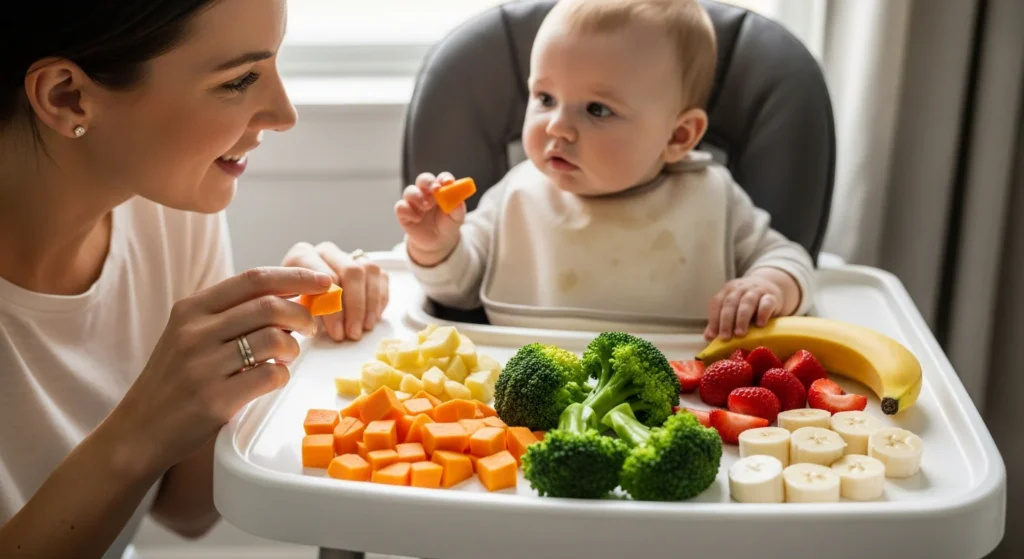
Phase 2: building complexity (7–9 months)
More combined textures and finger-sized shapes as the pincer grasp develops.
- New fruits and vegetables: peeled cucumber spear, roasted (floppy) bell pepper strips, ripe peach wedge, kiwi spear, and berries — large blueberries lightly flattened, or smashed.
- Proteins: soft meatballs, lentil patties, fully cooked omelet strips, moist shredded chicken in clumps, firm tofu strips.
- Grains and dairy: baby-sized pancakes (banana and egg), large well-cooked pasta shapes like rigatoni, full-fat yogurt scooped onto the tray or pre-loaded on a spoon, soft cheese in thick sticks.
A simple all-in-one idea: mix a pound of ground beef or turkey with a grated, squeezed-dry zucchini, an egg, a couple of tablespoons of breadcrumbs, and mild herbs; roll into large walnut-sized balls and bake at 375°F for about 20 minutes until soft and moist.
Phase 3: toward family meals (9–12+ months)
- Smaller pieces: pea-sized bits of familiar foods to practice the refined pincer grasp.
- Trickier textures: flaky fish, tender shredded meats, lightly steamed green beans, quartered grapes (always quartered), soft-cooked skinless apple pieces.
- Adapted family food: a deconstructed taco (seasoned ground meat, smashed beans, avocado, a tortilla strip), pasta with a simple sauce, shepherd’s pie scoops — modified for safety with low salt, soft textures, and safe sizes.
Introducing Allergens
BLW is a natural platform for the early, sustained allergen introduction now recommended to help prevent food allergies. The main allergens are peanut, egg, cow’s milk, tree nuts, soy, wheat, sesame, fish, and shellfish. Introduce one at a time, earlier in the day (not right before bed) so you can watch for a reaction, offer a small amount, and wait 2–3 days before adding another new one. Once a food is tolerated, keep it in the regular diet rather than offering it once and stopping. Safe forms include smooth peanut butter thinned into oatmeal or yogurt, fully cooked scrambled egg, full-fat yogurt, and hummus on a toast finger. Our detailed guide to introducing allergens walks through it step by step, and if you’re worried about a reaction, read up on the signs of a food allergy in advance.
How to Serve Tricky Foods Safely
- Banana: serve a half with part of the peel on, or roll a peeled half in crushed baby cereal to reduce slipperiness.
- Grapes and blueberries: always quarter lengthwise into flat, disc-like pieces — never served whole or halved.
- Apple: never raw and hard — offer a thin, soft-cooked wedge (skin on for grip) for younger babies, or grated raw for older ones with more chewing skill.
- Meat: start with a long, thick strip of slow-cooked, fall-apart tender meat for gnawing, then move to smaller shredded pieces.
- Bread: lightly toasted is safer than soft, gummy bread (which can ball up); cut into thick strips.
- Cheese: thick sticks of soft cheese rather than small cubes.
Building a Simple Meal
Forget picture-perfect plates — aim for balance across food groups: a protein, a vegetable, a carbohydrate or fat, and a fruit. A few examples by stage:
- 6–7 months: a couple of roasted sweet potato spears, an avocado spear with skin, and a strip of omelet.
- 8–9 months: two or three soft meatballs, a few pieces of soft-cooked broccoli, and dollops of yogurt on the tray.
- 10–12 months: shredded chicken with soft rice, smashed peas, and mango slices.
Offer water in a small open cup (a shot-glass size is perfect for little hands) with meals.
Frequently Asked Questions
Completely normal. For the first few months, squishing, tasting, and exploring is the work — your baby is learning texture, weight, and coordination. Nutrition still comes mainly from breast milk or formula through the first year, so try not to measure success in mouthfuls.
Prioritize iron-rich foods from the start: strips of red meat for gnawing, iron-fortified oatmeal, lentil or bean patties, and dark leafy greens mixed into fritters or omelets. A baby’s iron stores start to run low around six months, so make iron a regular feature of meals.
No. Gagging is a normal, protective reflex, and it’s different from choking (which is silent). It moves farther back in the mouth as your baby gains experience. If it makes you anxious, take an infant CPR and choking-response course — the confidence it gives is worth it.
Yes — this “combined approach” is common and completely fine. You can offer pre-loaded spoons of yogurt or mashed food alongside finger foods and let your baby choose. Doing both doesn’t confuse a baby, and it can ease the worry about how much they’re getting.
Avocado, banana, sweet potato, and soft-cooked broccoli or carrot are excellent starters — nutritious, easy to prepare, and simple for a baby to grip. Just prepare each in a safe shape and texture, soft enough to mash between your fingers.
The Bottom Line
Baby-led weaning comes down to trust — in your baby’s growing abilities and in the process. Expect plenty of food on the floor and some stunning moments of discovery in equal measure. Keep the safety fundamentals front and center (upright posture, soft mashable foods, safe shapes, constant supervision, and knowing gagging from choking), lean on iron-rich foods and early allergen exposure, and let your baby set the pace. Whether you go all-in on finger foods, stick with purées, or blend the two, you’re laying the groundwork for a healthy, relaxed relationship with food.
This article is for general information and is not a substitute for personalized medical advice.
References
- American Academy of Pediatrics (HealthyChildren.org). Starting Solid Foods.
- American Academy of Pediatrics (HealthyChildren.org). Choking Prevention.
- Centers for Disease Control and Prevention. Foods and Drinks for 6 to 24 Month Olds.
- National Institute of Allergy and Infectious Diseases. Food Allergy and Early Introduction.