A TENS machine is a small, drug-free pain-relief tool you control yourself — no needles, no restriction on moving around, and usable from the first twinges at home through active labor. It’s been part of childbirth toolkits for decades, especially in the UK, but it’s often misunderstood. Here’s how it works, what the evidence actually shows, how to set it up correctly, and how to tell whether it fits your birth plan.
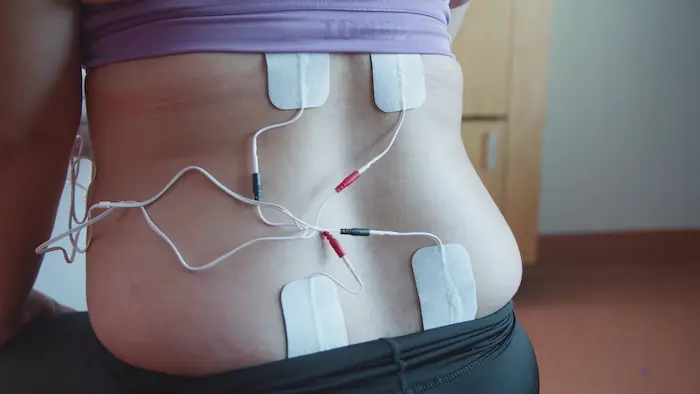
What a TENS Machine Is and How It Helps
TENS stands for Transcutaneous Electrical Nerve Stimulation — “transcutaneous” just means “through the skin.” It’s a small, battery-operated device that sends mild, safe electrical impulses into your body through sticky electrode pads on your skin.
How it eases pain comes down to the “Gate Control Theory.” Picture your spinal cord as having a gate that decides which nerve signals reach your brain. Pain signals travel on slow, small nerve fibers, while the buzzing sensation from the TENS travels on fast, large fibers. When you switch it on, that rapid flood of “non-pain” signals effectively closes the gate, reducing how many slower pain signals from your contracting uterus and back get through to where pain is perceived. It doesn’t remove the sensation — it turns down the volume on the pain channel by filling it with a stronger signal. The gentle pulses are also thought to prompt your body to release its own endorphins, so it works two ways: a neurological distraction and a natural painkiller boost.
What It Actually Feels Like
This matters, because if you expect it to numb you, you’ll be disappointed. The sensation is a strong, rhythmic tingling, buzzing, or fizzing under the pads — noticeable enough to hold your attention, but never sharp, burning, or painful. A good comparison is the feeling of your foot “waking up,” but controlled and rhythmic. As a contraction builds, you or your partner turn the intensity up to match it; as it fades, you turn it back down. That element of control is a big part of the benefit.
What the Evidence Says
The research paints a nuanced picture. TENS is consistently found to be safe for parent and baby, with no known adverse effects on labor progress or the baby. Satisfaction is generally high — many people report a greater sense of control and a lower perception of pain, even when the measured intensity is unchanged. It seems most useful for back pain and early-to-mid active labor; for the deep ache of back labor from a posterior baby, the pads sit right over the relevant nerves. Its effect in late active labor and transition is more variable — some find it less distracting as sensations intensify, while others hold onto it as a familiar anchor. The honest bottom line: TENS isn’t a standalone solution for everyone, but it’s a safe, low-risk part of a broader non-drug pain-relief plan. It changes your relationship to the pain rather than erasing it.
Pros and Cons
Pros: it’s non-invasive and drug-free, with no systemic side effects for you or the baby; you control the intensity moment to moment; it’s small and portable, so you can walk, sway, or use a birth ball while wearing it; you can start at home at the first signs of labor; and it’s especially good for back pain.
Cons: for many it isn’t enough on its own and works best combined with other techniques; it needs correct pad placement, wire management, and charge; the adhesive can loosen if you sweat a lot; fiddling with settings mid-contraction can distract if you haven’t practiced; and it isn’t suitable for everyone (see below).
Safety and Who Shouldn’t Use It
Used correctly, TENS is safe — the current is very low and localized. But there are firm rules:
- Never place the electrodes on your abdomen. The pads go on your back, not over the uterus.
- Never use it in the bath or pool. It’s an electrical device — disconnect the lead wires from the unit before getting into water.
- Don’t use it if you have a cardiac pacemaker or other implanted electronic device, epilepsy, or a history of blood clots (DVT) in the legs.
- Don’t place pads over broken skin, rashes, or varicose veins.
- Tell your midwife or obstetrician you plan to use one, and bring it with you.
How to Set It Up and Use It
Get the right equipment
You can rent or buy a maternity-specific TENS unit from physiotherapy clinics, online maternity-hire companies, or some pharmacies. A good one has a “Burst” or “Modulation” mode (best for labor), at least two channels for two pairs of pads, and simple controls.
Place the pads (this is the crucial part)
For labor, the standard is a “square of four” on the lower back, which targets the nerve pathways from the uterus and cervix (around T10–L1) and the sacral nerves for back pain (S2–S4). Your maternity TENS will come with a placement diagram — follow it, and here’s the text version:
- Clean and dry the skin on your lower back.
- For channel 1, place two pads vertically, about 3–4 inches apart, straddling the spine at the level of your waist.
- For channel 2, place the second pair about 3–4 inches below the first, also straddling the spine — giving you a “square” of four pads over your lower back and upper sacrum.
- Connect the lead wires, matching the colors and channels.
Start low and adjust with each contraction
Begin with both channels on the lowest intensity in Burst or Modulation mode, then gradually turn each up until you feel a strong, comfortable buzzing. In labor, hit the boost button (or manually increase intensity) at the start of a contraction to “close the gate” early, raise it a little more at the peak, and bring it back to baseline as the contraction eases. If it feels prickly or sharp, lower the frequency/pulse-width setting; if it feels weak or thumpy, raise it. For back labor, you may want a higher intensity on the lower (sacral) channel. You can keep using it until you feel the urge to push, and you’ll remove it before an epidural, since it can interfere with placement.
Combining TENS With Your Other Tools
TENS shines as part of a toolkit. Wear it while walking, rocking on a birth ball, or in a hands-and-knees position; use the rhythm of the pulses to focus your breathing; and have your partner add sacral counter-pressure or massage right next to the pads. It also pairs naturally with other comfort measures like acupressure, and it’s a good way to manage early labor while you wait, if you later decide on an epidural. Speaking of which — your partner makes an ideal “TENS technician,” handling the boost button during contractions and keeping an eye on the battery and wires so you can focus on laboring. It’s worth practicing placement together and noting your plan in your birth plan.
Quick Troubleshooting
| Issue | Likely Cause | Solution |
|---|---|---|
| Prickly, sharp sensation | Frequency/pulse width too high. | Turn down the frequency/pulse-width setting. |
| Weak, thudding sensation | Frequency/pulse width too low. | Turn up the frequency/pulse-width setting. |
| Pads won’t stick | Oily skin or hair. | Clean the area with soap and water; use a skin-prep wipe. |
| No sensation | Poor pad contact, dead battery, or wire issue. | Re-seat pads and wires; replace the battery. |
| Sensation fades during use | Nerves adapt to it. | Slightly change the mode or frequency. |
Frequently Asked Questions
You can, but a maternity-specific model is better. It has modes tuned for labor pain (Burst/Modulation) and often a handy boost button. The principles are the same — the maternity versions are just optimized for it.
Start in early labor at home. Getting used to the sensation while contractions are still mild gives the device the best chance to work well. Starting during strong, established labor is much harder.
Not at all — think of them as sequential. TENS is great for early labor and may help you delay or avoid an epidural. If you later choose an epidural, you simply remove the TENS first. They aren’t mutually exclusive.
Renting is common and cost-effective. Reputable companies provide a brand-new, sealed set of electrode pads for you to keep, along with a machine that’s been professionally cleaned and sanitized.
You can’t have the unit on or connected while you’re in the water because of the electrocution risk. Use it right up to getting into the tub, and reconnect afterward if you’d like.
On your lower back, in a “square of four” straddling the spine — never on your abdomen. That placement targets the nerves carrying pain from your uterus and lower back, which is why it’s especially good for back labor.
The Bottom Line
A TENS machine is a simple piece of technology that uses your own nervous system to create comfort. It won’t do the work for you, but it can make the work feel more manageable — and it hands you a real sense of control during an intense experience. Understand the science, practice the setup before your due date, and fold it into a broader plan, and you’ll have a low-risk, drug-free tool ready when early labor begins.
This article is for general information and is not a substitute for personalized medical advice from your healthcare provider.
References
- NHS. Pain Relief in Labour.
- Cochrane Database of Systematic Reviews. Transcutaneous electrical nerve stimulation (TENS) for pain management in labour.
- MedlinePlus (U.S. National Library of Medicine). Childbirth.