The journey to your baby’s first word is one of the most exciting parts of early parenthood — and that milestone doesn’t appear out of nowhere. It’s the result of months of invisible work, building neural pathways that start forming before birth. The good news is that the most powerful ways to support it are simple, free, and woven into everyday moments. This guide walks through practical, evidence-based activities to boost language skills from pregnancy through your baby’s first year. For a gentler overview of the core principles, see our day-one language tips, and to know what to expect when, our baby’s first words timeline.

The First Classroom: Before Birth
Language development begins in the womb. A baby’s auditory system develops early, with the ability to detect sounds beginning around 18 weeks of gestation, and by the third trimester your baby can hear your voice clearly and even show preferences for familiar patterns of speech and music. They aren’t “learning words,” but they’re absorbing the rhythm and melody of language — what linguists call prosody. Newborns recognize and prefer their mother’s voice, and can even recognize stories or songs they heard repeatedly before birth. Think of it as preparing the soil before planting seeds.
To make the most of it, simply talk to your bump as a habit — narrate your day, describe what you’re doing, and let your baby absorb the natural flow of your speech. Play and sing music with clear melodic lines, read a few favorite children’s books aloud so the repetition builds familiarity, and encourage your partner and family to talk and sing too, so your baby gets used to multiple voices. None of this requires changing how you speak; it just means bringing a little intention to interactions that are your baby’s very first language exposure.
The First Year, Month by Month
Over the first year, your baby moves from reflexive sounds to intentional communication. Here’s how to support each stage, alongside the CDC’s typical milestones.
Newborn to 3 Months: Building Connection
Your baby startles at loud sounds, quiets or smiles when spoken to, coos, cries differently for different needs, and begins making vowel sounds. The best boosters at this stage:
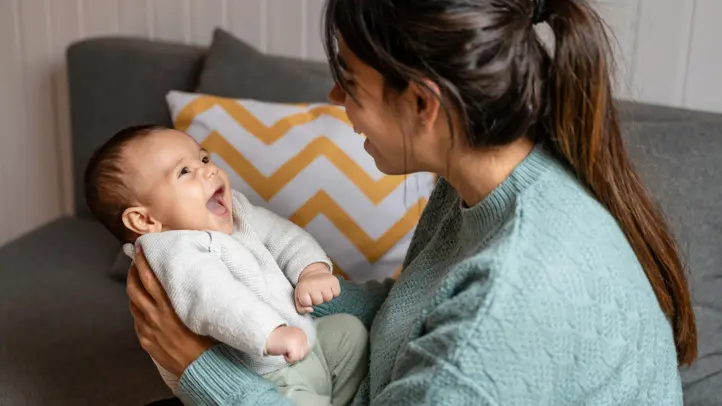
- Use “parentese” — the musical, higher-pitched, slightly exaggerated way of speaking that comes naturally to most caregivers. Babies pay more attention to it, and it highlights the sounds and patterns of language (this is real words with melody, not nonsense baby talk).
- Get face-to-face — hold your baby about 8–12 inches away (their ideal focal distance), make eye contact, and let them watch your mouth and expressions as you talk.
- Play “serve and return” — when your baby coos, pause, make eye contact, and respond. This back-and-forth teaches the basic structure of conversation.
- Narrate routines — “Now I’m changing your diaper, let’s get a fresh one, what a clean baby!”
- Sing during caregiving — predictable song patterns help your baby anticipate what comes next.
4 to 6 Months: Discovering Sounds
Your baby responds to changes in tone, begins babbling with consonants (“b,” “m”), makes sounds to show joy or displeasure, and turns toward sounds. Good activities:
- Imitate their sounds — when they say “ba-ba,” answer with “ba-ba-ba!” to reinforce the attempt and show communication is social.
- Label objects simply and consistently: “Ball. This is a red ball.”
- Read interactively — bright pictures, simple text, pointing as you name: “I see a dog! The dog says woof-woof.”
- Connect cause and effect with words — “You shook the rattle! Shake-shake-shake!”
- Name body parts as you gently touch them: “Here’s your nose! There’s your toe!”
7 to 9 Months: Intentional Communication
Your baby understands “no,” responds to their name, uses gestures like waving and pointing, and strings more syllables together. Try:
- Acknowledge gestures — “You’re pointing to the cup! You want your cup?”
- Offer simple choices — hold up two items: “Do you want the apple or the banana?” and respond to their reaction.
- Sing action songs — “Itsy Bitsy Spider” or “Pat-a-Cake” pair words with movements to connect language and meaning.
- Play hide-and-find — hide a toy under a cloth (“Where did the ball go?”) and reveal it (“There it is!”) to build anticipation.
- Expand their sounds — when they say “ba” for ball, reply with the full word: “Yes, ball! That’s your blue ball.”
10 to 12 Months: Preparing for Words
Your baby follows simple commands with gestures, says “mama” and “dada” specifically, tries to imitate words, and uses exclamations like “uh-oh.” Now:
- Emphasize single words — instead of “Do you want to play with this big red ball?” try “Ball! You want the ball.”
- Follow their lead — talk about whatever has their attention. If they’re watching a dog, that’s your topic.
- Introduce pretend play — a toy phone (“Hello!”) or feeding a doll builds symbolic thinking.
- Use consistent routine phrases — “All done!” “Time for bath!” “Let’s get dressed!”
- Celebrate every attempt — your enthusiasm for new sounds and word approximations encourages more. Our 10–12 month milestones guide covers this stage in full.
Relationship Before Vocabulary
The most important insight from decades of research is that language grows from relationship. Your consistent, loving attention provides more than words — it provides the emotional security that makes learning possible. Every conversation, song, and story tells your baby: your sounds matter, your attempts are important, I’m here listening and responding. The real boosters aren’t complicated techniques or expensive products; they’re the daily moments of pausing to make eye contact when your baby coos, describing the world you see together, and putting words to their interests. Variation is normal — some babies gesture extensively before making sounds, others babble for months before gesturing — so focus on the overall progression and the quality of your interactions. You are your child’s first and most important language teacher.
Frequently Asked Questions
Responsive talking (acknowledging their sounds with your words), face-to-face interaction using parentese, and gentle singing during caregiving routines. Responsive, back-and-forth caregiving in these early months builds a secure foundation for all development.
It exposes your baby to the rhythm and melody of language long before they understand words, building neural connections that support later comprehension and literacy. It also makes reading a comforting, bonding ritual from the start.
The AAP recommends avoiding screen time other than video chatting for children under 18–24 months. Infants don’t learn language effectively from screens — they need the responsive timing, eye contact, and emotional connection of real human “serve and return” interaction, which screens can’t provide.
Parentese is real language delivered with exaggerated melody, a slower pace, and a higher pitch — correct grammar and real words. Unhelpful baby talk uses made-up words or incorrect grammar. Parentese highlights language structure; nonsense words don’t.
By 12 months, talk to your pediatrician if your baby doesn’t babble with consonants, doesn’t use gestures like pointing or waving, doesn’t respond to their name consistently, shows no interest in games like peek-a-boo, or doesn’t try to imitate sounds or actions. Early intervention is most effective, so it’s always worth raising.
The Bottom Line
Helping your baby toward their first words isn’t about drills or gadgets — it’s about connection. Talk, sing, read, and respond, and trust that these simple daily interactions are laying a foundation that lasts a lifetime: the ability to communicate, to connect, and to understand the world. Enjoy the journey, follow your baby’s lead, and remember that every coo you answer is a small, real lesson in conversation.
This article is for general information and is not a substitute for personalized medical advice.
References
- American Academy of Pediatrics (HealthyChildren.org). Language Development: Birth to 1 Year.
- Centers for Disease Control and Prevention. Important Milestones: Your Baby By One Year.
- World Health Organization. Early childhood development.
- Mayo Clinic. Infant development: Birth to 3 months.