Your baby’s first word feels like a sudden breakthrough, but the journey to it began long before — quietly, steadily, from their very first day. Language development isn’t a switch that flips at one year; it starts in the womb and builds through your daily interactions. And the single most powerful tool for it isn’t a flashcard or an app — it’s you. This guide focuses on the core principles that make the difference (the “why” and the mindset), while our companion language development activities guide gives the full stage-by-stage playbook, and our first words timeline shows what to expect when.
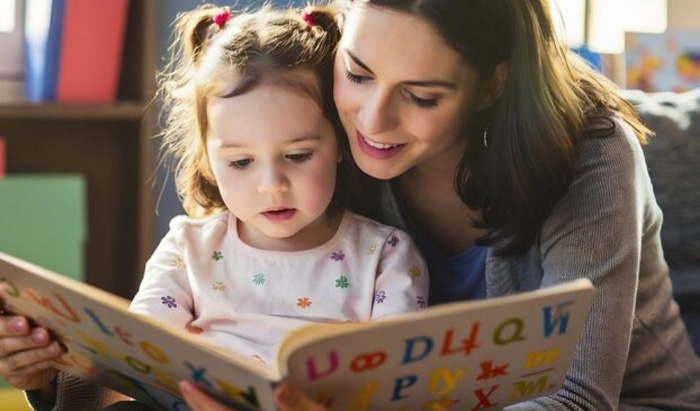
Forget pressure; think connection. If you take away one idea, let it be this: language grows out of warm, responsive relationship, not drills. Everything below is just a way of putting that principle into practice.
It Starts Before Birth
Long before you hold your baby, they’re listening. A fetus’s inner-ear structures can detect some sounds by around 18 weeks of pregnancy, and by 24 to 28 weeks the ear-to-brain connections are established enough that babies respond to voices and noises from outside the womb. It’s a muffled world dominated by your heartbeat and blood flow, but your voice cuts through clearly, resonating through your body — which is why newborns consistently prefer their mother’s voice and can even recognize songs or stories heard repeatedly in the womb. You don’t need a curriculum: talk to your bump as you go about your day, read a favorite book aloud a few times a week, sing, and invite your partner to do the same. The goal is calm connection — introducing the “sound of home,” not teaching vocabulary.
Four Principles That Do the Heavy Lifting
Across the whole first year, the same handful of habits matter far more than any specific toy or program:
- Use “parentese.” That instinctive high-pitched, slow, melodic way of talking captures a baby’s attention and highlights the sounds of language. It’s not nonsense “baby talk” with made-up words — it’s real, grammatical speech delivered in a captivating way.
- Serve and return. When your baby coos, gurgles, or later babbles, pause, make eye contact, and respond as if they said something meaningful (“Yes! Tell me more!”). This back-and-forth teaches the fundamental rule of conversation: I take a turn, you take a turn.
- Narrate and label. Describe what you’re doing and name what your baby sees (“Here’s your cup,” “Daddy’s home!”). This steadily builds their mental dictionary long before they can speak.
- Follow their lead. Talk about whatever has their attention rather than redirecting it. If they’re staring at a dog, that’s your topic — shared attention is where words stick.
As your baby grows, these principles simply take new forms: face-to-face “conversations” and singing in the newborn months; imitating their babble and reading interactive books at 4–6 months; acknowledging gestures and offering simple choices at 7–9 months; and celebrating every word attempt (never correcting) as first words emerge at 10–12 months. For the specific activities at each stage, see the full activities guide.
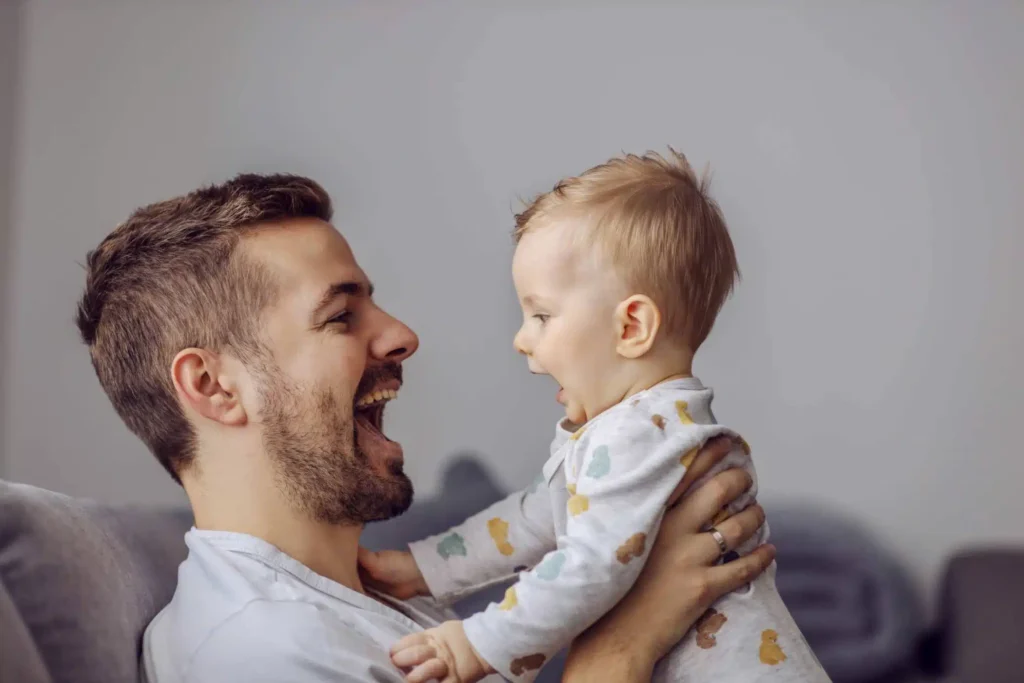
The Power of Reading — From Day One
Reading to your baby from birth does far more than build vocabulary. It exposes them to the rhythm and melody of language, creates a daily ritual of closeness, and models shared attention — all foundations for later literacy. Newborns benefit from simply hearing your voice and rhythm; by 4–6 months, books with textures, flaps, and bold pictures invite touching and pointing; and by the end of the year, pausing to ask “where’s the dog?” turns reading into a two-way exchange. It doesn’t matter if you finish the book or read the same one for the hundredth time — the connection is the point.
Frequently Asked Questions
It’s genuinely helpful. The melodic, exaggerated, higher-pitched style known as parentese boosts infant brain activity for language and helps babies distinguish speech sounds. The key is that it’s real words and correct grammar delivered in an engaging tone — not made-up nonsense words like “owie-boo-boo.”
Yes. Babies’ brains are wired to differentiate multiple sound systems from birth, and multilingualism is a gift, not a cause of speech delay. The main ingredient is consistent exposure — a common approach is one person consistently speaking one language. Bilingual babies may mix languages at first, which is completely normal.
Absolutely — it’s one of the most valuable things you can do. Long before babies produce words, they’re building the brain circuits for language by hearing rich, responsive talk. Narrating your day and answering their coos teaches turn-taking and steadily grows their understanding.
By 12 months, talk to your pediatrician if your baby isn’t using gestures like pointing, waving, or reaching; doesn’t respond to their name consistently; isn’t babbling with consonant sounds (“mamama,” “bababa”); or doesn’t seem to understand simple words like “no” or “bye-bye.” Early intervention is most effective, so it’s always worth raising.
Not at all. Some babies gesture extensively before making many sounds, while others babble for months before gesturing — both are normal. Gestures like pointing and waving are important communication milestones in their own right. Keep responding to and naming what they point to.
The Bottom Line
Encouraging language is woven into the fabric of your relationship — it happens during diaper changes, on walks, at the grocery store, and during quiet cuddles with a book. It’s connection over perfection: your consistent, loving, talk-rich interaction is the single most significant factor in your child’s language journey. You’re not just teaching words; you’re showing your child that their voice, from the first coo to the first word, is worth listening to. Sign language can complement this too — see our baby sign language guide — but the foundation is simply talking, listening, and responding. Start the conversation today.
This article is for general information and is not a substitute for personalized medical advice.
References
- American Academy of Pediatrics (HealthyChildren.org). Language Development: Birth to 1 Year.
- Centers for Disease Control and Prevention. “Learn the Signs. Act Early.” Developmental milestones.
- Mayo Clinic. Fetal development: The second trimester.