Picture the scene: your 10-month-old is in the high chair, red-faced and crying, batting away the sippy cup and wailing louder at a toy. They want more banana, but they have no way to tell you, and the guessing game is exhausting for you both. Now rewrite it: your baby looks at the empty spot where the banana was, looks at you, and taps their fingertips together — the sign for “more.” You light up: “Oh! You want MORE banana!” and hand them a piece. The tension evaporates. That simple, silent “aha” is the heart of baby sign language — a way to hand your pre-verbal child a key to communicate before their mouth can form the words. And to bust the biggest myth up front: signing does not delay speech. This guide is a stress-free map to getting started.
Why Sign With Your Baby?
The most consistent, well-supported benefits of baby signing are about communication and connection rather than making a baby “smarter”:
- Reduces frustration. This is the most immediate payoff — when babies can communicate a basic need, the powerlessness that leads to meltdowns eases. Fewer tears for them, less stress for you.
- Strengthens your bond. That moment of being understood tells your baby “my person gets me,” building trust and deepening connection.
- Supports early communication. Signing gives babies practice with the back-and-forth turn-taking of conversation and reinforces symbolism (a hand shape stands for a thing) — the same skills spoken language draws on.
- Offers a window into their world. Suddenly you know they’re thinking about the dog they saw earlier or want the cup, not the ball. It’s fascinating.
A note on the science: early studies popularized the idea that signing babies end up with larger spoken vocabularies or a cognitive edge, but later reviews have found the evidence for accelerating speech or boosting IQ to be mixed and inconclusive. What’s reliably reported is that signing doesn’t delay talking and can reduce frustration and enrich early interaction — so think of it as a helpful bridge to communication, not a head-start program. For the bigger picture of how talking develops, see our baby’s first words timeline.
When and How to Start
The sweet spot for babies to start signing back is usually 6 to 9 months, when they understand routines, can focus on your hands, and are developing the motor control to imitate. But you can start modeling signs as early as you like — even from birth — just by talking and signing as you go. And if your baby is already an older, frustrated toddler, that’s a perfect time to start too. A few core principles keep it easy:
- Keep it simple and fun — this is play, not homework.
- Always pair the sign with the spoken word — say “milk” clearly as you sign it. The sign supports the word; it never replaces it.
- Be consistent — use the same sign in the same context every time.
- Follow their motivation — start with signs for things they care about (food, comfort), not abstract concepts.
The First 10 Signs: Your Starter Vocabulary
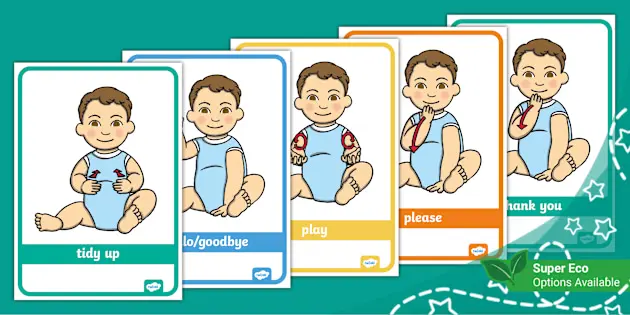
These signs (based on American Sign Language) are chosen for high motivation and daily use. Don’t launch all ten at once — pick 2–3 that fit your routine.
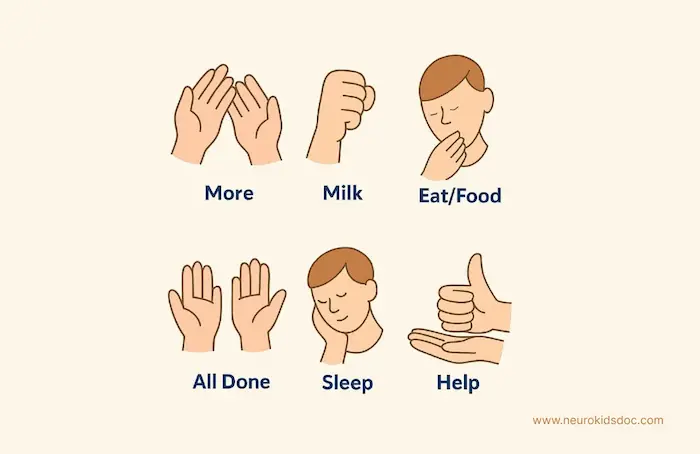
- Milk — make a fist, then open and close it a few times (like milking a cow). A primary need, so highly motivating. Use it every time you offer milk.
- More — tap the fingertips of both hands together. Endlessly useful at mealtime and play; pairs beautifully with “all done.”
- All done / finished — hold your hands up, palms facing you, and shake them back and forth. Lets your baby end an activity, heading off meltdowns when food or play is over.
- Eat — bring the fingertips of one hand to your mouth, as if putting food in. A clearer hunger signal than fussing.
- Drink — make a “C” shape with your hand and tip it toward your mouth. Handy as they start using cups.
- Mom & Dad — for mom, tap your thumb on your chin; for dad, tap your thumb on your forehead. Empowering and personal — being able to call for a specific person is huge.
- Diaper / change — tap both hands on your hips a couple of times. Turns a routine necessity into a communicated event.
- Sleep / bed — rest your flat palm against the side of your face and tilt your head onto it. Cues what’s coming next and supports routine.
- Help — make a fist with one hand, palm up, place your other flat hand under it, and lift both together. Perhaps the most valuable sign, teaching them to ask for assistance instead of dissolving into frustration.
How to Weave Signs Into Your Day
Think in phases, not deadlines — your baby moves through these at their own pace:
- Phase 1 — Modeling (start anytime): just fold signs into your natural talk. “I’m pouring your MILK.” “Oh, you’re ALL DONE.” Babies are brilliant little sponges.
- Phase 2 — Recognition & approximation (around 6–9 months+): you’ll see the lightbulb flicker — intent staring at your hands, excitement at a familiar sign. They may sign back, and it’ll look creative (a fist pump for “more”). Celebrate it enthusiastically and don’t correct the form.
- Phase 3 — Active use (9+ months and beyond): they sign purposefully, in context, to communicate. Respond with joyful recognition and the spoken word: “You signed MILK! Here it is!” That positive response is rocket fuel.
Anchor signs to predictable routines: mealtime is the goldmine (eat, more, all done, drink with every meal); diaper changes suit “diaper” and “all done”; playtime is great for more, help, ball, book; and book reading lets you sign what you see (dog, cat, sleep). Reading your baby’s other cues alongside signs makes the whole picture clearer.
Expanding the Vocabulary — and the Bridge to Speech
Once your baby has a few signs down, follow their lead and add favorites — animals (dog, cat, bird), toys (ball, car, book), people (grandma, grandpa, baby), and feelings (happy, sad, scared). Then watch for the bridge: your baby starts to sign “ball” and say “ba!”, connecting the symbol to the sound. Over time, as speech strengthens, they’ll often drop the sign and use only the word. That’s the ultimate success — the sign was a scaffold, and now spoken language stands on its own.
Frequently Asked Questions
No — this is the most persistent myth, and research doesn’t support it. Signing activates the language centers of the brain and gives babies practice with the turn-taking of conversation. It’s a complement to speech, not a competitor, and most children naturally drop signs as their words take over.
Keep modeling — they’re processing, and consistency is key. Some babies watch for weeks and then produce a sign out of the blue. If a homemade sign appears (they sniff for “flower”), celebrate it and use it alongside the standard one; inventing a symbol is a real cognitive leap.
Anywhere from about 8 to 14 months for those first purposeful signs is normal, and earlier exposure often leads to earlier use. Don’t worry if your baby signs before talking — signing is communication in a different form, and the words will come.
Using ASL signs has real advantages — it’s a genuine language, consistent, and understood by others. But the most important thing is consistency in your home. If a simple homemade sign is easier for you to remember and use, that’s fine; the goal is communication.
Yes on both. In a bilingual home, one sign stays constant across both spoken languages, giving a stable shared symbol. And signing is widely used in early intervention — it can be especially supportive for children with speech or language delays, Down syndrome, or autism, offering a clear visual way to communicate. If you have concerns about your child’s overall development, check with your pediatrician or a speech-language pathologist.
The Bottom Line
Baby sign language isn’t a performance — it’s listening with your eyes. It tells your child, “What you think matters to me, and I’ll find a way to understand you.” The rewards are real: less guesswork, fewer power struggles, more shared smiles, and an early window into the person growing before you. Start today — pick one sign, make it a game, be consistent, and watch closely. You’re not just teaching signs; you’re building the foundational joy of conversation.
This article is for general information and is not a substitute for personalized medical advice.
References
- American Speech-Language-Hearing Association. Communication Development in Children.
- American Academy of Pediatrics (HealthyChildren.org). Language Development: Birth to 1 Year.
- Centers for Disease Control and Prevention. “Learn the Signs. Act Early.” Developmental milestones.