The stretch between 10 and 12 months is one of the most dynamic phases of the first year — the gateway where a dependent infant visibly transforms into an independent, curious toddler. It’s marked by two big surges: the conquest of upright mobility and the dawn of intentional communication. Watching your baby pull up to stand for the first time, take those initial side-steps along the furniture, and say “mama” or “dada” and mean it are unforgettable moments — and they bring new questions and safety concerns. This is a deep dive into the 10–12 month stage; for the whole first-year arc, see our month-by-month milestones guide, and for the previous stage, our 7–9 month milestones.
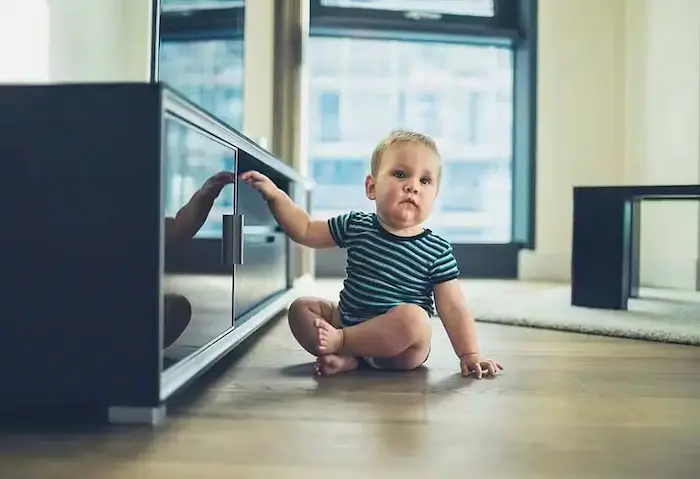
Grounded in the developmental guidelines of the American Academy of Pediatrics (AAP) and the CDC, we’ll cover the key physical, cognitive, and language milestones of this age, the typical range of normal, and practical ways to encourage new skills safely — while childproofing your home for a newly mobile explorer.
From Pulling Up to Side-Stepping
Gross motor development at this age follows a logical (if not always linear) sequence, with strength building on strength.
The pull-up: using arm and core strength, your baby hauls themselves from sitting or crawling to standing by grabbing stable furniture — a coffee table, couch, or crib rail. It signals real upper-body strength, core stability, and coordination, and it’s the foundation for all upright mobility. Encourage it by placing enticing toys on the seat of a sturdy, low sofa or ottoman (making sure nothing can tip over).
Cruising: the bridge between standing and walking. Holding furniture with both hands, your baby shuffles sideways, one foot then the other, and may start to “transfer” between two pieces of furniture set close together. Cruising builds leg strength, balance, and confidence, and teaches weight-shifting — a critical piece of independent walking. Create a safe “cruising path” by arranging stable furniture in a semicircle or along a wall, and clear tripping hazards (rugs, cords) from it.
Toward walking: briefly letting go to stand alone for a few seconds is a big milestone, often near the end of this window. Many babies love pushing a sturdy push-toy (not a sit-in walker) or holding your hands to step forward. Some take their first independent steps by their first birthday, but many walk in the weeks or months that follow — both are perfectly normal. The CDC’s “Learn the Signs. Act Early.” program stresses that the range of normal for walking is broad, so focus on the progression of skills (sitting → crawling → pulling up → cruising) rather than a rigid date. Our crawling guide covers the mobility that leads here.
The Dawn of Dialogue: Cognitive and Language Leaps
While their bodies are in motion, their minds are making equally impressive strides. On the language side, receptive language (what they understand) explodes first: they grasp simple commands (“no,” “come here,” “give me”), recognize familiar words (“bottle,” “bye-bye,” “shoe”), and may look at a family member or pet when named. Expressive language then begins with intention — a “true word” is consistent (the same sound for the same thing), intentional, and used without immediate imitation. “Mama” and “dada” become specific, though many first words are simplified, like “ba” for ball or “mo” for more. Communication isn’t only verbal, either: pointing, waving bye-bye, shaking the head “no,” and clapping are major gestures that often appear before words. Our baby’s first words timeline traces this in detail.
Cognitively, this is a rich period: object permanence is now fully mastered (they understand things exist when out of sight, fueling peek-a-boo and hunting for hidden toys), problem-solving emerges (pulling a blanket to reach a toy on it, working out how to open a cabinet), and they love imitating everyday actions — brushing their hair, “talking” on a phone, stirring a pot. Socially, a strong preference for primary caregivers is normal and healthy, and clinginess or wariness around unfamiliar people (stranger anxiety) is a sign of secure attachment.
How to Support Development Safely
Your role is to provide a safe, rich environment for exploration — not to “teach” these skills.
For motor skills: safety comes first — anchor top-heavy furniture and TVs to the wall, install safety gates, cover sharp corners, and remove choking hazards, since the floor is now the primary gym. Offer a sturdy, weighted push toy (that they push, not sit in), allow barefoot or non-slip-sock time indoors for better balance and sensory feedback, and skip sit-in baby walkers — the AAP strongly advises against them as a leading cause of infant injuries that can also delay the muscle development for walking.
For language and cognition: narrate your day (“I’m putting on your blue sock, now let’s find your shoe”), read interactively (point to and name pictures, ask “what does the dog say?”), respond to gestures and babble (“You want your cup? Here’s your cup”) to teach the power of communication, and sing simple action songs like “Itsy Bitsy Spider” or “Pat-a-Cake” that link words, rhythm, and movement.
New Challenges: Safety, Sleep, and Feeding
New skills bring new puzzles. Safety: re-childproof from a standing baby’s perspective, watching for hot drinks, pull-able tablecloths, and stairs. Sleep: some babies practice pulling up in the crib and then can’t figure out how to get down, leading to night wakings — practice gently lowering them during the day, and make sure the crib mattress is at its lowest setting. Feeding: this is prime time for self-feeding, so offer a variety of soft, bite-sized finger foods and expect mess as part of the learning (they may also get more distractible at meals). Our guide to how much your baby should eat helps with portions.
Red Flags: When to Talk to Your Pediatrician
Development varies, but the AAP suggests discussing these with your child’s doctor around the 12-month visit if your baby:
- Doesn’t crawl, or consistently drags one side of the body while crawling.
- Can’t stand with support.
- Doesn’t search for hidden objects.
- Says no single words like “mama” or “dada.”
- Doesn’t use gestures like waving, shaking the head, or pointing.
- Loses skills they once had.
Early intervention makes a real difference, so sharing your observations openly with your pediatrician is always the right step.
Frequently Asked Questions
Usually not. Walking has a wide range of normal — many babies take their first steps between 12 and 15 months, and some later. What matters is steady progression: pulling up, cruising, and standing with support. If your baby isn’t standing with support or shows no interest in bearing weight on their legs by 12 months, mention it to your pediatrician.
A true word is used consistently (the same sound for the same thing), intentionally, and not just copied back to you in the moment. It doesn’t have to be perfect — “ba” for ball or “mo” for more counts. “Mama” and “dada” become true words once your baby uses them specifically for you, usually around this age.
A sturdy push toy your baby walks behind is fine once they can pull to stand — it builds confidence. Sit-in walkers are different: the AAP strongly advises against them, as they’re a leading cause of infant injury and don’t help babies learn to walk.
This is very common — they’ve mastered getting up but not getting down. Practice lowering from standing to sitting during daytime play so they learn the move, keep the crib mattress at its lowest setting, and keep bedtime calm and consistent. It usually passes within a couple of weeks.
Anywhere from zero to a few is typical at 12 months — some babies say one or two words, others none yet, while understanding far more than they can say. Gestures like pointing and waving are just as important as spoken words at this stage. Keep talking, reading, and responding to build the foundation.
The Bottom Line
The 10-to-12-month window is a breathtaking preview of the toddler to come. Your baby is transforming from a passenger in their world to an active navigator, driven by an insatiable curiosity to move and communicate. It’s easy to fixate on “Is my baby walking yet?” or “How many words do they say?” — but this stage is about so much more than checking boxes: the determined look as they struggle to stand, the giggle as they cruise into your arms, the connection when they name you for the first time. You’re not a coach drilling for performance; you’re a guide and a witness. Secure your home, fill their days with loving interaction, embrace your child’s individual timeline, and trust their innate drive to develop.
This article is for general information and is not a substitute for personalized medical advice.
References
- Centers for Disease Control and Prevention. Important Milestones: Your Baby By One Year.
- American Academy of Pediatrics (HealthyChildren.org). Movement Milestones: Babies 8 to 12 Months.
- Mayo Clinic. Infant development: Milestones from 10 to 12 months.