The first time you look at your C-section scar, maybe in the hospital bathroom, maybe a week later at home, it does not look like what you expected. It is redder, or longer, or more raised. It might feel numb or oddly sensitive or both. And nobody gave you a very clear roadmap for what comes next.
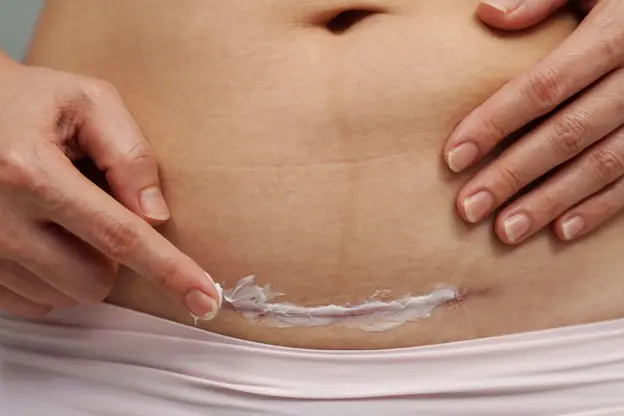
C-section scar care is one of the more underaddressed areas of postpartum recovery, partly because the scar looks healed on the outside long before it is healed on the inside, and partly because new mothers are generally managing so much else that scar management gets pushed down the priority list. This guide gives you the complete picture: what is happening at each stage, what you can do and when, how to reduce your scar’s appearance over time, and when to ask for professional help.
Understanding Your C-Section Incision
Most C-sections use a low transverse incision, the “bikini cut,” running horizontally across the lower abdomen just above the pubic bone. ACOG notes this type heals well and causes less bleeding than vertical incisions, which are reserved for specific emergency or medical circumstances.
What makes the C-section scar more complex than it looks from the outside is that the incision goes through multiple layers: skin, fat, fascia (the connective tissue covering the muscles), the abdominal muscles themselves, which are typically separated rather than cut, and then the uterine wall. Each of those layers heals on its own timeline, so when the skin looks closed and normal, the deeper layers may still have months of healing ahead. This is why recovery is longer and more nuanced than most people expect when they are told “six weeks and you will be cleared.”
The skin closure method, whether dissolvable sutures beneath the surface, surgical staples removed before discharge, or surgical glue, does not change the fundamental healing process, though the Mayo Clinic notes the method often depends on surgeon preference and delivery circumstances.
The First Two Weeks: Protection and Infection Prevention
The first two weeks are about one thing: protecting the incision while the initial healing phase proceeds undisturbed. This is not the time for scar products or massage; it is the time for keeping it clean, dry, and monitored.
Daily Incision Care
Your dressing will typically be removed within 24 to 48 hours. After that, the CDC’s surgical site guidance supports letting water run over the incision during showers rather than rubbing it, so gentle rinsing with mild unscented soap, then patting completely dry with a clean soft towel. No rubbing, and no creams, ointments, or powders unless your provider specifically prescribed them. Keep the area from becoming damp or humid, since moisture under the natural crease of the lower abdomen is one of the main contributors to delayed healing.
Normal Healing vs. Warning Signs
Normal in this window: slight bruising around the incision, minor swelling, clear or faintly pink fluid drainage in the first 24 to 48 hours, and itching as the skin knits together.
Contact your provider immediately for increasing redness that is spreading from the incision edges, pus or foul-smelling drainage, fever above 100.4°F, incision edges pulling apart, excessive bleeding, or pain that is worsening rather than improving. These are signs of infection or wound separation and need same-day attention.
Moving Safely
Three techniques make a real difference in the first weeks. Pillow splinting, meaning holding a pillow firmly against the incision when you cough, sneeze, laugh, or have a bowel movement, reduces tension on healing tissues significantly. Log rolling to get out of bed, meaning roll to your side, bend your knees, and push up with your arms while your legs swing down, protects the abdominal wall; never sit straight up from a lying position. And lifting restrictions are strict: nothing heavier than your baby, which means no groceries, no laundry baskets, and no toddlers.
Weeks 2 to 6: The Active Healing Phase
By week two, the external incision may look largely healed. Steri-strips, if you had them, will have curled at the edges and fallen off on their own, so do not pull them. Once they are gone and the incision is fully closed with no scabs or open areas, you can begin very gentle care: not deep massage yet and not scar products yet, just gentle moisturizing of the surrounding skin and protection from the sun.
Sun exposure is worth taking seriously, since the American Academy of Dermatology warns that new scars are highly susceptible to UV damage that can permanently darken scar tissue. Keep it covered by clothing when you are outdoors, or use a high-SPF mineral sunscreen directly on the scar once it is fully closed. This single habit makes a meaningful difference in the final appearance.
Walking is excellent during this phase, since it promotes circulation, reduces blood clot risk, and supports overall recovery. What to continue avoiding: abdominal exercises, heavy lifting, high-impact activity, and anything that causes pulling or pain at the incision site, none of which should resume without your provider’s clearance at the 6-week checkup. The comprehensive picture of what is happening across your whole body during this period is in our guide to postpartum body changes in the first six weeks.
Months 2 to 6: Active Scar Management
This is the most important window for active C-section scar care. The scar tissue is still being remodeled, with collagen fibers reorganizing, so the scar is more responsive to intervention now than it will be later. What you do during months 2 to 6 meaningfully affects the final appearance and function of the scar.
Scar Massage: How and When
Scar massage can begin once the scar is well healed, typically around 8 to 12 weeks postpartum and confirmed by your provider. Before that point, massage can disrupt the healing process rather than support it.
How to do it: apply lotion, oil, or silicone gel first to reduce friction, then use your fingertips to make small circles along the length of the scar. Gently lift the scar tissue away from the underlying muscle, which is the part that addresses adhesions forming between layers, and stretch the skin above and below the scar in opposite directions. Do this for 5 to 10 minutes daily. You may feel pulling or mild discomfort as the scar tissue mobilizes, which is expected, but sharp pain means stop.
The goals of massage are to break up internal adhesions, improve the mobility of the scar relative to the tissue underneath it, reduce tightness, and improve sensation over time. A scar that feels “stuck” to the layer below it, one that does not slide freely when you try to move it, is one where adhesions have formed, and massage directly addresses this. For many women this is also where pelvic floor physical therapy becomes valuable, since a trained therapist can assess and treat internal adhesions that massage alone cannot fully reach. More detail on why this matters for core and pelvic function is in our guide to postpartum pelvic floor recovery.
Silicone Therapy: The Best-Supported Option for Appearance
If you want to reduce your scar’s appearance, silicone is the most well-supported option, and the American Academy of Dermatology endorses silicone therapy for scar management. Silicone sheets or gels create a protective barrier that hydrates the scar tissue, helps regulate collagen production, and helps flatten raised scars.
How to use it: clean and completely dry the area, apply the silicone gel or sheet directly over the scar, and wear it for at least 12 hours daily, continuing for 2 to 3 months to see meaningful improvement. Consistency matters more than any single product, since the benefit builds over sustained daily use. Begin only after your provider confirms the incision is fully healed and closed, which for most women is somewhere between 4 and 6 weeks postpartum, though your provider’s assessment matters more than the calendar.
The C-Section Shelf
Many women develop a “C-section shelf,” a visible overhang of tissue just above the scar line. This can result from swelling, changes in fat distribution, or scar tissue tethering the skin downward and causing the tissue above to bulge. Some of this resolves with time and healing, and scar massage directly addresses the tethering component by mobilizing the scar tissue away from the underlying layers. Pelvic floor physical therapy can also target the specific adhesion patterns that contribute to the shelf appearance. It is worth knowing that this is common and that it often improves significantly over the first year with consistent scar care.
At One Year and Beyond
By one year postpartum, your C-section scar has largely reached its final appearance. It should be flatter and softer than it was in the early months, and lighter in color, though the exact color relative to your surrounding skin depends on your individual pigmentation and how much sun protection you maintained. Scar tissue never fully replicates normal skin, since it lacks oil glands, sweat glands, and hair follicles and has different elastic properties, but with consistent care through the maturation window it can be significantly less visible and functionally unrestricted.
Numbness and Sensation
Numbness around the C-section scar is among the most common and longest-lasting symptoms. Small nerves cut during surgery take time to regenerate, from months to years, and some degree of numbness may be permanent. The flip side also happens: some women experience hypersensitivity or shooting pains as nerves regenerate, which can feel alarming but is part of normal nerve recovery. Both sensations can fluctuate and are generally not cause for concern unless they are worsening rather than gradually changing.
Future Pregnancies
The uterine scar is a significant factor in future pregnancies. ACOG recommends waiting at least 18 months before conceiving again to allow complete healing, which protects uterine integrity and reduces the risk of uterine rupture, a rare but serious complication. Whether you are a candidate for VBAC, meaning vaginal birth after Cesarean, depends on the type of uterine incision from your first C-section. Discuss this explicitly with your provider early in any subsequent pregnancy rather than at the last minute.
Complications: When to Get Checked
Most C-section scars heal without issue, but certain complications can emerge months or even years after surgery and are worth knowing about.
Infection can happen early or late. Signs include increasing redness, warmth, swelling, pus, fever, or pain that is worsening rather than gradually improving over time. Any of these deserve same-day medical attention.
Scar endometriosis is rare but specific to C-section scars, where uterine lining cells implant in the incision site. Signs include a tender nodule or lump in or near the scar, pain that intensifies around your period, or swelling or bleeding from the scar during menstruation, and it typically appears months to years after surgery. If you notice cyclical pain or changes at the scar site that correlate with your menstrual cycle, raise it with your provider, since it is treatable but needs to be identified.
Incisional hernia occurs when tissue pushes through a weakness in the abdominal wall at the incision site. Signs include a visible bulge near the scar, pain with lifting or straining, or a feeling of heaviness or pulling in the area. This also requires medical evaluation and may need surgical repair.
Returning to Exercise After C-Section
The six-week clearance is the starting line for more structured exercise, not the finish line of recovery. When you are cleared, deep core activation, specifically the transverse abdominis that runs horizontally across the abdomen, is the right starting point rather than crunches or planks. These exercises gently re-engage the core without placing high load on the incision area or worsening any diastasis recti that developed during pregnancy. The phased approach is detailed in our guide to returning to exercise after baby, which is worth reading before you start so you understand why certain exercises need to wait and what the progression should look like.
The Emotional Side of C-Section Recovery
Your scar carries emotional weight alongside its physical reality. For some women it represents strength and the moment their baby arrived safely. For others, particularly those who had an unplanned or emergency C-section, it can be a complicated symbol: of a birth that went differently than planned, of a recovery that was harder than expected, of a body that feels unfamiliar. The WHO recognizes that birth experiences significantly affect maternal mental health, and that difficult birth experiences, including emergency surgery, can contribute to postpartum depression and post-traumatic stress.
If your feelings about your scar or your birth experience are interfering with daily life, bonding with your baby, or how you feel about yourself, that is worth naming, whether to someone you trust, a therapist, or your provider. You do not have to have made peace with every aspect of how your baby arrived in order to be a good mother, but you do deserve support in processing it if it is something you are carrying. Understanding what is normal versus what might need support is also in our guide to when to seek postpartum help.
Nutrition for Scar Healing
What you eat directly affects how your body repairs tissue. Protein is the building block of collagen, the main structural protein in scar tissue, so lean meats, eggs, dairy, legumes, and nuts should anchor your meals. Vitamin C is required for collagen synthesis, since your body cannot make collagen without it, so include citrus, bell peppers, strawberries, and broccoli. Zinc supports immune function and cell growth during healing, available from meat, shellfish, nuts, seeds, and whole grains. And hydration keeps tissues supple and supports every aspect of the repair process from the inside.
If you are also breastfeeding, your nutritional needs are elevated across the board. More detail on what to eat during the postpartum recovery period is in our guide to postnatal nutrition.
Your Scar Care Timeline
Weeks 1 to 2: Keep the incision clean and dry, watch for infection signs, use pillow splinting for coughing and movement, and rest with strict activity limits.
Weeks 2 to 4: Once fully closed, begin gentle moisturizing of the surrounding skin and protect the scar from sun exposure consistently. Continue activity restrictions. Gentle touch around, not on, the scar is fine if comfortable.
Weeks 4 to 8: After your provider confirms the incision is fully healed, begin silicone therapy. Attend your 6-week postpartum checkup and gradually resume walking and light activity as cleared. Hold off on working the scar tissue itself until your provider says it is ready.
Months 2 to 6: Once cleared, usually around 8 to 12 weeks, add daily scar massage alongside consistent silicone use. Consider pelvic floor physical therapy if the scar feels tight, restricted, or is affecting core function, and monitor for any late complications.
Months 6 to 12: The scar reaches its final appearance. Continue maintenance care as needed, address persistent concerns with a dermatologist or surgeon, and track any cyclical symptoms that might indicate scar endometriosis.
Frequently Asked Questions
The external skin heals in about 4 to 6 weeks, the uterine incision takes 6 to 8 weeks or longer, and full scar maturation, where the scar reaches its final appearance and internal tissue has remodeled, takes up to a year. This timeline matters because what you see at 6 weeks is not what you will see at 12 months, and interventions like massage and silicone therapy are most effective when used during the maturation window rather than abandoned once the skin looks healed.
Once the incision is fully healed with no scabs, open areas, or drainage, typically around 8 to 12 weeks postpartum, and after confirming with your provider. Starting before the incision has adequately healed can disrupt the process. The window between roughly 8 weeks and 6 months is when massage is most beneficial, so there is no advantage to starting early at the expense of safety.
Itching during healing is a sign of nerve regeneration and collagen formation, so it genuinely indicates things are working. If it is mild, it is normal. If itching is severe, persistent, or accompanied by a rash, contact your provider to rule out a skin reaction to a product or a developing infection.
No. The first few months are the most dramatic phase in terms of appearance, and most scars flatten, soften, and lighten significantly over the first year. Consistent silicone therapy, sun protection, and massage all meaningfully influence the final result. What you see at 6 weeks is genuinely not predictive of what you will see at 12 months.
For many women it improves substantially with time and scar care. The tethering component, where scar tissue is adhered to the layer beneath and pulls the skin downward, responds well to consistent scar massage and pelvic floor physical therapy, and fat redistribution and skin recovery also continue over the first year. For some women a degree of shelf persists, particularly with deeper adhesion patterns that massage cannot fully address, and a pelvic floor physical therapist can evaluate what is driving it and whether further intervention would help.
For some women, altered sensation in the scar area and lower abdomen affects intimacy, either through reduced sensation from numbness or discomfort from scar tissue tightness. Both can improve with time and consistent scar massage. If scar pain is specifically interfering with sexual activity, that is worth naming to your provider and to a pelvic floor physical therapist who can assess and address the specific patterns involved.
One Last Word
Your C-section scar is the result of your baby being brought safely into the world. Whatever feelings you have about how that happened, whether relief, grief, pride, ambivalence, or a mix that shifts day to day, the scar itself deserves consistent, informed care. The physical recovery is longer than most people expect and involves more than the external skin healing, but with the right approach at the right time, your scar can heal well, function well, and bother you significantly less than it does in those first raw months.
Be patient with the process. Ask your provider anything you are uncertain about. And know that even at a year, if something about your scar is still bothering you functionally or aesthetically, it is not too late to seek help.
This article is for general information and is not a substitute for professional medical advice. Confirm with your healthcare provider before starting scar products, massage, or exercise after a C-section.
References
- American College of Obstetricians and Gynecologists. (2023). Cesarean birth. acog.org/womens-health
- Mayo Clinic Staff. (2024). C-section recovery: What to expect. mayoclinic.org
- Centers for Disease Control and Prevention. (2024). Surgical site infection guidelines. cdc.gov/infection-control
- American Academy of Dermatology. (2023). Scars: Tips for managing. aad.org
- World Health Organization. (2023). Maternal mental health. who.int
- American College of Obstetricians and Gynecologists. (2019). Vaginal birth after cesarean delivery. acog.org/clinical