Moving your baby from the bottle or breast to a cup can feel like a minor errand — just find something that holds liquid and doesn’t spill everywhere. But the choice between a sippy cup and a straw cup carries more weight than it seems: it touches oral-motor development, dental health, and speech. Here’s how each type actually works, what the trade-offs are, and a practical, age-based way to choose.
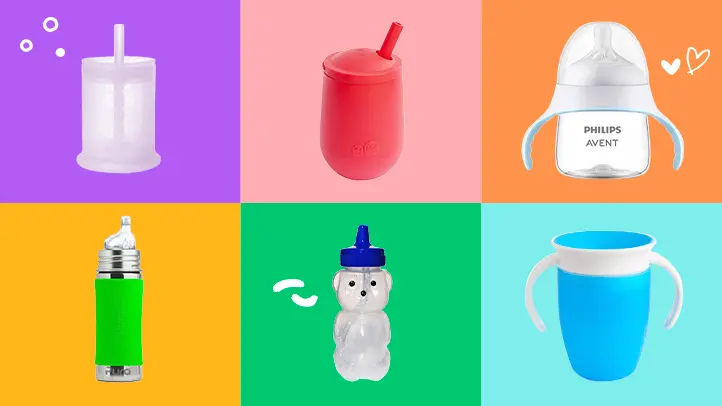
For decades the hard-spouted sippy cup was the default next step after the bottle. These days, pediatric feeding specialists, dentists, and speech-language pathologists tend to steer parents toward straws and open cups instead. This fits right after our guide to weaning from the bottle — once you’re ready to switch, this helps you pick the cup.
How Each Cup Works
The difference in mechanics is the root of the recommendations.
A classic hard-spout sippy cup asks a child to bite down on the spout, tip the head back, and use a bottle-like sucking motion to draw liquid up. Many have valves that need real suction to release liquid — spill-proof, but it changes the natural drinking action, and the tongue often presses forward against the spout (a “tongue thrust” pattern).
A straw cup is a more advanced skill. The child seals their lips around the straw, uses the tongue and cheeks to create suction, and coordinates the swallow — all while the tongue stays in a more natural, retracted position. Some straw cups have valves too, but the fundamental action is different from a spout.
The Trouble With Relying on Sippy Cups
Sippy cups are popular because they contain messes and feel like an easy step from a bottle. The concerns are mostly about prolonged or exclusive use:
- Oral-motor development. The bite-and-suck action can reinforce an immature, bottle-like pattern rather than the mature tongue and jaw movements used for clear speech and efficient eating. The American Speech-Language-Hearing Association notes that a persistent tongue thrust can interfere with speech-sound production.
- Dental health. Sipping sugary liquids (juice or milk) all day bathes the front teeth, and the spout can rest against them — raising the risk of tooth decay (sometimes called “sippy cup caries”). Prolonged spout use is also thought to be one factor, alongside things like extended pacifier or thumb use, that can contribute to bite problems such as an open bite.
- Skill progression. A sippy cup can act as a long-term training wheel — a child who only ever uses one isn’t practicing the skills needed for an open cup, which is the real goal.
If you do use one, a hard-spouted, valveless model (which needs less aggressive sucking) can be a short-term bridge for a child struggling with other cups — but treat it as a brief transitional tool with a plan to phase it out, not a destination.
Why Specialists Favor Straw Cups
Pediatric occupational therapists and speech-language pathologists increasingly recommend straw drinking as the better first cup skill after the bottle:
- Builds oral-motor strength. Drawing liquid up a straw works the jaw, cheek, and tongue muscles, which supports both the coordination used for articulation and the mature swallow needed for managing food textures.
- Better tongue posture. The tongue retracts and elevates during a straw drink — a healthier resting position — and liquid heads toward the back of the mouth, away from the front teeth, which discourages the tongue thrust a spout can encourage.
- A stepping stone to the open cup. The lip rounding and sealing a straw needs are close to open-cup skills, making it a manageable intermediate step.
- Independence with less mess. Many straw cups are spill-resistant, so they offer peace of mind while still building a more advanced skill.
The Real Goal: The Open Cup
Whatever you choose in between, the destination is an open cup. The American Academy of Pediatrics and World Health Organization both stress moving off the bottle to a cup by around 12–18 months to help prevent overfeeding and dental problems. You can start open-cup practice as early as 6 months with help — a small, weighted cup (even a shot-glass-sized silicone cup) with a few sips of water at meals, fully expecting spills as part of learning. Many experts suggest a progression: a straw cup as the main independent cup around 9–12 months, with supervised open-cup practice at seated meals alongside it. Our baby hydration guide covers what and how much to offer.
A Practical, Age-Based Guide
Babies 6–9 months: the introduction phase
The focus is exploring the skill and adding small sips of water alongside milk — as your baby starts solids. The best pick is assisted open-cup practice at mealtimes, with a soft silicone straw cup or straw trainer as a secondary option (place the straw in their mouth and give a gentle squeeze to show that liquid comes up). Goal: exposure, not mastery.
Older babies & toddlers 9–18 months: building independence
Now the focus is transitioning off the bottle or breast and drinking independently. A spill-resistant straw cup makes a great everyday cup for hydration, with open-cup practice continuing at meals. If you use a sippy at all, choose a hard-spouted, valveless model and plan to phase it out by 18 months at the latest.
Check in with your pediatrician or a feeding therapist if, by 12–15 months, your child can’t seal their lips around any spout or straw, consistently chokes or coughs while drinking, refuses all cups to the point it affects hydration, or shows significantly delayed oral-motor skills.
Choosing and Using a Cup
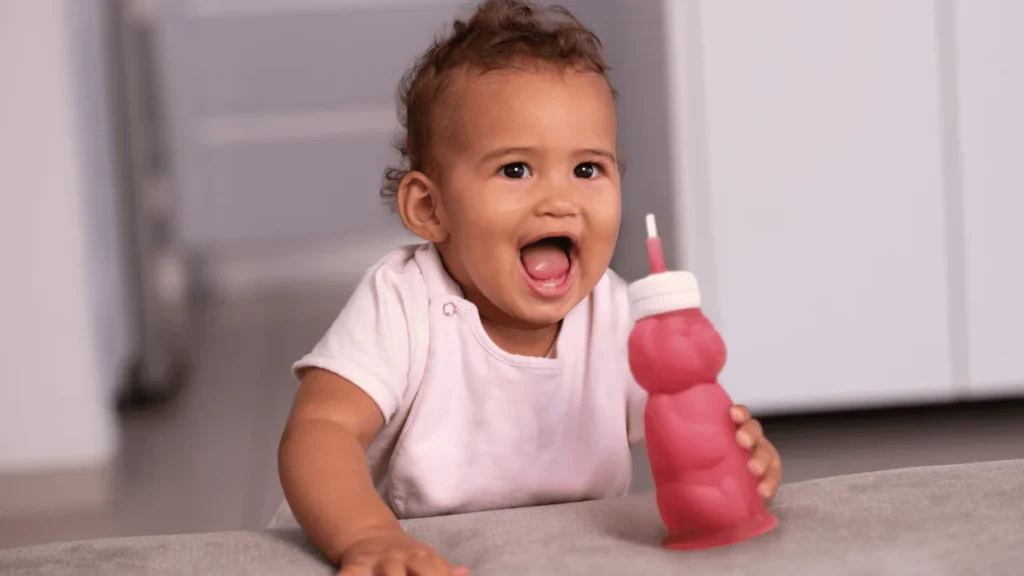
For a straw cup, look for soft silicone straws, an easy-to-clean (ideally dishwasher-safe) design, and a weighted straw that moves to find liquid at any angle. Avoid cups with complex valves that demand heroic suction — the goal is functional drinking, not spill-proof perfection. To teach the skill, dip the straw in liquid, cap the top with your finger to trap a little, and release a drop into their mouth; a squeezable “honey bear” cup works well too.
A few habits protect teeth and health: straws and valves can harbor mold, so choose cups you can fully take apart and clean thoroughly. Don’t let your child carry a cup of milk or juice and sip for hours — offer drinks at meal and snack times, then put the cup away. And for all-day sipping, plain water is the safest choice for teeth; save milk for mealtimes. Keeping juice minimal matters too, as our guide to juice for babies explains, and protecting those new teeth ties into early dental care.
Frequently Asked Questions
A sippy cup uses a bite-and-suck motion much like a bottle, which reinforces an immature oral pattern. A straw cup uses a lip seal with a retracted tongue, which builds the more mature oral-motor skills used for eating and speech. That’s why specialists tend to favor straws.
Be patient and try different styles (angled or weighted). Model drinking from a straw yourself, and use a favorite liquid to motivate them. A trick that often clicks: offer a regular straw in a thick liquid like a yogurt smoothie so they feel the draw more easily.
They’re generally a better option than spouted sippy cups — the child drinks from the rim, which promotes a good lip seal and no biting. They still involve a compression-suck motion and can be fiddly to clean, but they make a useful middle-ground tool.
The AAP recommends weaning from the bottle by 15–18 months at the latest to protect teeth and prevent overconsumption of milk. Starting cup practice early, around 6 months, makes that transition much smoother.
Yes — used mindfully. Choose a hard-spouted, valveless model, limit its use, plan to phase it out, and pair it with open-cup practice. Parenting is about informed choices that work for your family, not perfection.
For sipping through the day, water is best for dental health. Offer milk at mealtimes and then put the cup away, and keep juice to a minimum. This protects teeth and builds a healthy drinking routine.
The Bottom Line
Between the two, the straw cup is the clear front-runner for developmental benefit — but the bigger point is intention. Think of cup drinking as a skill to nurture, like crawling or first words: prioritize straw cups and early open-cup practice, embrace the mess as a sign of learning, and aim for progression over perfection. And if a sippy cup is part of your journey, that doesn’t make you a bad parent — just use it mindfully and keep the open cup as the goal.
This article is for general information and is not a substitute for personalized advice from your pediatrician or dentist.
References
- American Academy of Pediatrics (HealthyChildren.org). Discontinuing the Bottle.
- American Dental Association (MouthHealthy). Baby Bottle Tooth Decay.
- American Speech-Language-Hearing Association. Feeding and Swallowing Resources.