Somewhere around 2 a.m., running on a few hours of broken sleep, you’ll face a diaper that seems to defy physics — and in that moment, a well-stocked changing station is worth its weight in gold. A functional station isn’t about matching baskets or aesthetic labels, though. It’s about a setup that protects your baby’s delicate skin, prevents accidents, and spares your own recovering body. Here’s how to build one around what actually matters, with the reasoning behind each choice.
The Foundation: Choosing Your Surface
The single most important safety rule comes first: never leave your baby unattended on a changing surface, even for a second, and always keep one hand on them. With that in mind, the choice of surface comes down to stability and ergonomics.
- Standalone changing tables often include shelves or drawers. If you go this route, make sure the base is wide and sturdy — give it a firm push, and if it wobbles, look elsewhere.
- A dresser topper is the most space-efficient option: a low, sturdy dresser with a contoured changing pad secured on top gives you storage and doesn’t become furniture you’ll later have to get rid of. “Secured” is the key word — the pad needs a non-slip base or an anchor strap so it can’t shift.
Two more essentials: use the pad’s safety strap every single time, even before your baby is rolling — babies pick the exact moment you reach for a diaper to make their first roll. And set the surface at roughly waist height. Hunching over a low surface strains a back, core, and pelvic floor that are already working hard to recover from birth, while a too-high surface is unstable. Aim for a height where you can stand comfortably upright.
The Non-Negotiables: Core Supplies
Diapers
Newborn skin is sensitive, so the type matters. Look for fragrance-free diapers (fragrance is a common irritant), get the size right (too small leaves red marks and leaks; too large gaps and leaks — size up once your baby is consistently above the lower weight limit), and for the first few weeks choose a newborn style with a cut-out or fold-down front so the drying umbilical cord stump stays exposed to air.
Wipes
You’ll use thousands, so choose wisely: short ingredient lists (water, a mild cleanser, maybe aloe), and avoid alcohol, fragrance, and harsh preservatives like methylisothiazolinone, which can cause contact dermatitis. Plain warm water on a soft cloth is actually the gentlest option of all, and reusable cloth wipes suit many sensitive-skinned babies. A cold wipe startles some babies — warming it briefly in your hand solves that without a dedicated warmer.
Diaper cream
Keep a barrier cream (zinc oxide or petroleum-based) for prevention — a thin layer at changes, especially overnight, works like lip balm for the skin. If a rash shows up as bright red with small “satellite” bumps, that can be a yeast infection needing an antifungal, so check with your pediatrician before treating. Apply with a clean finger or spatula, wash your hands before and after, and never double-dip a used applicator back into the jar. Our guide to diaper rash covers telling the types apart.

Keeping It Clean
A diaper change is a hygiene event, so build in a few safeguards:
- Hand sanitizer (at least 60% alcohol) at the station as a backup. Soap and water is best, but when you’re holding a wiggly baby and a soiled diaper, a sink isn’t always reachable — sanitize before and after.
- Disposable or washable pad liners sit on top of the pad cover and catch the surprise pee, so you toss just the liner instead of stripping the whole pad at 3 a.m. They double as a clean surface away from home.
- A diaper disposal system. A foot-pedal pail keeps it hands-free, and systems that wrap each diaper in plastic contain odor well — though a simple lidded step-can with scented bags often works just as well for less money.
Staying Organized
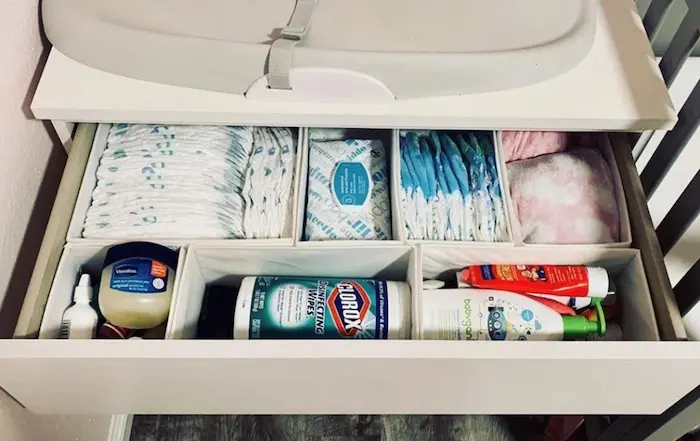
Group like items in open baskets so you can find them one-handed: one for diapers (sorted by size), one for creams and a spatula, one for spare onesies, socks, and mittens, and one for burp cloths (you’ll always want more than you think). Add a portable caddy — stocked with a few diapers, a travel pack of wipes, a tube of barrier cream, a liner, and a spare onesie — so you can change the baby wherever you are, and restock it each evening. And decant floppy diaper packs into a basket or holder to avoid the tangle of ten diapers flying out when you grab one.
The Just-in-Case Kit
- A full spare outfit within reach — blowouts happen, and you don’t want to dig through a drawer with messy hands.
- Receiving blankets or burp cloths as your all-purpose cleanup crew and a warm barrier during changes.
- A nail care kit — clippers or blunt scissors, or an electric file many parents find less intimidating. Trim during deep sleep.
- A digital rectal thermometer, the most accurate method for infants. In a baby under 3 months, a rectal temperature of 100.4°F (38°C) or higher needs immediate medical evaluation.
- Simethicone gas drops (kept out of baby’s reach) to address discomfort during or after a change, if your pediatrician suggests them.
A Few Anatomical Notes
For baby boys: the cold-air pee is real — lay a wipe or cloth over the area for a few seconds after opening the diaper. If your son is circumcised, follow your pediatrician’s aftercare instructions, which usually involve dabbing plain petroleum jelly on the area to keep the diaper from sticking to the healing skin during the first week; keep a separate tube on hand for this.
For baby girls: always wipe front to back to keep bacteria away from the urethra and prevent UTIs — make it a habit from day one. Some white or slightly bloody vaginal discharge in the first weeks is normal, caused by maternal hormones, and needs nothing more than gentle cleansing with water.
What You Can Skip
Just as useful as knowing what to buy is knowing what to leave at the store:
- Wipe warmers — they can dry out wipes and harbor bacteria if not cleaned meticulously. Room-temperature wipes are fine.
- Fancy hanging diaper stackers — a basket or open shelf is easier to see into and pull from one-handed.
- Any changing pad without a safety strap or non-slip base — not worth it for the look of a particular cover.
- A cabinet full of lotions and potions — newborn skin does better with less. Stick to a barrier cream and, only if your pediatrician recommends it, a gentle fragrance-free lotion for dry patches.
Setting Up for Your Own Recovery
You’ll spend a lot of time here, so make the station work for you too: keep a water bottle within reach (hydration supports energy and milk supply), install a dimmable or red-hued nightlight so 3 a.m. changes don’t jolt you fully awake or suppress your melatonin, and stash a few shelf-stable snacks nearby for when hunger hits mid-change.
Frequently Asked Questions
Either is safe if it’s stable and wide-based, set at about waist height, with the pad secured by a non-slip base or anchor strap. What matters most isn’t the furniture — it’s never leaving your baby unattended and keeping a hand on them at all times.
Not really. Warmers can dry out wipes and, if not cleaned carefully, harbor bacteria. Room-temperature wipes are fine — if a cold wipe startles your baby, just warm it briefly in your hand first.
Follow your pediatrician’s aftercare instructions. This usually means dabbing plain petroleum jelly on the area at each change during the first week so the diaper doesn’t stick to the healing skin. Call your provider if you notice increasing redness, swelling, or a fever.
Always front to back, to keep bacteria away from the urethra and lower the risk of a urinary tract infection. Some white or slightly bloody discharge in the first weeks is normal, from maternal hormones, and just needs gentle cleansing with water.
A zinc oxide or petroleum-based barrier cream for everyday prevention, applied in a thin layer at changes. Keep an antifungal only for a suspected yeast rash (bright red with satellite bumps) — and check with your pediatrician before using it. Never double-dip a used applicator into the jar.
Wipe warmers, fancy hanging diaper stackers, changing pads without a safety strap, and a shelf full of baby lotions. Newborn skin needs very little, and a simple, safe, well-organized setup beats an elaborate one every time.
The Bottom Line
A diaper changing station is one of the first practical corners of parenthood you’ll set up, and it’s easy to get pulled toward cute accessories over useful ones. Focus on the essentials — a stable, waist-height surface with a strapped pad, gentle fragrance-free products, good hygiene habits, and simple organization — and you’ll have exactly what you need within reach, even in the bleary-eyed middle-of-the-night moments. That reliability is worth far more than any perfectly coordinated basket.
This article is for general information and is not a substitute for personalized medical advice.
References
- American Academy of Pediatrics (HealthyChildren.org). Diapering Your Baby.
- Mayo Clinic. Diaper Rash.
- Centers for Disease Control and Prevention. About Handwashing.
- American Academy of Pediatrics (HealthyChildren.org). Fever and Your Baby.