In the first days of your baby’s life, two things often surprise new parents: how impossibly small your baby is, and how surprisingly sharp their fingernails can be. Those thin, fast-growing nails can quickly become tiny scratchers, leaving marks on their own face, on your skin, and — if they reach the eyes — even causing a corneal scratch. For a lot of parents, bringing a sharp tool near those tiny fingers is genuinely nerve-wracking. But nail care is a basic part of hygiene and safety, and with the right tools and a calm technique it turns from an ordeal into a quick, routine part of caregiving. Here’s how to do it confidently.
Understanding Baby Nails
A baby’s nails are quite different from an adult’s, and understanding that shapes how you care for them. They’re soft and pliable, often curling at the edges — more like thick extensions of the skin than the hard plates adults have, which is why they can sometimes be gently peeled or filed in the early weeks. They grow fast: fingernails may need trimming 1–2 times a week, while slower-growing toenails often only need attention every 2–3 weeks. And the nail bed is tightly attached to the skin, so the clear “white tip” that guides adult trimming barely exists in a newborn — which is exactly what makes parents nervous about cutting the skin. This biology is what dictates the gentle tools and techniques below.
Choosing Your Tools
Having the right tool removes half the fear. Each has its ideal use:
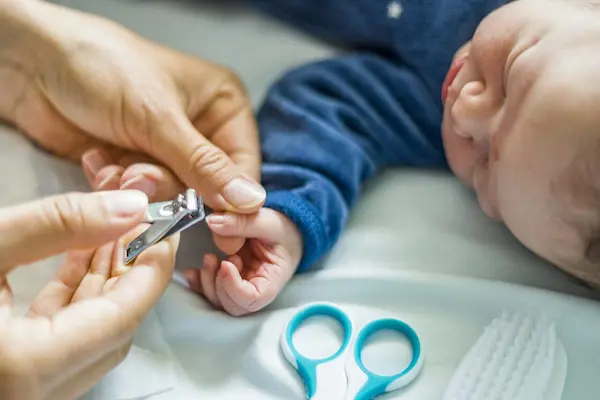
- Baby nail clippers — look for rounded safety tips, a built-in magnifier, and a comfortable grip. Most parents find these easiest for fingernails once the baby is a few weeks old and the nails have firmed up. Keep them sharp: a dull clipper crushes or tears the nail rather than cutting cleanly.
- Baby nail scissors — small, blunt-tipped, slightly curved blades. Many parents prefer these for newborns because they give more control over each small snip, and the blunt tips prevent stabbing if the baby moves suddenly.
- Electric baby nail file — a battery-operated file with a soft, spinning sandpaper head that gently grinds the nail down. Great for anxious parents, very squirmy babies, or smoothing edges after a clip, since it’s virtually impossible to cut the skin. The noise startles some babies; choose a model made for infants with a fine-grit head.
- Emery board or soft nail file — ideal in the first week or two when nails are softest, and for daily upkeep to file down a sharp corner between trims. Use a fine grit and file in one direction.
A Step-by-Step Trim
The key is preparation and technique, not speed. Set yourself up well first: many parents find it easiest while the baby is asleep (often after a feed, when hands are relaxed and still), or after a bath when the nails are softest. A helper to hold and comfort the baby, and good light (natural daylight by a window is perfect), both help a lot.
Fingernails
Hold your baby’s palm and finger firmly but gently, and press the finger pad slightly down and away from the nail to create a little space. Trim straight across, following the natural curve of the fingertip, and avoid rounding the corners deeply (which can encourage ingrown nails). Take tiny, incremental snips rather than trying to remove the whole edge at once, then run your thumb over the edge and smooth any sharpness with a file.
Toenails
Cutting straight across matters even more here — never curve the edges, as that’s the main cause of painful ingrown toenails. Leave a tiny bit of white rather than cutting too close, and never dig at the corners.
If you nick the skin
It happens to almost everyone — stay calm. Apply gentle pressure with a clean, dry gauze pad until the bleeding stops (it’s usually minimal). Don’t use an adhesive bandage, which is a choking hazard on a baby. These tiny nicks heal quickly; just keep the area clean. A small nick isn’t a failure, just a common learning moment.
Daily Care and Scratch Prevention
Trimming is the main event, but a little daily upkeep prevents problems. On the mittens question: scratch mittens can help in the first week or two, especially at night, but relying on them long-term gets in the way of your baby using their hands to explore, which matters for sensory development — frequent trimming is the better long-term answer. Keep a fine emery board handy to dull a sharp corner instantly between trims. And after a bath, you can gently smooth the thin skin at the base of the nail with a soft towel and apply a mild, fragrance-free moisturizer to hands and feet to keep the surrounding skin soft and prevent hangnails. Trimming right after bath time pairs these two tasks neatly.
Troubleshooting Common Nail Problems
Ingrown toenails
This happens when a nail corner grows into the surrounding skin, causing redness, swelling, and tenderness. Prevent it by always cutting toenails straight across and avoiding tight socks or footies. For a mild case, soak the foot in warm water 2–3 times a day, dry it well, and gently massage the swollen skin away from the nail; a tiny piece of clean cotton tucked under the ingrown corner can help lift it. Call your pediatrician if the area looks infected (red, warm, oozing pus) or doesn’t improve in a few days — and don’t try to cut out an ingrown nail yourself.
Peeling or brittle nails
Common in newborns adjusting to the dry world outside the womb, and it usually resolves on its own. Keep nails trimmed short and smooth. If it persists beyond a few months, mention it to your pediatrician to rule out rare nutritional issues.
Discolored nails
A white spot is usually a minor past bump to the nail. A greenish-black patch under the nail is likely a small blood blister from a pinch or smash (a “subungual hematoma”) and will grow out with the nail. Widespread discoloration (yellow or very white) with no injury is worth a pediatrician’s look.
Infection around the nail (paronychia)
An infection of the skin fold beside the nail, often starting from a small cut or hangnail. Signs are red, swollen, warm, tender skin around the nail, sometimes with a pus-filled blister. This one needs a pediatrician — they may need to drain it or prescribe an antibiotic.
What to Expect as They Grow
- Newborn (0–4 weeks): file with an emery board or use blunt-tip scissors; trim weekly or as needed.
- Infant (1–6 months): move to safety clippers or scissors; fingernails 1–2 times a week, toenails every 2–3 weeks.
- Older baby and toddler (6 months+): mobility makes it trickier — trim while they’re distracted, asleep, or just out of the bath, and turn it into a little game or song to build a positive association.
Frequently Asked Questions
From birth if they need it. In the first week or two, when nails are very soft, many parents simply file them with a fine emery board rather than cutting, then move to baby scissors or clippers once the nails firm up a little.
When your baby is asleep — often after a feed, when their hands are relaxed and still — or right after a bath when the nails are softest. Good light and, if possible, a second person to hold and comfort the baby make it much easier.
Stay calm — it happens to nearly everyone. Press a clean, dry gauze pad gently against it until the minimal bleeding stops, and keep the area clean. Don’t use an adhesive bandage, which is a choking hazard for a baby. These little nicks heal quickly.
Always cut toenails straight across and never round the corners — curved cutting is the main cause of ingrown toenails. Avoid tight socks and footed outfits that press on the toes. See your pediatrician if the skin becomes red, swollen, or infected.
They’re useful in the first week or two, especially at night. But relying on them long-term limits how your baby uses their hands to explore, which matters for development. Frequent trimming is the better long-term solution.
The Bottom Line
Trimming your baby’s nails feels huge at first and quickly becomes a two-minute routine. Choose sharp, baby-specific tools, work in good light while your baby is calm or asleep, and keep the cut straight across — especially on toenails — to prevent ingrown nails. Be gentle with yourself, too: a tiny nick is a common learning moment, not a failure. With a little practice, keeping those tiny hands and feet safe becomes second nature.
This article is for general information and is not a substitute for personalized medical advice.
References
- American Academy of Pediatrics (HealthyChildren.org). Baby Bathing & Skin Care.
- Nemours KidsHealth. A Guide for First-Time Parents.
- Mayo Clinic. Ingrown Toenails.