As contractions build, many people want ways to actively take part in their labor — to ease the edge of a contraction or release tension locked in the shoulders. Acupressure is one such tool: a hands-on comfort measure you or your birth partner can use during labor. It won’t erase pain, but many find it changes the quality of the experience and adds a sense of control. Here’s how it works, what the evidence says, the important safety limits, and five practical pressure points.
What Acupressure Is (and How It Differs from Acupuncture)
Acupressure is a traditional East Asian technique that applies firm pressure to specific points on the body, called acupoints — essentially acupuncture without the needles, using thumbs, knuckles, or a tool instead. In its traditional framework, pressure is thought to free the flow of qi (vital energy) along pathways called meridians. From a Western physiological view, stimulating these points may help by prompting the release of endorphins (the body’s natural pain-relievers), dampening pain signals traveling to the brain, and increasing local blood flow. Whichever framework resonates with you, the practical appeal is the same: for many people it offers a real sense of relief and agency during labor.
What the Evidence Says
It’s worth asking about the science. Several studies and reviews suggest acupressure may modestly reduce labor pain intensity and anxiety, and some report shorter active labor — though, as with many complementary therapies, the research is limited and mixed, and larger high-quality trials are still needed. It tends to be reported as most helpful for back labor — the deep ache radiating through the lower back when a baby is in a posterior position — where firm counter-pressure to the sacrum can relieve pain other methods miss. It’s not a magic eraser, but for many it makes the waves of contractions more manageable, with the bonus of a greater sense of control.
Safety First: The “Do Not Use” Rules
This is the most important section. Acupressure is safe when practiced correctly and with strict attention to a few rules, because some points are potent and should be avoided during pregnancy until you’re at term.
- Do not stimulate LI4 (Hegu) or SP6 (Sanyinjiao) before 40 weeks. These points are thought to strongly influence the uterus and pelvic floor, and using them early is traditionally believed to potentially encourage contractions. Save them for when you’re full-term with signs of readiness, or during established labor.
- Avoid acupressure entirely if you have vaginal bleeding of unknown cause, a known platelet disorder, a history of preterm labor in this pregnancy, or any skin infection or lesion at the point site.
- Listen to your body. Pressure should be firm and focused, producing a deep, dull “good ache” — never sharp, shooting, or unbearable pain. Bad pain is a signal to stop immediately.
When in doubt — and especially with a high-risk pregnancy — check with your maternity care provider first.
Five Key Points and How to Use Them
It helps to practice locating these with your partner before the big day — it builds confidence for you both.
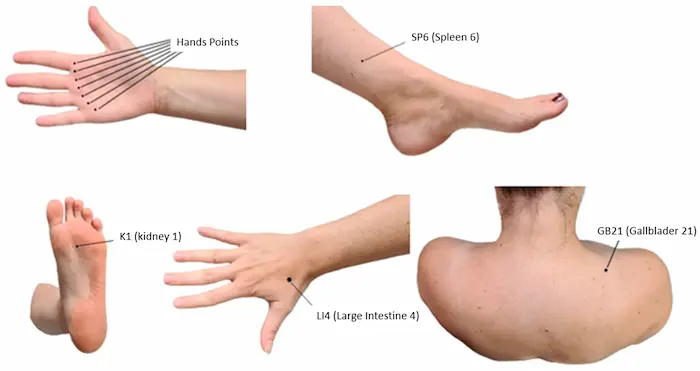
Large Intestine 4 (Hegu / LI4) — pain modulation
Location: on the back of the hand, in the fleshy webbing between thumb and index finger (the highest spot of the muscle when you bring thumb and finger together). How: your partner applies firm, downward pressure with their thumb, held steady or in small deep circles, for 30–60 seconds per hand during a contraction. Best for: general pain relief in early active labor. Forbidden before 40 weeks.
Spleen 6 (Sanyinjiao / SP6) — pelvic support
Location: on the inner leg, about four finger-widths above the tip of the inner ankle bone, just behind the shin bone, in a tender groove. How: with you sitting or lying with knees bent, your partner presses firmly with a thumb (the sensation is often strong). Best for: easing pelvic pressure and supporting labor progression. Forbidden before 40 weeks.
Gallbladder 21 (Jianjing / GB21) — tension release
Location: on top of the shoulder muscle, midway between the base of the neck and the outer tip of the shoulder. How: your partner applies deep, steady pressure or kneads the area with thumbs or knuckles — great between contractions. Best for: releasing the tension that gathers in the neck and shoulders during labor.
Bladder 32 (Ciliao / BL32) — back labor
Location: in the dimples of the sacrum, about a thumb-width either side of the midline of the lower back, at the level of the hip bones. How: with you on hands and knees, leaning over a ball, or standing and leaning forward, your partner applies deep, sustained counter-pressure into these dimples with thumbs or the heel of the hand during a contraction. Best for: back labor — the go-to for direct, relieving counter-pressure to the sacrum.
Liver 3 (Taichong / LV3) — calm and focus
Location: on top of the foot, in the valley between the big toe and second toe, about two finger-widths back from the webbing. How: firm, holding pressure from a partner’s thumb. Best for: easing frustration and overwhelm during a long labor and promoting a sense of calm.
The Partner’s Playbook
A partner’s role here is active. The core techniques: sustained pressure (firm and stationary for 30–90 seconds), small circles (deep, tiny, deliberate circles with the thumb pad), and “pump and release” (press firmly 2–3 seconds, ease off, repeat — useful for tender points). Coordinate the pressure with the birthing person’s exhale (“press in as you breathe out”), and communicate constantly: “Harder or softer? Is it helping? Right spot?” Our guide to the partner’s role in labor pain has more on this teamwork.
Combining It with Other Comfort Measures
Acupressure works best alongside other tools rather than on its own. Use LI4 while swaying through a contraction, or BL32 in a hands-and-knees position to open the pelvis — our guide to labor positions pairs well here. Combine LV3 with slow, calming breathing during rest periods, and a warm shower can relax muscles enough to make pressure on GB21 or SP6 more effective. It can even work with an epidural: while you won’t feel points below the block, points on the hands, shoulders, and face can still help with anxiety, nausea, and pressure sensations. It fits naturally into a broader labor pain management plan, and it’s worth noting your interest in your birth plan and mentioning it at a prenatal visit.
Frequently Asked Questions
Points like LI4 and SP6 are traditionally used to encourage progression once labor has begun naturally — for example, at or past 40 weeks with some cervical ripening. They aren’t recommended as a sole method to start labor from an unripe cervix, so always discuss it with your provider first.
Firmly enough to create a distinct “good ache” or dull sensation, but never enough to cause wincing pain or bruising. It’s therapeutic pressure, not a test of endurance.
Don’t stress — the general area is often effective. Use feedback (“Does it feel better here, or here?”) to zero in. Focused, intentional touch is helpful in itself.
Yes. Points on the hands (LI4) and feet (LV3) are easy to reach yourself. For points on your back or legs, a partner, doula, or nurse is ideal.
You can begin in early labor for relaxation using gentler points like GB21 and LV3. Save the stronger points, LI4 and SP6, for active, established labor when you need more substantial pain modulation.
Yes. You won’t feel points below the block, but points on the hands, shoulders, and face can still help manage anxiety, nausea, and the pressure sensations you may still notice.
The Bottom Line
Acupressure is a low-cost, drug-free comfort measure that turns your birth partner into an active ally. Learn the points ahead of time, respect the safety rules — especially avoiding LI4 and SP6 before term — and use it alongside movement, breathing, and other tools. It won’t remove every contraction’s intensity, but point by point, it can make labor feel more manageable and more your own.
This article is for general information and is not a substitute for personalized medical advice from your healthcare provider.
References
- National Center for Complementary and Integrative Health (NCCIH). Acupuncture: What You Need To Know.
- NHS. Pain Relief in Labour.
- MedlinePlus (U.S. National Library of Medicine). Childbirth.