You’re scrolling through cribs online or walking a store aisle, and the labels start to blur together: “Meets all CPSC standards!” “JPMA Certified!” “Greenguard Gold for low emissions!” “OEKO-TEX 100!” “Non-Toxic & Organic!” When every product claims to be “safe,” how do you tell which claims are meaningful and which are just marketing? That $200 crib says it’s safe; the $800 one says it’s certified. Is the pricier one actually safer? This guide breaks down what these seals really mean — where they overlap, where they differ, and how to use them to shop with confidence.
The Legal Floor: Mandatory CPSC Standards
Before the “gold standard” seals, there’s the baseline. In the United States, the Consumer Product Safety Commission (CPSC) is the federal agency that sets and enforces mandatory safety rules for consumer goods, including juvenile products.
- They’re the legal minimum. Any crib, mattress, high chair, or toy sold in the U.S. must comply — it’s illegal to sell a non-compliant product.
- They address critical hazards. For cribs, that includes precise slat spacing (to prevent head entrapment), strict lead and phthalate limits in paints and plastics, and structural integrity tests.
- “Meets CPSC standards” is not a premium claim. It essentially means “this product is legal to sell.” It’s the starting point for safety, not a mark of distinction.
So if everything must meet CPSC rules, why do other certifications exist? Because CPSC sets the minimum. Voluntary certifications often test to stricter, more comprehensive standards — and involve independent, third-party verification, which is the crucial difference. Getting the crib set up correctly matters just as much; our guide to a safe sleep environment covers that side.
JPMA Certification: Physical Safety
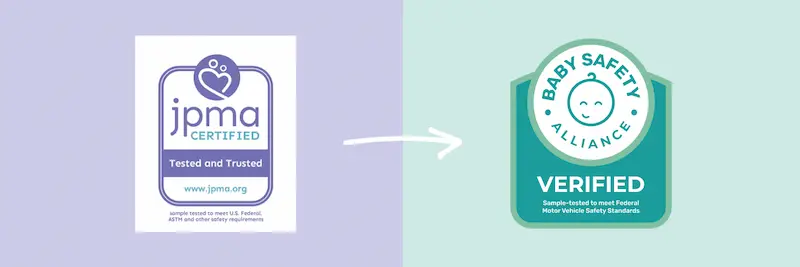
The JPMA Certified seal is one of the most respected voluntary safety certifications in the juvenile products industry. The Juvenile Products Manufacturers Association (JPMA) is a trade organization, and its certification program is a central part of its safety mission. For a product to earn the seal:
- The manufacturer voluntarily submits the product to an independent, JPMA-approved testing laboratory.
- The lab tests it not just to the minimum CPSC rules, but against the relevant voluntary ASTM International safety standard — developed by committees of engineers, doctors, consumer advocates, and industry reps, and often more rigorous than federal regulations.
- The product must pass every requirement of that ASTM standard, which can include tougher stress tests and checks for hazards not covered by law.
- JPMA also runs annual factory audits to ensure certified products keep meeting the standard.
It covers key items like cribs, mattresses, strollers, high chairs, play yards, and bedside sleepers. Choosing a JPMA certified product signals a manufacturer’s commitment to exceeding the legal minimum — an independent expert has verified it meets a higher, consensus-driven standard.
Greenguard & Greenguard Gold: Air Quality
Where JPMA focuses on physical safety (collapse, entrapment, structure), Greenguard focuses on an invisible hazard: the chemical emissions a product releases into the air your baby breathes. Administered by UL Solutions, these voluntary, science-based certifications measure how many volatile organic compounds (VOCs) a product “off-gasses” into a controlled test chamber over time.
The difference between the two levels is the key point of confusion:
- Greenguard: sets emission limits for hundreds of VOCs, suitable for general indoor use (like an office).
- Greenguard Gold: the one that matters for a nursery. It has stricter emission limits tailored for sensitive individuals like children and the elderly, screens for thousands of chemicals including formaldehyde, and tests emissions over time so a product stays low-emitting — not just when new.
This matters because a baby can spend 12 or more hours a day in a crib, breathing a confined micro-environment. A mattress, crib finish, glider, or rug that off-gasses VOCs contributes to poorer indoor air quality. One caution: Greenguard Gold does not mean “organic,” “natural,” or chemical-free — it certifies low airborne emissions. A synthetic product can earn it if its materials are stable, while a “natural” product could fail if its treatments or adhesives off-gas. The non-toxic nursery angle goes deeper on reducing chemical exposure.

Other Common Labels, Demystified
- “ASTM F-XXXX compliant”: ASTM International writes the detailed voluntary technical standards for safety and testing. A claim of “ASTM compliant” means the manufacturer asserts the product meets that standard — but unlike JPMA certification, this is usually a self-declaration with no mandatory third-party verification. A good sign, but it lacks the independent audit.
- OEKO-TEX Standard 100: an independent testing and certification system for textiles. It checks for over 100 harmful substances (pesticides, heavy metals, allergenic dyes) in the fabric itself. Where Greenguard tests what goes into the air, OEKO-TEX tests what’s in the fabric that touches skin — great for mattress covers, sheets, and plush toys.
- GOTS (Global Organic Textile Standard): the premier organic textile standard. To use the logo, a product must contain at least 95% certified organic fibers, and it covers the whole supply chain, including environmental and social criteria. The gold standard for genuinely organic fabric.
- “Made in USA”: a geographic and marketing claim regulated by the FTC for accuracy — not a safety certification. Such a product still must meet CPSC rules, but it doesn’t automatically meet higher voluntary standards.
How to Shop With Confidence
Think of these as layers of protection:
- The legal baseline: any product should meet CPSC standards. Non-negotiable, but assume it.
- Physical safety for critical items: for cribs, mattresses, play yards, and high chairs — where a failure can cause serious injury — prioritize JPMA Certified.
- Air quality for the sleep space: for mattresses, crib finishes, gliders, rugs, and furniture, prioritize Greenguard Gold.
- Material safety for textiles: for anything in prolonged skin contact — mattress covers, sheets, swaddles, clothing — look for OEKO-TEX Standard 100 or, for the highest organic assurance, GOTS.
For a crib and mattress specifically, a quick checklist: the crib is JPMA Certified (confirmed by seal or the JPMA website); the crib and/or mattress is Greenguard Gold; the mattress cover and sheets are OEKO-TEX or GOTS; and the mattress fits snugly, with no more than two finger-widths of gap on any side. Whatever you buy, take the one essential final step — register the product with the manufacturer, since that’s the only way you’ll be directly notified of a recall. Our newborn safety checklist and minimalist baby registry can help you round out the nursery.
Frequently Asked Questions
It’s not legally required, but it’s advisable. All cars must meet federal safety standards, yet some earn higher crash-test ratings; a JPMA certified crib is the equivalent — independently verified to meet a stricter, consensus-based standard.
They address different things. Greenguard Gold verifies low emissions and air quality, which matters given how close your baby breathes to it. “Organic” is a material claim that doesn’t guarantee low emissions from adhesives or fire barriers. The ideal is a mattress that is both.
No — it just means the product is legal to sell, having met the mandatory federal minimum. It’s the baseline every product must clear, not a premium mark. Voluntary certifications like JPMA and Greenguard Gold go beyond it.
Yes. Some companies use unofficial logos or vague wording like “meets Greenguard standards” without actually holding the certification. Always look for the official seal and verify it directly on the certifying body’s website.
“Non-toxic” is an unregulated marketing term with no legal or standardized definition — it can mean whatever the company wants. A verifiable certification like Greenguard Gold or OEKO-TEX provides a tested, science-based definition instead.
Use caution. Never use a crib made before June 2011, when stricter CPSC crib standards took effect. For any older item you can’t verify certification or recall history, so buy new for critical items like cribs and car seats, or only accept hand-me-downs from a trusted source with the model details.
The Bottom Line
The point of understanding these standards isn’t to fear every un-certified product — it’s to shift from passively trusting marketing to actively evaluating safety claims. “Safe” has several dimensions: mechanical, chemical, and environmental. The strongest nursery choices often combine them — JPMA for physical safety, Greenguard Gold for air quality, and OEKO-TEX or GOTS for fabrics. When you see these verifiable, third-party seals, you’re buying the rigorous testing and independent scrutiny behind them, which is exactly what cuts through the noise.
References
- U.S. Consumer Product Safety Commission. Safe Sleep — Cribs.
- Juvenile Products Manufacturers Association. JPMA Certification Program.
- OEKO-TEX. Standard 100 by OEKO-TEX.
- Global Organic Textile Standard. GOTS.