The first time your baby rolls over is a genuine surprise — for both of you. It’s one of the earliest big motor milestones, a sign of real progress in strength and coordination, and the moment your baby stops staying quite where you put them. Here’s when rolling typically happens, how to support it, and — just as important — the safety habits that need to change the day it begins.

The Rolling Timeline: A Range, Not a Deadline
According to the CDC’s developmental milestones, many babies begin rolling from their tummy to their back as early as 4 months. This direction usually comes first, since the momentum of lifting that heavy head during tummy time helps carry them over.
The roll from back to tummy typically follows, often by around 6 months. As the American Academy of Pediatrics notes, this takes more coordinated strength, because the baby has to use their core and neck to initiate the turn without gravity’s help.
The key word is range. Some vigorous babies surprise everyone with an accidental roll at 3 months; others take until 7 months to roll both ways consistently. That variation usually isn’t a concern as long as your baby is showing steady, growing strength and engagement during play. It fits within the broader arc of 4-to-6-month milestones.
What’s Happening Behind the Roll
A roll isn’t a random flop — it’s a coordinated skill that comes together from a few threads:
- Strength. Months of tummy time build the neck muscles to lift and turn the head, the shoulders and arms to push and pivot, and an engaged core to start the movement.
- Neurological wiring. The brain develops bilateral coordination — the two sides of the body working together — plus the balance and spatial awareness to shift weight without toppling.
- The “aha” moment. Strength and wiring sync up, a baby lifting their head shifts their weight a little too far, and suddenly they’ve flipped. That accidental success is a powerful motivator, and they start practicing on purpose.
How to Support Rolling
You’re the coach and cheerleader here, not a personal trainer — the goal is opportunity, not pressure.
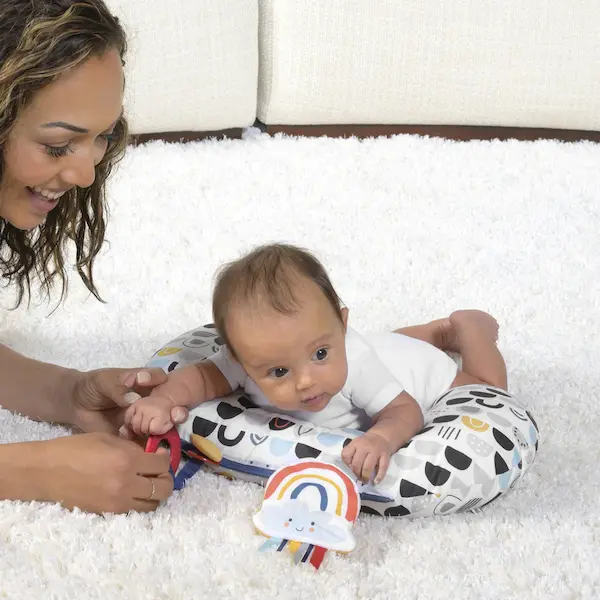
- Prioritize tummy time. It’s the road to rolling. The AAP recommends supervised tummy time from the first day home, building to at least 15–30 minutes total per day by around 7 weeks. If your baby dislikes it, try chest-to-chest reclining, a rolled towel under the armpits for support, or an unbreakable mirror to draw their gaze up.
- Encourage weight shifting and reaching. During diaper changes or play, gently sway their hips side to side to introduce the feeling of weight transfer. Place an interesting toy just to the side of their midline so they reach across their body — that twisting reach is the precursor to a roll.
- Get on the floor and cheer. Demonstrate rolling yourself (they love the show), and when you see them arching or kicking a leg over, offer calm encouragement — your voice is a real motivator.
- Minimize “container” time. Swings, bouncers, and seats have their place, but lots of time in them limits free movement. Give your baby plenty of unrestricted play on a firm, safe surface to explore what their body can do.
Safety Changes the Day Rolling Begins
The day your baby can roll is the day your safety habits level up — you can no longer assume they’ll stay where you left them.
- Never leave them unattended on a raised surface. The moment rolling seems possible, stop using changing tables, beds, or sofas for unsupervised changes or play. Keep a hand on your baby — a roll happens in a blink.
- Stop swaddling. At the first signs of rolling, stop swaddling so your baby’s arms are free to push up and reposition, and switch to a sleep sack instead.
- Re-check sleep safety. If your baby rolls onto their tummy during sleep, the AAP is clear: you don’t need to flip them back once they can roll both ways on their own. But keep safe sleep tight — a firm, flat mattress with a fitted sheet in a bare crib (no pillows, blankets, toys, or bumpers), and always start them on their back.
- Make a safe floor zone. Clear the immediate area of small objects, sharp corners, and unstable furniture, and use a clean play mat in the center of the room.
Frequently Asked Questions
Very common — babies often master the muscle sequence for one direction first and favor that side. Keep encouraging reaching and play from both sides. If a strong preference persists past about 7 months, mention it to your pediatrician to rule out muscle tightness like torticollis.
This is normal — sometimes called “milestone forgetting.” A baby achieves a skill once, then seems to set it aside for a few weeks while their brain works on something else, like babbling or grabbing their feet. The rolling comes back and becomes consistent.
Focus on the overall trajectory: are they pushing up on their arms, bringing hands to the middle, kicking vigorously, and engaged with their surroundings? If so, they may just be on their own schedule. The CDC recommends talking with your pediatrician if your baby shows no attempts to roll in either direction by 6–7 months, or if you have any concerns about muscle tone or strength.
Not really. Hitting motor milestones early tends to reflect temperament (an active, physical baby) and opportunity (lots of floor time) more than future intelligence. All developmental paths are valid.
Yes. Stop swaddling at the first signs of rolling so your baby’s arms are free to push up and reposition. A wearable blanket or sleep sack keeps them warm without restricting movement.
No. Once your baby can roll both ways on their own, the AAP says you don’t need to reposition them if they roll in their sleep. Keep placing them down on their back in a bare crib, and let them settle however they’re comfortable.
The Bottom Line
Rolling over usually lands somewhere between 4 and 6 months, but your baby’s own timeline is the right one. Your job is simpler than it feels: give them safe floor space, plenty of tummy time, and cheerful encouragement, and update your safety habits the moment they start to move. Development isn’t a race — it’s a cascade of skills, each building on the last. Get down on the floor, put a toy just out of reach, and enjoy watching them figure it out.
This article is for general information and is not a substitute for personalized advice from your pediatrician.
References
- Centers for Disease Control and Prevention. CDC’s Developmental Milestones.
- American Academy of Pediatrics (HealthyChildren.org). Movement Milestones: Babies 4 to 7 Months.
- Mayo Clinic. Infant Development: Milestones From 4 to 6 Months.