There’s something about watching your baby experience sunshine for the first time—that momentary squint as they adjust to brightness, the way light catches their eyelashes, the pure joy of warm air on bare skin. Those early outdoor moments become core memories, the ones you’ll pull out years later and hold up to the light.
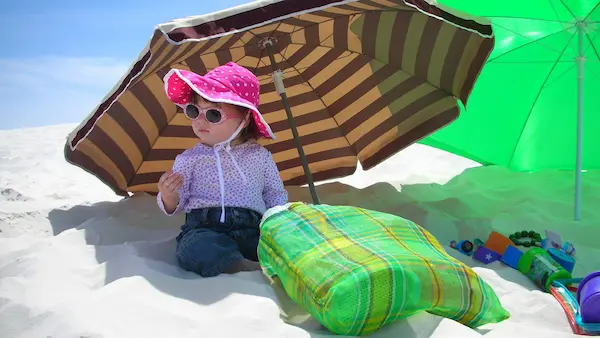
But if you’re a new parent, those precious moments come with a nagging question: How much sun is too much? When do I need sunscreen? Is my baby too young for hats? What about their eyes?
Let me ease your mind with something I wish someone had told me: Sun safety for babies isn’t complicated once you understand a few key principles. And the habits you build now—during these early months—will protect your child for a lifetime.
Why Infant Sun Protection Matters More Than You Think
Before we dive into the how, let’s talk about the why. Understanding what makes baby skin different helps explain why the rules shift in those first months.
The Biology of Baby Skin
Your newborn’s skin is structurally different from yours. It’s thinner—about 20 to 30 percent thinner than adult skin, according to dermatology research. That means protective melanin is spread more thinly. The outer layer (stratum corneum) isn’t fully developed, making it more permeable to everything, including UV radiation and the ingredients in sunscreen.
Babies also have a higher surface-area-to-body-weight ratio. In practical terms, this means they absorb more of anything applied to their skin relative to their body size. Their developing immune and organ systems are less equipped to process unfamiliar substances.
The Lifetime Risk Connection
Here’s the statistic that stops parents mid-thought: A single blistering sunburn during childhood more than doubles the risk of developing melanoma later in life. The Skin Cancer Foundation notes that just five or more sunburns at any age doubles your melanoma risk, but childhood burns carry particular weight because of the cumulative nature of sun damage.
The UV exposure your baby receives in these first years accounts for a significant portion of their lifetime exposure. Protecting them now isn’t just about preventing today’s sunburn—it’s about reducing their total lifetime UV burden and, with it, their skin cancer risk.
Immediate Risks vs. Long-Term Risks
The immediate risks are obvious: sunburn, pain, fussiness, dehydration. But the long-term risks extend beyond cancer. Chronic sun exposure accelerates skin aging and can cause eye damage (cataracts and macular degeneration) decades later. Those baby blues need protection too.
The Golden Rule: Keep Babies Under 6 Months Out of Direct Sun
Let’s start with the non-negotiable foundation of infant sun safety, straight from the American Academy of Pediatrics: For babies younger than 6 months, direct sun exposure should be avoided entirely whenever possible.
This isn’t a suggestion or a guideline you can bend on nice days. It’s the primary protection strategy for the youngest infants.
Why Such a Strict Rule?
Remember that thin, underdeveloped skin we discussed? It doesn’t just absorb more—it also burns faster. A newborn can develop sunburn in minutes that would take an adult half an hour to achieve. Their bodies are also less efficient at cooling themselves, making overheating a parallel concern.
For babies under 6 months, sunscreen is considered a backup plan, not a primary strategy. The AAP’s position is clear: The best sunscreen for a baby under 6 months is a wide-brimmed hat, protective clothing, and shade.
What “Out of Direct Sun” Actually Means
This doesn’t mean you’re confined to the house until your baby turns 6 months old. It means:
- Keeping walks and outings to early morning or late afternoon when UV is lower
- Staying in the shade of trees, umbrellas, or canopies
- Using the stroller canopy strategically
- Planning beach trips for before 10 a.m. or after 4 p.m.
- Checking the UV index and treating any reading above 3 as significant
Sunscreen for Babies: A Comprehensive Guide
Once your baby passes the 6-month mark—or in those unavoidable situations where shade simply isn’t available—sunscreen becomes part of the protection toolkit. But not all sunscreens are created equal, and not all application methods work on a wiggly, uncooperative infant.
Sunscreen for Babies Under 6 Months: What the Guidelines Say
I want to be precise here because this nuance matters. The AAP states that for babies under 6 months, sunscreen should be used only on small areas of skin that can’t be protected by clothing or shade—think the back of the hands, a small area of the face, or the tops of the feet.
If you’re at the beach and your baby is in a shaded tent wearing a UPF outfit and wide-brimmed hat, you don’t need sunscreen. If you’re on a walk and your baby’s feet keep escaping the blanket, a dab of mineral sunscreen on those exposed toes is reasonable.
The key word is “small.” You’re not slathering a newborn. You’re spot-treating areas that genuinely can’t be covered.
Sunscreen for Babies Over 6 Months: Making It a Routine
Once your baby reaches that 6-month milestone, sunscreen becomes a regular part of outdoor preparation—like packing diapers and bringing snacks. Apply it whenever you’ll be outside for more than a few minutes, even on cloudy days.
Mineral vs. Chemical Sunscreens: Why It Matters for Babies
This distinction matters more for babies than for adults. Let me explain the difference clearly.
Mineral sunscreens (also called physical sunscreens) use zinc oxide or titanium dioxide as active ingredients. They sit on top of the skin and act like millions of tiny mirrors, reflecting UV rays away. They start working immediately upon application.
Chemical sunscreens use ingredients like oxybenzone, avobenzone, octinoxate, or octisalate. They absorb into the top layers of skin, where they convert UV radiation into heat, which then dissipates. They require about 15 to 30 minutes to become effective after application.
For babies, mineral sunscreens are strongly preferred for several reasons:
- Minimal absorption: They sit on the skin’s surface rather than being absorbed into the bloodstream.
- Lower irritation risk: They’re less likely to cause allergic reactions or skin sensitivity.
- Immediate protection: No waiting period before going outside.
- Broad spectrum naturally: Zinc oxide and titanium dioxide inherently block both UVA and UVB rays.
The FDA has stated that zinc oxide and titanium dioxide are “generally recognized as safe and effective” for use in sunscreens. The same cannot be said for some chemical filters, which are still under review.
The main downside? Mineral sunscreens can leave a white cast on skin, though newer micronized formulations have improved this significantly. Personally, I’ll take a temporarily pale baby over chemical absorption concerns any day.
What to Look For: SPF, Broad Spectrum, and Water Resistance
When you’re standing in the sunscreen aisle, here’s exactly what to check:
SPF 30 or higher: SPF 30 blocks about 97% of UVB rays. SPF 50 blocks about 98%. The difference is marginal, and no sunscreen blocks 100%. Higher SPFs can tempt people to stay in the sun longer than they should, which increases overall exposure.
Broad spectrum: This means the product protects against both UVA (aging, deeper skin damage) and UVB (burning) rays. Both types contribute to skin cancer risk.
Water resistance: No sunscreen is truly waterproof. They’re either water resistant for 40 minutes or 80 minutes. Check the label, know which you’re buying, and reapply accordingly—especially after swimming or sweating.
Ingredients to Avoid in Baby Sunscreens
Not all sunscreen ingredients belong on baby skin. Here’s what to skip:
Oxybenzone: This chemical filter has been detected in human blood, breast milk, and urine samples. While the clinical significance of this absorption is still debated, the precautionary principle suggests avoiding it in infants when alternatives exist. It’s also a common skin sensitizer.
Octinoxate: Another chemical filter with similar absorption concerns. Additionally, both oxybenzone and octinoxate have been banned in several regions (like Hawaii and Key West) due to their damaging effects on coral reefs.
Retinyl palmitate: A form of vitamin A added to some sunscreens as an antioxidant. Some studies suggest it may speed the development of skin tumors when applied to sun-exposed skin. The precautionary approach: avoid it in baby products.
Fragrances and parabens: Babies have sensitive skin and developing endocrine systems. Fragrance-free, paraben-free formulations reduce the risk of irritation and unnecessary chemical exposure.
How to Apply Sunscreen to a Wriggly Baby
Applying sunscreen to an infant requires strategy. Here’s what works:
Apply indoors: Put sunscreen on 15 to 30 minutes before going outside (for mineral sunscreens, you can go out immediately, but the routine matters). Doing it inside means your baby is calm, not distracted by outside stimuli.
Use enough product: You need about a shot glass full (one ounce) to cover a baby’s entire body. Most parents use far too little. Be generous.
Don’t forget the hotspots: Ears (including backs), feet (tops and soles), backs of knees, back of neck, and any exposed scalp. If your baby has thin hair, the part line needs protection.
Make it a game: For older babies, singing a silly sunscreen song or letting them “help” (hold the bottle, pat the lotion on their own leg) builds cooperation over time.
Have a distraction ready: A toy, a snack, or pointing at something interesting immediately after application helps redirect attention.
Reapply every 2 hours, and after swimming or sweating: Set a timer on your phone. It’s too easy to lose track when you’re having fun.
Protective Clothing: Your Baby’s First Line of Defense
Think of clothing as your baby’s primary sun protection, with sunscreen filling in the gaps that clothing leaves exposed. This mindset shift—clothing first, sunscreen second—changes how you prepare for outdoor time.
UPF Clothing: What It Is and Why It Matters
UPF stands for Ultraviolet Protection Factor. Unlike SPF, which only measures UVB protection, UPF measures protection against both UVA and UVB.
A UPF rating of 50 means the fabric allows 1/50th of the sun’s UV radiation to reach the skin—essentially blocking 98% of rays. UPF 50+ is the highest standard.
Regular cotton t-shirts typically provide about UPF 5 to 8, and that protection drops significantly when the fabric gets wet. UPF clothing maintains its protection even when wet, making it ideal for swimming and water play.
Sun Hats for Babies: Finding the Right One
A good sun hat does more than look adorable (though they certainly do that). Here’s what to look for:
Wide brim, all around: At least 3 inches of brim that shades the face, ears, and back of the neck. Baseball caps leave the ears and neck exposed.
Chin strap: Babies remove hats. It’s what they do. A soft chin strap with a breakaway safety feature keeps the hat on without becoming a strangulation hazard.
UPF rating: Look for fabric with a stated UPF rating. Many baby sun hats are now made with UPF 50+ fabric.
Breathable material: Natural fibers or performance fabrics that wick moisture prevent overheating.
Fit check: The hat should stay in place without being tight. If you can see the top of the ears or the back of the neck peeking out when your baby looks up, the brim isn’t wide enough.

Swimwear and Rash Guards
For water activities, long-sleeved rash guards offer superior protection to traditional swimsuits. They cover more skin, stay in place during movement, and maintain UPF protection when wet.
Look for rash guards specifically labeled with UPF ratings. Many baby swimwear lines now include full-body suits with built-in UPF 50+ protection, covering from neck to ankles.
Regular Clothing That Works
Not every outdoor moment requires specialty UPF gear. Regular clothing can provide decent protection if you choose wisely:
- Darker colors absorb more UV than lighter colors, offering more protection
- Tighter weaves block more UV than loose weaves—hold fabric up to the light; if you can see through it easily, UV can penetrate
- Long sleeves and pants obviously cover more skin than shorts and tank tops
- Dry fabric protects better than wet fabric—change wet clothing when possible
Sunglasses for Babies: Are They Necessary?
Short answer: yes. Long answer: here’s why.
Why Baby Eyes Need Protection
Your baby’s eyes are more transparent to UV light than adult eyes. The lens of an infant’s eye allows more UV radiation to reach the sensitive retina than an adult’s lens does. Cumulative UV exposure over a lifetime contributes to cataracts, macular degeneration, and other eye problems.
The eyes can also sunburn directly—a painful condition called photokeratitis. While temporary, it’s miserable and completely preventable.
What to Look For in Baby Sunglasses
Not all sunglasses provide equal protection. Here’s what matters:
100% UV protection (UVA/UVB): Check the label. “UV400” means the lenses block 99% of UV rays up to 400 nanometers, which covers the full spectrum.
Polycarbonate lenses: These are impact resistant and shatterproof—essential for anything going near a baby’s face.
Wrap-around style: Styles that curve around the face block peripheral UV that straight lenses miss.
Elastic strap: Babies will remove regular earpieces. A soft, adjustable elastic strap keeps sunglasses in place (and serves as a backup if they do manage to get them off).
Flexible frame: Soft, bendable materials prevent injury during inevitable face-grabbing moments.
Getting Baby to Keep Them On
Real talk: Some babies tolerate sunglasses; others wage war against them. Start early, wear sunglasses yourself (modeling matters), and make it part of the outdoor routine. If your baby absolutely refuses, prioritize a wide-brimmed hat that shades the eyes and know that you’re still providing significant protection.
Shade Strategies: Beyond Just Finding a Tree
Shade is your best friend for sun safety, but it has limitations worth understanding.
The Limitations of Shade
Here’s something that surprises many parents: shade reduces UV exposure but doesn’t eliminate it entirely. UV rays reflect off surfaces like sand, water, concrete, and even grass. If your baby is under a tree but sitting on a sandy beach, they’re still getting reflected UV from below and sideways.
This is why shade alone isn’t sufficient—it works best combined with protective clothing and strategic sunscreen use.
Umbrellas and Canopies
Invest in good shade structures:
- Beach umbrellas: Look for UPF-rated fabric and tilt options to adjust as the sun moves
- Pop-up tents: Many are designed specifically for babies and toddlers, with UPF fabric and ventilation panels
- Stroller canopies: Extendable canopies or clip-on umbrella attachments provide moving shade
Stroller Safety: The Blanket Warning
This warning matters enormously: Never cover your baby’s stroller with a blanket or receiving blanket to create shade.
It seems intuitive—drape a blanket over the stroller to block sun—but it creates a dangerous greenhouse effect. Airflow is restricted, temperatures inside the stroller can rise dangerously high, and your baby can overheat rapidly. Infants are less efficient at regulating body temperature than adults.
Instead, use:
- Built-in, extendable stroller canopies
- Clip-on stroller umbrellas specifically designed for this purpose
- Portable fans clipped to the stroller for airflow on hot days
The American Academy of Pediatrics has specifically warned against covering strollers with blankets for this reason.
Timing Your Outdoor Activities
The sun’s intensity varies dramatically throughout the day. Peak UV hours typically run from 10 a.m. to 4 p.m. During these hours, UV levels can be more than double what they are at 8 a.m. or 5 p.m.
Check the UV index on your weather app—it’s often listed alongside temperature and precipitation. Any reading above 3 warrants full protection. Readings above 6 (high) or 8 (very high) mean peak hours should be spent indoors or in deep shade.
Plan beach trips, park outings, and walks for early morning or late afternoon. Your baby will be more comfortable, and you’ll worry less.
Recognizing and Treating Baby Sunburn
Despite our best efforts, sunburns happen. Maybe a cloud cover lifted unexpectedly. Maybe a nap ran long. Maybe you simply miscalculated. If it happens, here’s what you need to know.
What Baby Sunburn Looks Like
Baby sunburn can be harder to spot than adult sunburn because their skin is naturally pinker. Look for:
- Skin that’s noticeably warmer to the touch than covered areas
- Redness that doesn’t blanch (turn white) when pressed
- Fussiness or crying when the area is touched
- In severe cases, blistering or peeling
- Possible fever, chills, or lethargy with extensive burns
Immediate First Aid for Sunburn
If you suspect sunburn:
Get out of the sun immediately. This seems obvious, but sometimes parents don’t connect the dots right away. Move indoors or into deep shade.
Cool compresses or a lukewarm bath: Apply cool (not cold) compresses to the burned areas. A lukewarm bath can soothe larger areas. Avoid cold water, which can cause shivering and further discomfort.
Hydrate: Sunburn draws fluid to the skin surface and away from the rest of the body. Offer extra breastmilk or formula to prevent dehydration.
Moisturize: Apply a fragrance-free moisturizer or aloe vera gel to soothe the skin. Avoid products containing alcohol, which can sting and dry further.
Pain relief if needed: For significant discomfort, acetaminophen or ibuprofen (age and weight appropriate) can help. Check with your pediatrician for dosing.
Leave blisters intact: If blisters form, don’t pop them. They’re the body’s natural protective bandage. Popping increases infection risk.
When Sunburn Requires Medical Attention
Call your pediatrician or seek medical care if:
- Your baby is under 1 year old with any sunburn (their skin is too delicate to take chances)
- Blistering covers a significant area
- Your baby has a fever over 100.4°F (38°C)
- There are signs of infection: increasing redness, swelling, pus, or red streaks
- Your baby seems lethargic, confused, or is refusing fluids
- You notice signs of dehydration: fewer wet diapers, dry mouth, no tears when crying
Sun Safety for Special Situations
Different environments require different strategies. Here’s how to adapt.
At the Beach or Pool
Water intensifies everything. Sand and water reflect up to 80% of UV rays, meaning you’re getting hit from above and below. Key adjustments:
- Use water-resistant sunscreen (80-minute rating preferred)
- Reapply immediately after toweling off—even if the bottle says 80 minutes, towel drying removes protection
- Rinse off after swimming to remove salt or chlorine, which can irritate skin
- Pop-up tents provide essential sand-free shade
- UV-protective swimwear makes a dramatic difference
In the Snow
Winter sun safety matters too. Snow reflects up to 80% of UV rays—similar to water. High altitudes (think ski trips) increase UV exposure by 4 to 5% per 1,000 feet of elevation.
If you’re taking a baby into snowy environments (carefully, with appropriate bundling), remember:
- Sunglasses are essential—snow glare is intense
- UPF clothing still matters under the layers
- Lip balm with SPF protects delicate lips
- The same timing principles apply: avoid peak hours
On Cloudy Days
Up to 80% of UV rays penetrate cloud cover. You can absolutely get sunburned on an overcast day. If you’ll be outside for more than brief periods, follow the same protection protocols as sunny days.
In the Car
Car windows block most UVB rays (the burning rays) but allow significant UVA rays (the aging, deeper-damage rays) to pass through. For short trips around town, this isn’t a major concern. For longer road trips, consider:
- Window shades that block UV (many are now rated for sun protection)
- UPF clothing for babies who’ll be in the car seat for hours
- Keeping in mind that side windows offer less protection than windshields (which are often treated to block more UV)
Modeling Sun Safety: Setting Your Child Up for Life
Here’s something parenting books don’t always emphasize: your children learn from watching you. If sunscreen is a rushed, miserable experience that you complain about, they’ll absorb that attitude. If you model sun safety as a normal, non-negotiable part of outdoor life, they’ll internalize it.
Make It a Family Routine
- Apply sunscreen together—you do yours while they watch, then you do theirs
- Wear your own hats and sunglasses
- Seek shade as a family during peak hours
- Talk about sun safety in positive terms: “We’re protecting our skin so we can play outside for a long, long time!”
The Long Game
The habits you build now—the hat that goes on automatically, the sunscreen in the diaper bag at all times, the instinct to check the UV index—will become second nature. By the time your baby is a toddler, then a child, then a teenager making their own choices, these habits will be deeply ingrained.
You’re not just preventing today’s sunburn. You’re teaching your child that their skin matters, that their health is worth protecting, and that taking care of yourself is just what you do.

Frequently Asked Questions About Baby Sun Safety
Can I use last year’s sunscreen on my baby?
Check the expiration date. Sunscreen ingredients degrade over time, and expired products won’t provide labeled protection. If it’s expired, toss it and buy fresh. If it’s been stored in a hot car all summer, replace it regardless of the date—heat degrades sunscreen.
What’s the difference between baby sunscreen and regular sunscreen?
Often, not much besides marketing. Some baby-specific sunscreens are formulated with fewer chemical filters and more mineral options, and they’re typically fragrance-free. But always check the ingredient list rather than relying on “baby” labeling.
My baby has eczema. How do I handle sun protection?
Mineral sunscreens (zinc oxide, titanium dioxide) are generally better tolerated than chemical options on sensitive skin. Test a small area first. UPF clothing becomes even more valuable since it requires no skin contact. Consult your pediatrician or dermatologist for specific recommendations.
Can babies wear sunscreen on airplane flights?
Yes, if you’ll be near windows with significant sun exposure. At cruising altitude, UV exposure can be higher due to thinner atmosphere. Window shades usually block UV, but if your baby is by a window and the shade is up for an extended period, protection is reasonable.
How do I get sunscreen off my baby at the end of the day?
A warm bath with mild, fragrance-free baby soap usually does the trick. Mineral sunscreens can be stubborn—using a small amount of baby oil on a cotton ball can help break down stubborn residue, followed by regular bathing.
What if my baby hates wearing a hat?
Keep trying different styles—some babies prefer bucket hats, others respond better to caps with neck flaps. Use hats consistently from birth so they become normal. If hats remain impossible, focus extra attention on sunscreen for the face and ears, and use the stroller canopy strategically.
Is spray sunscreen safe for babies?
Generally not recommended. Spray sunscreens can be inhaled, making it hard to control how much gets into lungs. They also make even coverage difficult—it’s easy to miss spots. Stick with lotions for babies. If you must use spray in a pinch (traveling, desperate situation), spray it into your hands first, then apply to baby.
Do I need to worry about vitamin D if I’m using sunscreen constantly?
Vitamin D is important, but the amount of sun exposure needed to generate adequate vitamin D is much less than the amount that causes sun damage. Most infants get sufficient vitamin D through breastmilk (with supplements) or formula. The AAP recommends vitamin D supplements for all breastfed infants regardless of sun exposure. Talk to your pediatrician about your baby’s specific needs.
A Final Word for Parents
Be gentle with yourself as you navigate this. Sun safety adds one more item to the endless mental checklist parents carry: diapers, wipes, extra clothes, snacks, sunscreen, hats, sunglasses, shade source. It’s a lot.
But here’s the thing about these early months and years: they’re not just about keeping your baby safe in the moment. They’re about building a foundation. Every time you reach for that hat, every time you set up the beach umbrella, every time you model putting on your own sunscreen—you’re teaching your child that their body matters. That protection is an act of love. That enjoying the outdoors and caring for yourself can happen together.
So pack the sunscreen. Buy the silly wide-brimmed hat with the chin strap. Sit in the shade and watch your baby discover the wonder of sunlight filtering through leaves. These are the moments you’re protecting.
And you’re doing a beautiful job.