The journey to your baby’s first word is one of the most exciting parts of early parenthood. That milestone doesn’t appear out of nowhere—it’s the result of months of invisible work, building neural pathways that begin forming long before birth. As expecting parents and new caregivers, you have a remarkable opportunity to actively nurture this development through simple, evidence-based interactions known as language skill boosters.

This comprehensive guide will walk you through the science and practice of boosting language skills from the prenatal period through your baby’s first year. We’ll translate developmental research into practical strategies you can use every day, turning ordinary moments into powerful opportunities for growth.
Part I: Prenatal Foundations – The First Language Classroom
Many parents are surprised to learn that language development begins in the womb. According to the Mayo Clinic, your baby’s auditory system starts developing early, with the ability to detect sounds beginning around 18 weeks of gestation. By the third trimester, your baby can hear your voice clearly, distinguish between different sounds, and even show preferences for certain patterns of speech and music.
Why Prenatal Exposure Matters
The womb provides the first language environment. While your baby isn’t “learning words” in the traditional sense, they’re absorbing the rhythm, melody, and patterns of language—what linguists call the “prosody” of speech. Research indicates that newborns recognize and show preference for their mother’s voice, and can even recognize stories or songs they heard repeatedly in utero.
This prenatal exposure creates neural pathways that will later support actual language comprehension and production. Think of it as preparing the soil before planting seeds—you’re creating a brain environment ready to process and produce language efficiently.
Practical Prenatal Language Skill Activities
1. Conversational Connection
Make talking to your bump a regular habit. Narrate your day, share your thoughts, or describe what you’re doing. This isn’t about teaching vocabulary but about exposing your baby to the natural flow of your speech patterns.
2. Musical Moments
Play music regularly, especially pieces with clear melodic lines. Singing to your baby—whether lullabies or your favorite songs—provides rich auditory stimulation. Studies suggest that musical patterns engage similar neural pathways to those used in language processing.
3. Shared Reading Rituals
Choose a few favorite children’s books and read them aloud regularly. The repetition helps your baby become familiar with specific speech patterns. According to the American Academy of Pediatrics, this early exposure to the rhythms of language supports later literacy skills.
4. Partner Involvement
Encourage your partner or other family members to regularly talk and sing to your bump. This helps your baby become familiar with multiple voices and speech patterns, broadening their auditory experience.
5. Mindful Communication
Pay attention to your own speech patterns. While you don’t need to modify how you speak, being aware that you’re providing your baby’s first language exposure can make these interactions more intentional and meaningful.
Part II: The First Year – Month-by-Month Language Skill Boosters
The first year after birth represents an extraordinary period of language development. Your baby progresses from reflexive sounds to intentional communication, building the foundation for speech. Here’s how you can support this journey with targeted language development activities for infants.
Newborn to 3 Months: Building Connection
Key Milestones (CDC Guidelines):
- Startles at loud sounds
- Quiets or smiles when spoken to
- Makes cooing sounds
- Cries differently for different needs
- Begins to make vowel sounds
Top Language Skill Boosters for This Stage:
1. The Power of Parentese
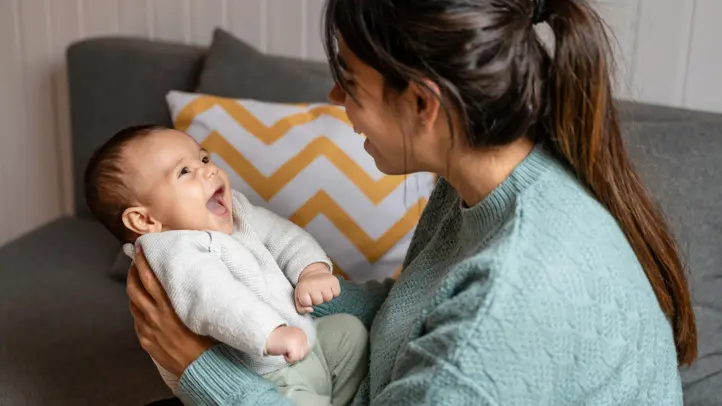
Use “parentese”—that musical, higher-pitched, exaggerated way of speaking that comes naturally to most caregivers. Research shows infants pay more attention to this style of speech, which highlights the sounds and patterns of language.
2. Face-to-Face Interaction
Hold your baby 8-12 inches from your face—their ideal focal distance—and make eye contact while talking. Let them watch your mouth movements and facial expressions.
3. Responsive Sound Games
When your baby coos or makes sounds, pause, make eye contact, and respond. This “serve and return” interaction, emphasized by the AAP, teaches the basic structure of conversation.
4. Environmental Narration
Talk about what you’re doing as you go through daily routines: “Now I’m changing your diaper. Let’s get a fresh one. Oh, what a clean baby!”
5. Gentle Singing
Sing simple songs during caregiving activities. The predictable patterns help your baby anticipate what comes next, building early prediction skills.
4 to 6 Months: Discovering Sounds
Key Milestones (CDC Guidelines):
- Responds to changes in tone of voice
- Begins babbling with consonant sounds (“b,” “m”)
- Makes sounds to show joy or displeasure
- Turns head toward sounds
Best Activities for Infant Language Growth:
1. Sound Imitation Games
When your baby says “ba-ba,” respond with “ba-ba-ba!” This reinforces their vocal attempts and demonstrates the social aspect of communication.
2. Object Labeling
Hold up objects and name them clearly: “Ball. This is a red ball.” Keep it simple and consistent.
3. Interactive Reading
Choose books with bright pictures and simple text. Point to images as you name them: “I see a dog! The dog says woof-woof.”
4. Cause-and-Effect Sounds
Use toys that make sounds when manipulated. Verbally connect the action with the result: “You shook the rattle! Shake-shake-shake!”
5. Body Part Games
Gently touch your baby’s nose, ears, or toes while naming them: “Here’s your nose! There’s your toe!”
7 to 9 Months: Intentional Communication
Key Milestones (CDC Guidelines):
- Understands “no”
- Responds to name
- Uses gestures like waving and pointing
- Has a wider range of sounds and syllable strings
Early Language Development Strategies:
1. Gesture Reinforcement
When your baby points or reaches, verbally acknowledge the gesture: “You’re pointing to the cup! You want your cup?”
2. Simple Choice Offering
Hold up two items: “Do you want the apple or the banana?” Observe their response and verbally acknowledge it.
3. Action Songs with Movements
Songs like “Itsy Bitsy Spider” or “Pat-a-Cake” that pair words with actions help connect language to meaning.
4. Hide-and-Find Games
Hide a toy under a cloth while saying, “Where did the ball go?” Then reveal it with, “There it is!” This builds object permanence and anticipation.
5. Expansion Technique
When your baby says “ba” for ball, respond with the complete word: “Yes, ball! That’s your blue ball.”
10 to 12 Months: Preparing for Words
Key Milestones (CDC Guidelines):
- Follows simple commands with gestures
- Says “mama” and “dada” specifically
- Tries to imitate words
- Uses exclamations like “uh-oh”
How to Improve Baby Communication Skills:
1. One-Word Emphasis
Simplify your language to highlight key words: Instead of “Do you want to play with this big red ball?” try “Ball! You want the ball.”
2. Following Their Lead
Talk about what captures your baby’s attention. If they’re looking at a dog, that’s your conversation topic.
3. Pretend Play Introduction
Offer a toy phone and say “Hello!” or pretend to feed a doll. This builds symbolic thinking—the understanding that objects and actions represent real things.
4. Routine Reinforcement
Use consistent phrases during daily activities: “All done!” “Time for bath!” “Let’s get dressed!”
5. Celebrating Attempts
Cheer when your baby tries new sounds or approximations of words. Your enthusiasm encourages further attempts.
Essential Questions About Language Development
What are the most effective language skill boosters for a 3-month-old?
For a 3-month-old, the most effective boosters are responsive talking (acknowledging their sounds with your words), face-to-face interaction using parentese, and gentle singing during caregiving routines. The World Health Organization emphasizes that responsive caregiving in these early months creates a secure foundation for all development.
How does reading to a newborn actually help?
Reading to a newborn exposes them to the rhythm and melody of language long before they understand words. According to the AAP, this early exposure builds neural connections that support later language comprehension and literacy skills. It also establishes reading as a comforting, bonding activity.
Is screen time ever beneficial for infant language development?
The AAP recommends avoiding screen time (other than video chatting) for children under 18-24 months. Research consistently shows that infants don’t learn language effectively from screens. Real human interaction—with its responsive timing, eye contact, and emotional connection—provides what screens cannot: authentic serve-and-return interactions essential for brain development.
What’s the difference between “parentese” and unhelpful “baby talk”?
“Parentese” is proper language delivered with exaggerated melody, slower pace, and higher pitch—it maintains correct grammar and real words. Unhelpful “baby talk” typically involves made-up words (“owie-boo-boo”) or incorrect grammar. Parentese helps highlight language structure; nonsensical baby talk does not.
How can I tell if my baby’s language development is on track?
Track development using the CDC’s milestone checklists. Generally, you should see progression from crying to cooing (2-3 months), cooing to babbling (4-6 months), babbling to gesturing (7-9 months), and gestures to first words (10-12 months). Regular well-child visits with your pediatrician provide professional assessment opportunities.
What are signs of a potential speech or language delay?
Consult your pediatrician if your baby, by 12 months:
- Doesn’t babble with consonant sounds
- Doesn’t use gestures like pointing or waving
- Doesn’t respond to their name consistently
- Shows no interest in interactive games like peek-a-boo
- Doesn’t attempt to imitate sounds or actions
The CDC’s “Learn the Signs. Act Early.” program provides detailed guidelines and emphasizes that early intervention is most effective.
The Heart of Language Development: Relationship Before Vocabulary
The most important insight from decades of developmental research is this: Language grows from relationship. Your consistent, loving attention provides more than just words—it provides the emotional security that makes learning possible.
Every conversation, every song, every story you share builds more than vocabulary. It builds connection. It tells your baby, “Your sounds matter. Your attempts at communication are important. I am here, listening and responding.”
The true language skill boosters aren’t complicated techniques or expensive products. They’re the daily moments of attention: pausing to make eye contact when your baby coos, describing the world as you see it together, following their gaze and putting words to their interests.
As you implement these strategies, remember that variation in development is normal. Some babies gesture extensively before making sounds; others experiment with sounds for months before using clear gestures. What matters most is the overall progression and the quality of your interactions.
You are your child’s first and most important language teacher. Trust the process, enjoy the journey, and know that in these simple daily interactions, you’re giving your child gifts that will last a lifetime: the ability to communicate, to connect, and to understand their world.
Sources:
- American Academy of Pediatrics. “Early Literacy.”
- Centers for Disease Control and Prevention. “Important Milestones: Your Baby By One Year.”
- World Health Organization. “Improving Early Childhood Development.”
- Mayo Clinic. “Infant development: Birth to 3 months.”
- American College of Obstetricians and Gynecologists. “Nutrition During Pregnancy.”