Your baby will spend more time in their crib than anywhere else in the first year, so it’s worth getting the setup right — and the reassuring news is that a safe crib is a simple one. Most of the products marketed for comfort or better sleep are exactly what safe-sleep guidance tells you to leave out. Here’s what the crib itself needs to meet, how to set up the sleep space, and how safety shifts as your baby grows — with the reasoning behind each rule.
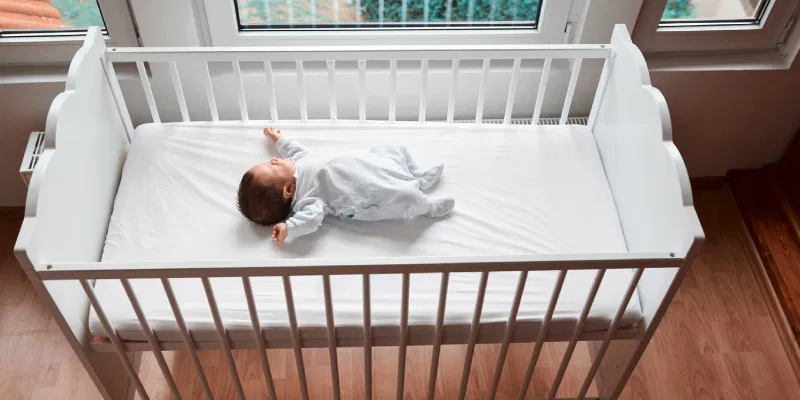
This is a crib-specific companion to our broader guides on the safe sleep principles and the wider sleep environment — here the focus is the crib’s construction, the bare-crib rule, and how the setup changes over time.
The Golden Rule: Back to Sleep, Firm and Flat
Every other guideline flows from one principle. Since the American Academy of Pediatrics’ 1992 “Back to Sleep” campaign (now Safe to Sleep), this single recommendation has cut Sudden Infant Death Syndrome (SIDS) by more than half.
- Always place your baby on their back for every sleep — naps and nighttime — which keeps the airway open.
- Never start a baby on their side or stomach. Once they can roll both ways on their own (around 6 months), you don’t need to reposition them if they roll in their sleep — but you still always start them on their back.
- The surface must be firm and flat — it shouldn’t indent around your baby’s head. Inclined sleepers, pillows, and soft mattresses can let the chin tuck to the chest and block the airway (positional asphyxia).
The Crib and Mattress: Structure and Standards
- A modern, compliant crib. Use one meeting current U.S. Consumer Product Safety Commission (CPSC) standards (a JPMA certification seal is a good sign). Avoid hand-me-downs made before June 2011, which may have dangerous drop-side mechanisms, wider slats, or lead paint. Our guide to baby product safety standards explains the certifications.
- Slat spacing no more than 2⅜ inches (about a soda can’s width), so a baby’s head can’t get trapped.
- Corner posts flush with the end panels (or very tall, like a canopy). Posts or knobs sticking up a little can catch clothing or pacifier strings — a strangulation risk.
- A firm mattress with a snug fit. Press the center and edges — it should spring back, not mold to your hand. You shouldn’t fit more than two fingers between the mattress and the crib frame on any side. Use only a fitted sheet made for that mattress.
- Assemble it carefully using only the provided hardware, and re-tighten bolts periodically, since cribs loosen with use.
A Bare Crib Is a Safe Crib
This is the most important — and most misunderstood — part. The crib should hold nothing but your baby:
- No pillows, cushions, or pillow-like toys.
- No blankets, quilts, or comforters — these are suffocation hazards.
- No bumper pads of any kind, including padded, vertical, and mesh versions. Crib bumpers are now federally banned in the U.S. under the Safe Sleep for Babies Act — they pose suffocation, strangulation, and entrapment risks and serve no safety purpose, since modern slat spacing already prevents limb entrapment.
- No stuffed animals or loose toys for a baby under 12 months.
- No sleep positioners, nests, or pods — these aren’t approved for safe sleep.
What’s safe to add: a wearable blanket (sleep sack) is the safe alternative to a loose blanket — sized correctly, with no hood or loose fabric. A pacifier at naps and bedtime is associated with a lower SIDS risk; if it falls out you don’t need to reinsert it, and never attach it with a string or clip. A small, breathable lovey or security blanket can be introduced only after the first birthday, once the SIDS risk has dropped and your child can move it off their face.
The Surrounding Environment
- Room-share, don’t bed-share. The AAP recommends your baby sleep in your room on their own separate approved surface (crib or bassinet) for at least the first 6 months, ideally a year — which can cut SIDS risk substantially. Bed-sharing on an adult bed is strongly discouraged due to suffocation, entrapment, and overlay risks. Safe sleep applies at night feeds too: feed, then return your baby to their own surface.
- Don’t overheat. Dress your baby lightly (a onesie plus a sleep sack); the room should feel comfortable for a lightly clothed adult. Keep the crib away from vents, heaters, and direct sun.
- Mind the cords. Position the crib away from windows, blinds, curtains, and electrical cords, and secure any nearby cords out of reach.
As Your Baby Grows
- Bassinets and portable cribs follow the same “bare is best” rules — JPMA certified, and only the mattress or pad that came with it (never add padding).
- Lower the mattress to its lowest setting as soon as your baby starts pushing up on hands and knees (or reaches about 35 inches tall), to prevent falls.
- Move to a toddler bed when your child starts climbing out (often 18–36 months). Don’t use crib tents or other after-market add-ons meant to keep a child in — they pose entanglement and strangulation hazards.
Frequently Asked Questions
It can be, but inspect it like a detective. It should be a fixed-side crib made after June 2011 (check the date stamp), with all original hardware and instructions, and no cracks, splinters, or loose joints. When in doubt, buy new.
No bumpers of any kind — crib bumpers are now federally banned in the U.S. Mesh versions can still pose a strangulation risk if they come loose, and they give a false sense of security. A bare crib is the safe choice.
It looks uncomfortable but usually isn’t dangerous — babies have flexible joints and free themselves. It’s a far smaller risk than the proven suffocation hazard of bumper pads, so leaving the crib bare is still safest.
Use layers of fitted clothing plus a wearable blanket or sleep sack rated for the room temperature. It’s the safest and most effective method — and take care not to overheat your baby.
Not until your child is at least 18–24 months old and has moved to a toddler bed. Even then, choose a small, firm toddler pillow and a thin, breathable blanket. The crib itself should stay bare for as long as it’s in use.
Lower the mattress to its lowest position once your baby can push up on hands and knees or reaches about 35 inches. Move to a toddler bed when they start trying to climb out — and skip crib tents, which aren’t safe.
The Bottom Line
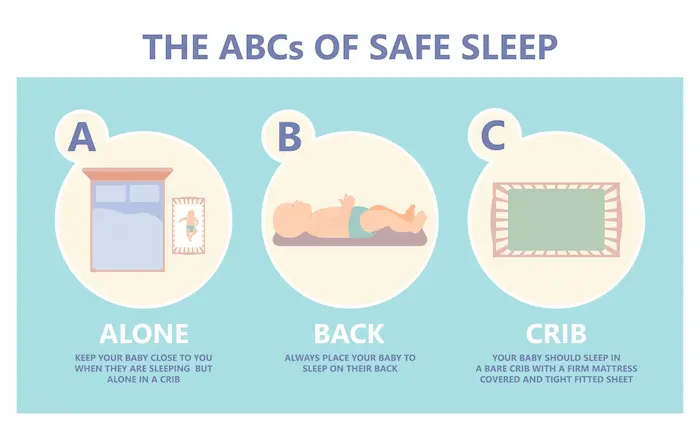
In a market full of products promising comfort and better sleep, the strongest safety tool is simplicity. The safest crib is minimalist: a modern, well-built frame, a firm and snugly fitting mattress, a fitted sheet, and your baby placed on their back. Keep the ABCs in mind — Alone, on their Back, in a Crib — and share these rules with every caregiver, since consistency is what makes them work. Choosing a bare crib isn’t depriving your baby of comfort; it’s giving them a proven-safe place to sleep.
This article is for general information and is not a substitute for personalized advice from your pediatrician.
References
- American Academy of Pediatrics (HealthyChildren.org). Safe Sleep.
- Safe to Sleep® (NICHD). Safe Infant Sleep.
- U.S. Consumer Product Safety Commission. Safe Sleep — Cribs.