The most sophisticated learning tool in your home isn’t a gadget — it’s play. To a child, play isn’t a break from learning; it’s the work of childhood itself. Through play, babies, toddlers, and preschoolers wire their brains, building the architecture for future thinking, problem-solving, creativity, and emotional resilience. Choosing toys, then, isn’t really about entertainment — it’s about supporting your child’s development. This guide connects specific kinds of play and toys to the milestones unfolding in your child’s mind, age by age, and pairs naturally with our month-by-month milestones guide.
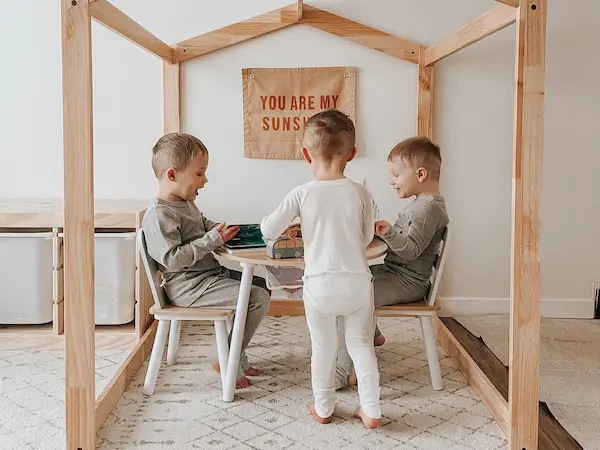
Why Play Is Serious Brain Work
When a baby bats at a mobile, a toddler stacks blocks, or a preschooler turns a cardboard box into a spaceship, the brain is firing at an astonishing rate. Play is the primary vehicle for cognitive development — a full-brain workout that strengthens neural pathways, keeping the connections a child uses often and letting unused ones fade. That process builds several critical foundations:
- Executive function — working memory, flexible thinking, and self-control, honed through games with rules, turn-taking, and complex pretend play.
- Sensory integration — learning to process sights, sounds, touch, and movement together, which hands-on sensory play with sand, water, or textured objects supports.
- Social-emotional skills — empathy, negotiation, and reading social cues, built through cooperative and side-by-side play.
- Problem-solving and creativity — figuring out how a puzzle piece fits, or inventing a new use for a blanket, fosters flexible thinking and persistence.
You Are the Most Important “Toy”
Before any object, one principle matters most: the most powerful catalyst for your baby’s development is you. Human interaction is irreplaceable. The back-and-forth of peek-a-boo teaches object permanence, narrating your day builds language circuits, and singing songs with gestures links movement to memory. A loving, responsive caregiver is the secure base from which all exploration springs — no toy can replicate that. Think of anything you buy as a tool to enhance this primary relationship, not a substitute for it.
The Age-by-Age Guide to Brain-Building Play
Newborn to 6 Months: Building Sensory Awareness
In these first months, your baby’s brain is mapping a new world of sensations. Vision is still blurry, so hearing and touch are the key learning channels, and mouthing is a primary way infants explore texture, shape, and temperature. The developmental focus is visual tracking (especially high-contrast patterns), early cause and effect (“I cry, and I’m comforted”), discovering their own body, and recognizing familiar faces and voices.
Toys that help, and why: high-contrast (black, white, red) cards and mobiles are easier for developing eyes to see and stimulate visual focus; a baby-safe unbreakable mirror draws babies to faces and supports self-recognition; soft rattles and easy-to-grasp toys encourage the palmar grasp and introduce cause and effect through sound; and a play gym or activity mat invites reaching, batting, and eventually rolling. Keep it simple — one or two items at a time avoids overstimulation. Make sure everything is too large to fit through a toilet-paper tube (a quick choke-hazard test), with secure seams and non-toxic materials.
6 to 12 Months: Cause, Effect, and Problem-Solving
Mobility changes everything. As your baby learns to sit, crawl, and cruise, play becomes intentional and experimental, and the focus shifts to cause and effect (press a button, something happens), solidifying object permanence, early problem-solving (reaching an out-of-reach toy), and imitating simple actions.
Toys that help, and why: stacking cups and nesting bowls teach size relationships and object permanence (and are great in the bath or sandbox); a simple shape sorter is a problem-solving powerhouse that builds spatial awareness; push and pull toys support gross-motor coordination once your baby is on the move; and an activity cube with dials, doors, and buttons packs several cause-and-effect experiences into one toy. Keep up vigilant choke-hazard checks, make sure push toys are stable, and avoid sharp edges or pinch points. This is also the stage to plan for mobility — our crawling guide covers how to encourage it safely.
1 to 2 Years: Independence and Symbolic Thought
The toddler brain is a whirlwind. Language explodes, symbolic play emerges (a block becomes a phone), and steadier hands allow more complex manipulation. Offer open-ended toys with no single “right” answer, and embrace the mess of sensory exploration.
Toys that help, and why: large wooden building blocks are the ultimate open-ended toy — they teach balance and spatial reasoning and become anything in pretend play; simple knobbed puzzles (2–12 pieces) build visual-spatial skills and patience; pretend-play sets (toy phone, doll, kitchen or tool items) let toddlers imitate the world, a key step in cognitive and social growth; and a sensory bin (dried beans or rice with cups and spoons, closely supervised) offers endless tactile and fine-motor practice. Watch for small parts, keep sensory materials non-toxic with constant supervision, and choose sturdy toys that survive throwing and banging.
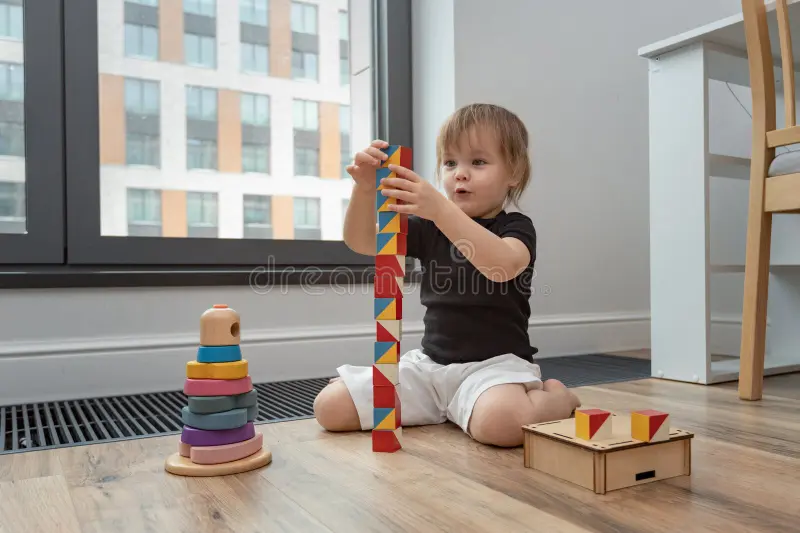
2 to 3 Years: Pretend Play and First Rules
This is the golden age of imagination. Play becomes narrative-driven and more social, and the brain can hold more complex ideas and follow simple rules — expect multi-scenario pretend play, early counting, the ability to follow 2–3 step instructions, and the beginnings of cooperative play.
Toys that help, and why: dress-up clothes and props allow full immersion in symbolic play, building narrative skills and empathy; interlocking building sets (large blocks or magnetic tiles) foster early engineering thinking; play-dough or modeling clay strengthens hand muscles for future writing and supports sensory regulation; and simple first board games teach turn-taking, rule-following, and how to handle winning and losing — all executive-function skills. Avoid costumes with long loose ties, keep monitoring for small parts, and choose non-toxic, washable art supplies.
3 to 5 Years: Refining Skills and Abstract Thinking
The preschooler is gearing up for the academic world, with play that’s more elaborate, rule-based, and logical — mastering early literacy and math concepts, more sophisticated reasoning, cooperative play with assigned roles, and an understanding of sequence and planning.
Toys that help, and why: construction sets with smaller parts (interlocking bricks, train tracks) demand planning, fine-motor precision, and persistence; open-ended art supplies (child-safe scissors, glue, assorted materials) foster creativity and a sense of mastery; dramatic-play centers (a play kitchen, doctor’s kit, or market stand) drive complex social negotiation and language; and memory, matching, and simple strategy games boost recall, attention to detail, and deductive reasoning. Teach and supervise safe scissor use, mind small parts around younger siblings, and match game complexity to their age to avoid frustration.
Too Many Toys — and the Screen-Time Question
More isn’t better. Research suggests that too many toys can overwhelm a child, shorten attention span, and stifle creativity — with fewer toys available, children tend to play more deeply and inventively with each one. When it comes to screens, the American Academy of Pediatrics offers clear guidance: avoid digital media other than video chatting for children under 18–24 months; for ages 2–5, limit high-quality programming to about an hour a day and co-view to help them understand what they’re seeing. Passive screen time can’t provide the rich, multi-sensory, physically active feedback of handling real 3D objects, feeling textures, and interacting with people — so prioritize hands-on, screen-free play for cognitive growth.
Creating a Brain-Boosting Play Space
- Rotate toys: keep a small selection (8–10 items) accessible and store the rest, rotating weekly to keep novelty and interest high.
- Create play zones: defined areas for reading, building, pretend play, and art help organize a child’s thinking.
- Follow their lead: notice what your child gravitates to and build on it — lining things up invites patterning games; a dinosaur obsession invites books, figurines, and a small-world “dinosaur land.”
- Allow boredom: boredom is the precursor to creativity. Resist the urge to constantly entertain — self-directed, imaginative play often emerges from it.
When to Check In With a Professional
Children develop at their own pace, but a consistent lack of interest in play or interaction can be worth discussing. Consult your pediatrician or a child-development specialist if, by around 18 months, your child doesn’t engage in any pretend play, shows no interest in toys or other children, has extreme difficulty with changes in routine or shows very repetitive and inflexible play, or doesn’t try to copy your actions or join simple interactive games. Early intervention is powerful — trust your instincts, and use the CDC’s developmental milestone checklists as a guide.
Frequently Asked Questions
Not really. Babies are drawn to lights and sounds, but overly complex electronic toys can overwhelm and often do the “thinking” for the child. Simple toys that respond directly to your baby’s action — a rattle that sounds when they shake it — are more effective for learning cause and effect. Hands-on exploration and human interaction beat gadgets for early learning.
The AAP strongly recommends against infant walkers. They’re a significant injury hazard, they don’t help babies walk sooner, and they can actually interfere with the muscle development and mechanics of walking. Safer options are a stationary activity center for short periods, or a sturdy push toy once your child is already pulling to stand.
The AAP advises avoiding digital media other than video chat before 18–24 months. For ages 2–5, limit high-quality programming to about an hour a day and watch together. Screen time can’t replace the hands-on, multi-sensory play that builds cognitive skills.
Open-ended toys that grow with your child — like simple wooden blocks — are hard to beat. They have no single “right” way to play, so they keep challenging a child across ages and invite creativity, problem-solving, and pretend play. Often the humble cardboard box wins, too.
Completely — and it’s a good sign. A box is the ultimate open-ended toy: it can be a car, a castle, or a cave. It shows their imagination is doing the work, which is exactly what you want. Follow that lead rather than steering them to the pricier item.
The Bottom Line
Choosing good developmental toys is less about buying the latest trend and more about understanding the learner in front of you. The best toy matches your child’s stage, challenges them just enough, and invites interaction — with the world and with you. It’s open-ended, safe, and fun. A cardboard box can be a castle, a spaceship, or a race car in the hands of a child whose imagination has been nurtured. By focusing on safety, simplicity, and responsive interaction, you’re not just filling a toy box — you’re stocking the workshop where your child’s mind, creativity, and confidence are built, one joyful moment at a time.
This article is for general information and is not a substitute for personalized medical advice.
References
- American Academy of Pediatrics. The Power of Play: How Fun and Games Help Children Thrive.
- American Academy of Pediatrics. Media and Young Minds.
- American Academy of Pediatrics (HealthyChildren.org). Baby Walkers: A Dangerous Choice.
- Centers for Disease Control and Prevention. Developmental Milestones.
- Zero to Three. The Importance of Play in Early Childhood.