Every birth story is unique. Many people picture a straightforward vaginal delivery, but labor is a dynamic process, and sometimes a parent and baby need a helping hand to finish it safely. That’s where assisted delivery — also called operative vaginal delivery — comes in. These procedures aren’t a sign of failure; they’re skilled, strategic tools that an obstetrician uses during specific challenges in the second stage of labor (when you’re fully dilated and pushing) to protect the well-being of both you and your baby.

The words “forceps” and “vacuum” can sound daunting, but knowledge is the antidote to fear. This guide takes a clear, honest look at why these methods are used, how they work, and what recovery involves — so you can move from anxiety to informed confidence as you prepare for your baby’s arrival.
What Assisted Delivery Actually Is
Assisted (operative) vaginal delivery is the use of a specialized instrument — obstetric forceps or a vacuum extractor — to help guide the baby through the birth canal during the pushing phase. Think of it not as replacing your effort but as augmenting it, providing gentle traction or guidance when progress stalls or an urgent delivery becomes necessary.
It’s important to distinguish this from a cesarean section: an assisted vaginal birth is still a vaginal birth. The instrument simply facilitates delivery through the birth canal, which can mean a quicker birth than an emergency C-section and often a shorter recovery. The decision is made in real time by your obstetrician, based on a specific set of conditions being met and a careful judgment of what’s safest in that moment. If those conditions aren’t met, a cesarean is usually the safer route.
Why It Might Be Recommended
The reasons always center on the health of you and your baby. The most common indications:
- A prolonged second stage: when pushing goes on longer than expected. As a rough guide, that’s more than about 3 hours for a first-time parent with an epidural (or 2 hours without one), and more than about 2 hours for someone who has given birth before with an epidural (or 1 hour without). Exhaustion can make effective pushing harder.
- Concern for the baby: if the fetal heart rate suggests the baby needs to be born quickly, this is a primary reason for urgent help.
- Maternal exhaustion or health concerns: conditions like certain heart problems or very high blood pressure (such as preeclampsia) can make prolonged pushing unwise.
- The baby’s position: if the baby is facing upward (occiput posterior) or slightly angled, an instrument may help gently rotate them to a better position for birth.
- Reduced pushing ability: certain medical conditions, or an especially dense epidural that dulls sensation, can limit effective pushing.
The Safety Prerequisites
Before proceeding, several strict conditions must be met to keep things safe and give the best chance of success:
- Full dilation (10 cm) — the door to the birth canal must be completely open.
- Ruptured membranes — the amniotic sac must be broken.
- An engaged head — the baby’s head must have descended well into the pelvis (typically at least zero station), and its exact position must be known.
- Adequate pain relief — a robust epidural or spinal is almost always used for forceps; for vacuum, an epidural is strongly preferred, though a local can sometimes suffice.
- Adequate pelvic size — the provider must be confident the baby can pass through with assistance.
- An empty bladder and informed consent — your provider should explain the situation, the instrument chosen, the risks, and a backup plan, and obtain your consent.
The Two Main Methods
Vacuum extraction (ventouse)
A soft or rigid cup connected to a suction pump is placed on the crown of the baby’s head. Once a seal forms and gentle suction is applied, the provider guides traction in sync with your contractions and pushing. Soft cups (silastic or plastic) are more common and may be gentler on the scalp, but can pop off if traction is too strong; rigid cups grip more firmly and detach less often, but carry a slightly higher chance of scalp marking. The process, in brief: you’re positioned (often with legs supported), the bladder is emptied, the baby’s position is confirmed, the cup is applied, and with each contraction and push the provider applies steady traction until the head crowns — then the cup comes off and birth completes normally. Vacuum generally causes less perineal trauma than forceps and is often preferred when the baby doesn’t need much rotation.
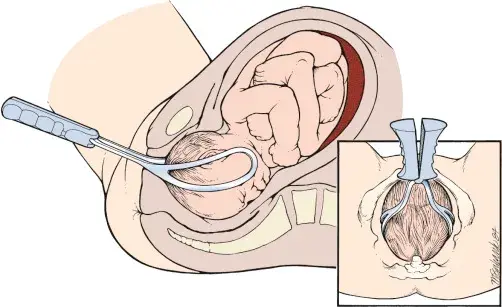
Forceps
Obstetric forceps look like two smooth, curved spoons designed to cradle the baby’s head with a firm but gentle grip. The blades are inserted one at a time, locked together, and used to guide (and sometimes gently rotate) the head with traction during contractions. Different designs serve different purposes — Simpson forceps for traction, Kielland for rotation. The steps mirror vacuum: similar positioning and prep, each blade slid carefully into place alongside the head, the blades locked, gentle pulls along the natural curve of the pelvis with each push, then removal once the head is delivered. Forceps can be more effective than vacuum for rotating a malpositioned baby and offer a firmer grip, which can matter in urgent situations.
Forceps vs. Vacuum: Side by Side
| Feature | Forceps | Vacuum extraction |
|---|---|---|
| Instrument | Two curved blades that cradle the head. | A suction cup (soft or rigid) on the crown of the head. |
| Primary use | Good for both traction and rotating the head. | Mainly traction; less effective for significant rotation. |
| Maternal trauma | Higher risk of severe perineal tears (3rd/4th degree) and episiotomy. | Lower risk of severe perineal tears than forceps. |
| Baby’s scalp | May cause temporary facial marking or bruising. | Causes temporary scalp swelling (a “chignon”); cephalohematoma possible. |
| Success rate | Slightly higher rate of achieving vaginal delivery. | Higher rate of “pop-off,” which may lead to a C-section. |
| Pain relief | Needs a very effective epidural or spinal. | Can sometimes use a local, but an epidural is strongly preferred. |
Potential Risks: An Honest Look
Like any procedure, assisted delivery carries risks, which is why a provider recommends it only when the benefits outweigh them.
For the parent: a higher chance of deeper perineal tears (3rd or 4th degree, involving the anal sphincter), especially with forceps, and an episiotomy is sometimes done to make room and prevent uncontrolled tearing; short-term or, rarely, longer-term pelvic floor issues like urinary or bowel incontinence; increased perineal pain, bruising, and swelling in the days after; temporary difficulty urinating or having a bowel movement; and, for some, disappointment or distress, especially if the intervention was unexpected.
For the baby: temporary scalp marks or swelling — forceps can leave red marks on the cheeks, and vacuum causes a round swelling (chignon), with a cephalohematoma (a collection of blood under the scalp) also possible; a slightly higher chance of newborn jaundice from the breakdown of bruised blood cells; small retinal bleeds (more common with vacuum, almost always resolving on their own); and very rare risks such as facial nerve injury or skull injury, which are extremely uncommon with a skilled provider.
Recovery and Self-Care
Recovery is similar to a standard vaginal birth but may need extra perineal care:
- Pain relief: ice packs for the first 24 hours, warm sitz baths, and pain relievers as recommended by your provider.
- Perineal care: keep the area clean and dry, use a peri-bottle of warm water to rinse after the toilet, and pat dry gently rather than wiping.
- Gentle pelvic floor work: begin gentle Kegel exercises once you’re comfortable, to support healing and restore muscle tone.
- Rest and nourishment: prioritize rest, stay hydrated, and eat high-fiber foods to ease constipation, which can be painful.
- Emotional recovery: process your birth story — talk it through with your partner, a doula, or a counselor. Mixed feelings are normal, and connecting with others who had similar experiences can help.
- Follow-up: attend your postpartum check-up and raise any ongoing pain, incontinence, or emotional concerns.
Can You Lower the Chance of Needing One?
The need often arises from unpredictable circumstances, but a few things may support an efficient labor: staying upright and mobile and changing positions to help the baby descend; considering perineal massage in the weeks before birth, which may reduce tearing; working with a supportive partner or doula, since continuous support is linked to fewer instrumental deliveries; and discussing epidural management, as a lighter dose may preserve some sensation and urge to push. Above all, remember: needing assistance is not your fault — it’s a sound medical response to the specific challenges of your labor.
Frequently Asked Questions
It can be, but it isn’t automatically. Trauma is subjective and depends on your expectations, your sense of control, and the support you received. Many parents feel grateful for the intervention that safely delivered their baby. If you do feel distressed, your feelings are valid and seeking support matters.
Usually not. An assisted delivery is still a vaginal birth, so it doesn’t rule out an unassisted vaginal birth in the future. What happens next time depends on the reason assistance was needed and the details of that pregnancy — something to discuss with your provider.
Generally, no. Once initial checks are done, skin-to-skin contact and breastfeeding can begin right away, just as with an unassisted birth. Temporary bruising or marks on the baby’s head don’t interfere with feeding.
The Bottom Line
Forceps and vacuum extraction are well-established tools that have been used safely in obstetrics for generations. They offer a middle path between an unassisted vaginal birth and a cesarean, often allowing a vaginal delivery when challenges arise. Birth is about safety and health, not adhering to a rigid plan — and understanding these procedures lets you partner with your care team and ask informed questions: “What are the prerequisites in my case?” “Which instrument are you considering, and why?” “What are our options?” With that knowledge, you can meet your birth with clarity and confidence, whatever entrance your baby makes.
This article is for general information and is not a substitute for personalized medical advice.
References
- American College of Obstetricians and Gynecologists (ACOG). Assisted Vaginal Delivery.
- NHS. Forceps or vacuum delivery.
- American Pregnancy Association. Forceps and vacuum-assisted delivery.