Few things set off a parent’s alarm like the thought of a fever in a newborn. In the first few months, a baby’s immune system is still developing, and a fever can be the first — sometimes the only — sign of a serious infection. The worry is often made worse by uncertainty about how to measure temperature accurately: Is a forehead scanner reliable? How do you safely take a rectal temperature? And what number actually counts as a fever in a baby this young? This guide answers all three, with clear steps for each method, the exact fever thresholds by age, and when a temperature means you need to act right away.
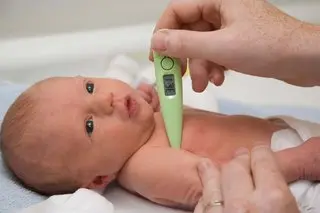
The Gold Standard: Rectal Temperature
For babies under 3 months, pediatricians universally recommend the rectal method as the most accurate reflection of core body temperature. It gives parents pause, but done correctly it’s safe, quick, and gives the reliable reading that critical decisions depend on. It closely mirrors internal temperature, is less thrown off by drafts or a recent feed, and is the method hospitals use — so all fever guidelines for young infants are based on rectal readings.
Use a digital thermometer with a flexible tip, and set one aside for rectal use only, clearly labeled. Then:
- Prepare: wash your hands, clean the tip with rubbing alcohol or soap and cool water, and apply a small dab of water-soluble lubricant (such as petroleum jelly) to the tip.
- Position your baby: lay them on their back on a firm surface and gently lift their legs as if changing a diaper, or lay them stomach-down across your lap.
- Insert gently: slide the lubricated tip in no more than ½ to 1 inch (about 1.3–2.5 cm). Stop immediately if you feel any resistance.
- Hold steady: keep one hand on the thermometer and the other on your baby’s bottom to prevent sudden movement. Never step away or leave them unattended.
- Wait and read: hold until it beeps, then remove, read the number right away, and clean the tip before storing.
Alternative Methods and Their Limits
For older infants or quick checks, other methods have their place — as long as you know their limitations. In a baby under 3 months, an elevated reading from any of these should be confirmed rectally.
- Axillary (underarm): place the tip in the center of a dry armpit and hold the arm snugly against the body. It’s less accurate, typically reading about 0.5–1°F lower than core temperature — fine as a quick, non-invasive screen, but confirm anything elevated (99.5°F/37.5°C+) rectally in a young infant.
- Temporal artery (forehead): swiped across the forehead. In newborns these can be unreliable — accuracy depends heavily on technique and can be thrown off by sweat, head coverings, or room temperature — so the AAP doesn’t recommend them as the sole method under 3 months.
- Tympanic (ear): not recommended for newborns. A tiny ear canal, earwax, or its curve make placement unreliable — generally not suitable under 6 months.

Understanding the Numbers: What Counts as a Fever
This is the most important part. A normal rectal temperature is roughly 97.9°F to 100.4°F (36.6°C to 38°C) and varies through the day. What matters is the threshold:
- Under 3 months: a rectal temperature of 100.4°F (38°C) or higher is a fever — and a medical emergency. Don’t wait; contact your pediatrician or go to the emergency room right away. Even a slight fever at this age can signal a serious bacterial infection that needs urgent assessment.
- 3 to 6 months: a rectal temperature of 100.4°F (38°C) or higher warrants a call to your pediatrician. A temperature above 102°F (38.9°C), or any fever with lethargy, irritability, or poor feeding, likely needs an urgent visit.
One key rule: don’t add or subtract degrees to “adjust” a reading. Just report the method and the actual number to your doctor — for example, “a rectal temperature of 101.2°F.” A fever under 3 months is one of the classic signs a newborn needs to be seen without delay.
Choosing a Thermometer
The cornerstone of a newborn kit is a digital rectal thermometer with a flexible tip, an easy-to-read display, and a quick read time. A separate thermometer for underarm or forehead checks is optional, handy for older siblings or quick screening. Some devices are best avoided for babies: glass mercury thermometers (breakage exposes your baby to toxic mercury), pacifier thermometers (inaccurate and unreliable), smartphone-app thermometers (not medically validated), and forehead strips (too unreliable for medical decisions).
A few accuracy tips: wait 15–30 minutes after a bath or heavy bundling before taking a temperature, keep the thermometer clean with a fresh battery, and aim for a calm baby — after a feed or during sleep often works best.
Beyond the Number: Reading Your Baby
A thermometer gives a number; your observation gives it context. When you call the doctor, be ready to report the exact temperature and method, your baby’s age, any other symptoms (lethargy, irritability, poor feeding, vomiting, diarrhea, rash, cough, or trouble breathing), how long the fever has lasted, and their hydration (are there wet diapers?).
Seek emergency care immediately for a fever in a baby under 3 months, or — at any age — for difficulty breathing or blue lips or tongue, an inability to wake or extreme lethargy, a stiff neck or bulging soft spot (fontanelle), or a seizure. For breathing trouble, a seizure, or a baby you can’t rouse, call 911.
Frequently Asked Questions
Not a true fever. The AAP notes that teething may cause a very mild rise in temperature, but a rectal reading of 100.4°F (38°C) or higher is due to illness, not teething — so don’t dismiss a genuine fever as “just teeth,” especially in a young baby.
For a baby under 3 months where you suspect a fever, yes — the risk of missing a serious infection outweighs the disrupted sleep. For older babies who are sleeping comfortably and seem well, you can usually wait until they wake.
For a newborn under 3 months with a first fever of 100.4°F or higher, call first and don’t give any medication unless your pediatrician directs it. For older infants, you can give a weight-appropriate dose of acetaminophen for comfort under your pediatrician’s dosing guidance — and always tell the doctor you’ve done so.
A digital rectal thermometer with a flexible tip — it’s the gold standard for accuracy under 3 months. Avoid glass mercury thermometers, pacifier thermometers, smartphone-app thermometers, and forehead strips, all of which are either unsafe or too unreliable for a young baby.
Trust the measured number and method over how the skin feels. Crying, overbundling, or a warm room can make a baby feel hot without a true fever. If you’re still concerned, remove a layer, wait a little, and recheck with a rectal reading, which is the most reliable.
The Bottom Line
Taking your newborn’s temperature is a fundamental caregiving skill, and it’s simpler than the worry around it suggests. Master the rectal method, keep a reliable digital rectal thermometer on hand, and hold on to the one rule that matters most: for a baby under 3 months, a rectal temperature of 100.4°F (38°C) means seeking medical care right away. Pair an accurate number with your own observation of how your baby is acting, trust your instincts, and you’ll navigate those first worrying moments with far more confidence.
This article is for general information and is not a substitute for personalized medical advice.
References
- American Academy of Pediatrics (HealthyChildren.org). How to Take a Child’s Temperature.
- American Academy of Pediatrics (HealthyChildren.org). Fever and Your Baby.
- Mayo Clinic. How to Take a Temperature.
- Nemours KidsHealth. Fevers.