The second trimester often brings a welcome shift — first-trimester fatigue lifts and your energy returns, which makes it a good window to settle into a movement routine. This isn’t about pre-pregnancy benchmarks, performance, or weight loss. It’s about building functional strength, easing the aches of a changing body, and preparing for labor and recovery. Here are the safety rules, the key adjustments for your changing body, a practical exercise toolkit, and sample weekly plans.

Aim for around 150 minutes of moderate activity a week — the general guideline in a healthy pregnancy — spread across several sessions. It all fits into the bigger picture in our guide to staying active during pregnancy.
Safety First
Get your provider’s okay before starting or continuing any exercise program. Then stop and call them if you have vaginal bleeding, persistent dizziness or faintness, headache, chest pain, muscle weakness, calf pain or swelling (a possible blood clot), fluid leakage, or decreased fetal movement.
A few guiding principles carry all the way through:
- The talk test. You should be able to hold a conversation while moving. If you’re too breathless to speak, ease off — this isn’t the time for gasping intervals.
- Hydrate before, during, and after; dehydration can trigger contractions.
- Avoid lying flat on your back after about 16 weeks, when the uterus can compress the vena cava and reduce blood flow. Use side-lying or propped-up positions.
- Pain means stop. Discomfort is information; sharp or persistent pain is a signal to stop the movement.
Moving in Your Changing Body
The second trimester isn’t about stopping movement — it’s about moving differently. Four concepts matter most:
- Protect your core (watch for “coning”). Your abdominal muscles are stretching to make room. If a ridge or dome pops up along your midline during an exercise like a sit-up or plank, that’s coning — a sign of too much intra-abdominal pressure. Stop that movement and modify. Our guide to safe core exercises goes deeper.
- Engage your deep core (the TVA). Think of the transverse abdominis as an internal corset for stability, not crunching. Gently draw your lower belly in and up toward your spine — like zipping tight jeans — without holding your breath. This is your brace for all movement now.
- Find a neutral spine. Keep the natural, gentle curves of your back rather than deep arching or tucking; this aligns your pelvis and protects your back.
- Stability over range of motion. The hormone relaxin makes joints more mobile and less stable, so favor controlled, smaller movements over deep stretches or heavy weights, building strength around the joints.
Your Movement Toolkit
Foundational strength
These build the functional strength you use daily — getting out of a chair, carrying groceries, lifting a baby:
- Modified squat. Stand with feet wider than hip-width, toes slightly out. Send your hips back and down as if reaching for a chair, chest lifted, knees tracking over (not past) your toes. Use a wall or sturdy chair for support and don’t go too deep. Great practice for birthing positions.
- Supported lunge. Holding a wall or chair, step one foot back and lower the back knee toward the floor, front knee behind your toes. Focus on balance and control.
- Pelvic tilts / cat-cow. On hands and knees, round your spine up (cat), then gently drop your belly and lift your head and tailbone (cow), moving slowly with your breath. The go-to for an achy lower back.
- Glute bridge. With knees bent and feet flat, lift your hips into a straight line from knees to shoulders, then lower with control. Keep it brief if on your back, or use a stability ball. Strengthens the backside and stabilizes the pelvis.
- Supported bent-over row. With one knee and hand on a bench, hold a light weight and pull it toward your ribcage, back flat, squeezing the shoulder blade. Counters the rounded-shoulder posture of a growing belly.
Cardio
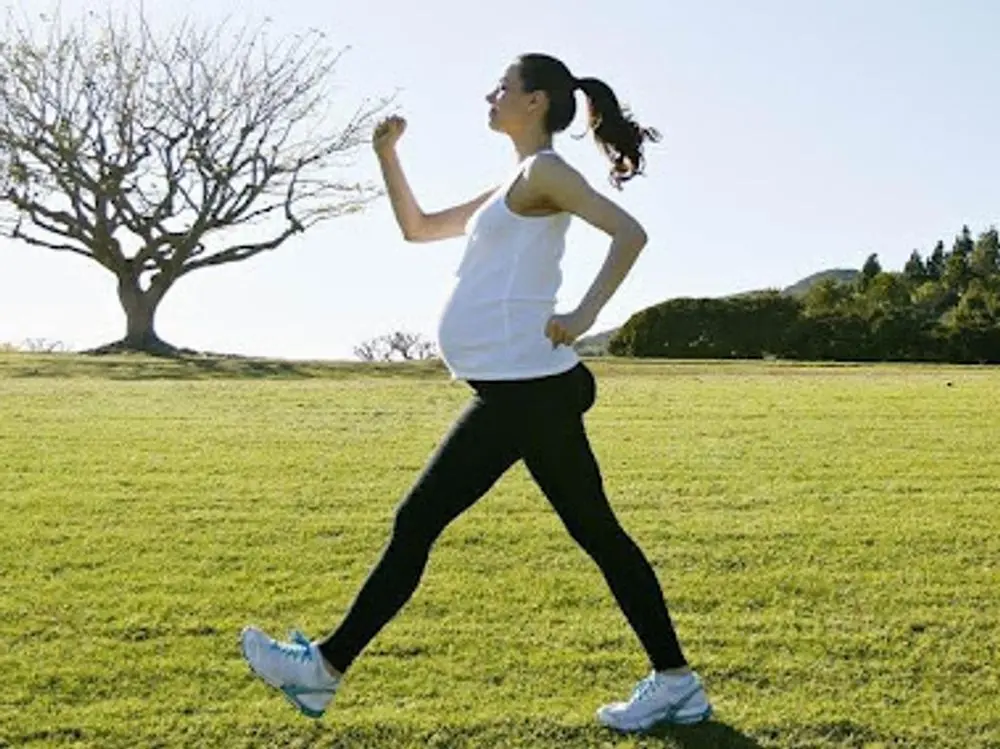
Consistent, moderate, low-impact cardio is the goal: brisk walking (no equipment, do it anywhere), swimming or water aerobics (buoyancy supports your joints and belly), stationary cycling (low-impact, no balance worries — keep resistance moderate), and low-impact prenatal aerobics with a qualified instructor (skip jumping and jarring moves).
Flexibility and release
This is about releasing tension, not deep stretching. Good options: cat-cow (above); child’s pose with wide knees (kneel, sit back on your heels, walk your hands forward and spread your knees to make room for your belly); supported pigeon for the hips (place a cushion under the hip of the bent leg); a gentle chest opener (clasp your hands behind your back and squeeze the shoulder blades); and calf stretches against a wall to head off cramps.
Sample Weekly Plans
Starting from sedentary: aim for consistency over intensity — 20 to 30 minutes, 3 days a week. For example: Monday a 20-minute brisk walk; Wednesday a 10-minute warm-up walk plus 2 sets each of pelvic tilts (10 reps), glute bridges (10 reps), and supported squats (8 reps); Friday a 25-minute walk or gentle swim.
Previously active: maintain strength and stamina with smart modifications — 30 to 45 minutes, 4 to 5 days a week. For example: Monday full-body strength (squats, lunges, rows, bridges); Tuesday a 30-minute swim or cycle; Wednesday prenatal yoga or stretching; Thursday rest or a gentle walk; Friday full-body strength; Saturday a 45-minute brisk walk or hike; Sunday rest.
Movement for Common Discomforts
- Round ligament pain: avoid sudden movements; from hands and knees, slowly shift your hips side to side, and try a supported pelvic tilt. More in our guide to round ligament pain.
- Lower back ache: pelvic tilts, glute bridges, and gentle cat-cow flows; stronger glutes take the load off your back. See more on back pain relief.
- Pelvic pressure: practice mindful Kegels (engaging and fully relaxing the pelvic floor) and supported hip openers like pigeon pose.
Frequently Asked Questions
It’s a sign of excessive pressure on the stretched midline of your abdominal muscles. Treat it as a visual cue to stop that specific movement — like a traditional crunch or full plank — and choose a modification that avoids it, such as a side-lying leg lift or a bird-dog.
Yes. This is a good time to start gently with walking and the foundational strength moves in the beginner plan. Go slow, prioritize form, and build up gradually — and check with your provider first.
Yes. Avoid contact sports, activities with a high fall risk (horseback riding, downhill skiing, gymnastics), scuba diving, hot yoga or exercising in extreme heat, and anything involving prolonged lying on your back or breath-holding (like heavy lifting with a Valsalva maneuver).
Watch for pain (not mild discomfort), dizziness, nausea, excessive breathlessness, feeling drained rather than energized afterward, or Braxton Hicks contractions that don’t ease with rest. If in doubt, scale back.
Yes, if you lifted before and use good form with modifications. Prioritize control and stability over the amount of weight, and reduce the load if you see coning, can’t keep a neutral spine, or have to hold your breath. Machines or resistance bands can help with stability.
A common target in a healthy pregnancy is about 150 minutes of moderate activity a week, spread across several sessions. Use the talk test to keep the intensity moderate, and let how you feel guide each session’s length.
The Bottom Line
Second-trimester movement is an investment that pays off now and after your baby arrives — every squat is practice for lifting your child, every mindful breath is practice for labor, every walk lifts your mood. It isn’t about getting your “body back”; it’s about meeting the body you have now with respect and building strength. Move with intention, honor your body’s signals, and celebrate what it can do today.
This article is for general information and is not a substitute for personalized medical advice from your healthcare provider.
References
- American College of Obstetricians and Gynecologists. Exercise During Pregnancy.
- Mayo Clinic. Pregnancy and Exercise.
- NHS. Exercise in Pregnancy.