Maybe it’s because you’re craving that familiar endorphin boost. Maybe your body feels a bit like a stranger right now, and you’re searching for a way to feel like “you” again. Or maybe—just maybe—the baby is finally napping for a solid forty-five minutes, and you’ve found a rare sliver of time that actually belongs to you.

Whatever your “why” is, I completely understand that deep urge to jump back in. You want to lace up those running shoes, roll out the yoga mat, and reconnect with the version of yourself that existed before pregnancy. It’s a natural, healthy desire.
But here is the most important thing I can tell you: rushing this process isn’t a sign of strength—it’s a risk. Honoring where your body is right now—not where it was a year ago or where you hope it will be next summer—is the most powerful thing you can do for your long-term health.
Let’s walk through how to return to exercise safely, using a timeline that respects everything your incredible body has just accomplished.
The Big Question: “When Can I Actually Start?”
Almost every new mom asks this. You’ve probably Googled it at 3 AM during a feeding, or whispered it to your friends, or brought it up at your postpartum checkup before your doctor even finished saying hello.
When can I start exercising after giving birth?
The honest, expert answer? It depends.
It depends on whether you had a vaginal delivery or a C-section. It depends on whether there were complications like tearing or infection. Most importantly, it depends on how your unique body heals. Your recovery is as individual as your fingerprint. Factors like sleep deprivation, stress levels, and whether you are breastfeeding all play a role in your postpartum exercise safe timeline.
While the American College of Obstetricians and Gynecologists (ACOG) provides general guidelines, remember that there is no universal “start line.” There is only your start line.
The First Six Weeks: Prioritizing Healing
It’s helpful to understand the massive “behind-the-scenes” work your body is doing during these first few weeks.
Your uterus is busy shrinking back to its pre-pregnancy size—a process called involution that takes about six weeks. Whether you are healing from vaginal tearing or a major abdominal surgery like a C-section, your tissues need time. Plus, your hormones are shifting, and your ligaments are still soft due to relaxin, the pregnancy hormone that loosens your joints.
This phase isn’t for “working out.” It is strictly for recovery.
What You Can Do
ACOG suggests gentle movement during this window, specifically walking and pelvic floor exercises. Don’t think of walking as a “workout”—think of it as gentle mobilization. It improves circulation, boosts your mood, and helps prevent blood clots. Even a short stroll can remind you that there’s a world beyond the nursery.
You can also begin pelvic floor exercises (Kegels) within days of delivery, as long as they don’t cause pain. The Mayo Clinic highlights that reconnecting with these muscles early is vital for long-term bladder control and core stability.
What to Avoid
During this period, please skip everything else. That means no running, jumping, heavy lifting (except for your baby!), crunches, or high-intensity interval training (HIIT). Your body is in a healing phase, not a training phase. Respect that boundary.
The CDC reminds us that the immediate weeks after birth are about recovery, not performance. Give yourself full permission to rest.
The 6-Week Mark: Clearance vs. Readiness
Around six weeks, you’ll likely have your postpartum checkup. Your doctor will assess your healing and will probably give you the “all clear” to exercise. However, medical clearance doesn’t always mean your body is physically ready for high-impact activity.
What a Thorough Checkup Should Cover
Ideally, your provider should check more than just your vitals. They should look at:
- Pelvic Floor Function: Are you experiencing any leaking, heaviness, or pressure?
- Diastasis Recti: Is there a significant gap between your abdominal muscles?
- Scar Healing: If you had a C-section, is the incision tender or numb?
- Overall Wellness: How is your energy, sleep, and pain level?
If your provider doesn’t check these things, don’t be afraid to ask. A postpartum exercise safe timeline is built on individual readiness, not just a date on the calendar.

Getting to Know Your Postpartum Body
Before diving into a new program, you need to tune in to three critical areas: your core, your pelvic floor, and your incision site.
Diastasis Recti: The Core Separation
Diastasis recti is a separation of the abdominal muscles that happens naturally during pregnancy to make room for the baby. For many, these muscles knit back together on their own, but for others, they need a little help.
Common signs of postpartum diastasis recti include:
- A visible “pooch” or “coning” down the center of your belly when you sit up.
- A palpable gap between the abdominal bands.
- Lingering lower back pain or poor posture.
The American Academy of Pediatrics (AAP) notes that this affects up to 60% of postpartum women. While the right exercises can heal it, the wrong ones—like traditional crunches—can actually make the separation worse.
Pelvic Floor Awareness
Your pelvic floor supported your baby for nine months and then performed the incredible feat of birth. It deserves some TLC. Before returning to high-impact movement, ask yourself:
- Do I leak when I sneeze, laugh, or jump?
- Do I feel a sense of heaviness or pressure “down there”?
- Is there any pain during intercourse?
If you answered yes to any of these, your pelvic floor needs more rehabilitation. The WHO emphasizes that pelvic floor dysfunction is highly treatable, often through specialized physical therapy.
C-Section Recovery
If you had a C-section, remember that you are recovering from major abdominal surgery. Returning to running after c-section requires extra patience because internal scar tissue takes months to fully remodel. Start with scar mobilization (once cleared), gentle walking, and deep breathing to reconnect with your core without straining the incision.
Phase 1: Rebuilding the Foundation (Weeks 6-12)
Once you are cleared, the focus shifts to foundation work. It might not feel like an intense workout, but it is the most vital part of your journey.
What You’re Doing
You are teaching your brain and body how to talk to each other again. You’re learning to engage your deep core and pelvic floor correctly before adding any heavy loads.
Safe Exercises
Effective core exercises after baby include:
Deep Core Breathing: Inhale and let your ribs expand; exhale slowly while gently drawing your lower belly toward your spine. You should feel a slight lift in your pelvic floor.
Pelvic Tilts: Lie on your back and gently flatten your spine against the floor, then release. This wakes up the deep abdominal muscles.
Glute Bridges: Lift your hips while squeezing your glutes. Focus on using your legs and butt, not your lower back.
Heel Slides: While on your back, slowly slide one heel out and back in, keeping your core perfectly still.
The goal here is quality over intensity. If you have to hold your breath or feel any pain, back off and try again later.
Phase 2: Progressive Strength (Months 3-6)
As you get stronger, you can gradually increase the challenge. This is where we introduce light resistance and low-impact cardio.
Safe Progressions
- Transition from flat walking to brisk walking or hills.
- Add light weights to your squats (goblet squats).
- Try stationary cycling or swimming for impact-free cardio.
- Progress from modified planks to full planks, provided your core remains stable.
Always listen to your body. Leaking or pressure is a signal from your body that you’re moving a bit too fast. It’s okay to slow down.
Phase 3: High-Impact Activity (Month 6+)
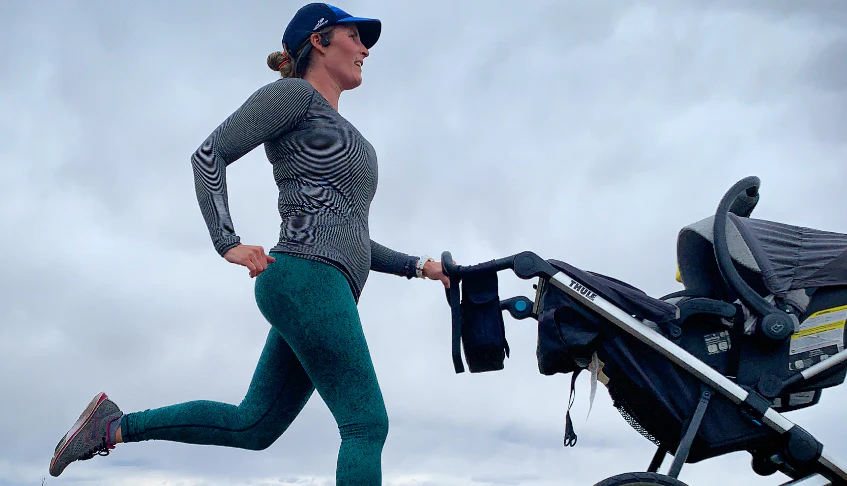
For many, this is the window where running and heavy lifting start to feel realistic. However, don’t rush it.
Tips for Returning to Running
Whether you’re returning to running after c-section or a vaginal birth, use these benchmarks:
- The Single-Leg Test: Can you balance on one leg for 10 seconds? Can you do a single-leg squat without your knee caving in? Stability is key for running.
- Intervals: Start with 1 minute of jogging followed by 4 minutes of walking. Slowly shift that ratio over several weeks.
- Symptom Check: If you feel any pelvic pressure or leaking, stop and return to walking for a few more weeks.
A Sample Postpartum Workout Plan for Beginners
Here is a gentle postpartum workout plan for beginners designed for months 2-4:
Weeks 1-2:
- Daily: 5 minutes of deep core breathing.
- 3x/week: 2 sets of 10 pelvic tilts, glute bridges, and heel slides.
- Walking: 10-15 minutes daily.
Weeks 3-4:
- Continue daily breathing.
- 3x/week: Add bird-dogs and clamshells to your routine.
- Walking: 20-25 minutes daily.
Weeks 5-8:
- 4x/week: Full circuit of foundation exercises with light resistance bands.
- Add low-impact cardio like cycling or swimming.
- Walking: 30 minutes, adding gentle inclines.
Healing Diastasis Recti Safely
If you have core separation, your approach must be intentional. Using diastasis recti safe exercises helps draw the muscles back together rather than straining them further.
Exercises That Help
Focus on deep core engagement and modified side planks. Movement like “Dead Bug” (alternating arm and leg extensions while on your back) is excellent for building stability without putting excessive pressure on the midline.
What to Avoid
Until the gap is healed, stay away from traditional sit-ups, double leg lifts, and full planks if you notice “coning” or “doming.” Working with a pelvic floor physical therapist is the gold standard for treating diastasis recti.
When to Pause: Listening to Your Red Flags
Your body is incredibly smart; it will tell you when you’re pushing too hard. Stop and consult a professional if you experience:
- Pain in the pelvis, back, or abdomen.
- Urine leakage.
- A feeling of heaviness or bulging in the vagina.
- New or increased vaginal bleeding.
Seeing a pelvic floor physical therapist isn’t just for when something is “broken.” It’s a wonderful way to ensure your body is working optimally for the long haul.
Conclusion: Embracing Your New Strength
If you’re feeling a bit discouraged by the wait, I hear you. But remember: strength right now isn’t measured by how fast you run or how much you lift. Strength is found in honoring your healing process. It’s found in resting when you’re tired and rebuilding your foundation with patience.
You have the rest of your life to be active, but you only have one chance to heal properly from childbirth. Be gentle with yourself. Your body just did something miraculous—treat it with the respect it deserves.
Frequently Asked Questions
Can I start exercising before my 6-week checkup?
Gentle walking and pelvic floor exercises are generally safe, but anything beyond that should wait until you’ve been evaluated by your provider. Your body is still healing internally, and pushing too soon can delay recovery or cause injury.
How do I know if I have diastasis recti?
Lie on your back with knees bent and feet flat. Place two fingers just above your belly button, pointing toward your feet. Lift your head and shoulders slightly (as if doing a mini crunch). Feel for a gap between your abdominal muscles. A gap of more than two finger-widths may indicate diastasis recti. Your provider or a pelvic floor physical therapist can confirm.
Is it safe to run while breastfeeding?
Yes, running is generally safe while breastfeeding, provided your body is ready for impact. Ensure you’re well-hydrated and wear a supportive bra. Some women find that high-impact exercise temporarily affects milk supply, but this usually stabilizes with adequate hydration and nutrition.
What exercises should I avoid postpartum?
Avoid high-impact activities until your core and pelvic floor are ready. Avoid crunches, sit-ups, and double leg lifts if you have diastasis recti. Avoid heavy lifting until you can maintain core engagement without breath-holding. Avoid any exercise that causes pain, leaking, or pelvic pressure.
How long does it take to get back to pre-pregnancy fitness?
There’s no universal timeline. Some women feel strong by six months; others take a year or more. Pregnancy and childbirth are significant physical events, and returning to pre-pregnancy fitness levels requires patience. Focus on function and feeling good rather than comparison.
Should I see a pelvic floor physical therapist even if I feel fine?
Yes, absolutely. A pelvic floor PT can assess your function, identify subtle issues you might not notice, and give you a personalized plan for safe return to exercise. Many women wish they’d seen one sooner. It’s preventive care for your long-term health.
What if I’m still leaking when I exercise?
Leaking is common but not normal. It indicates that your pelvic floor needs more support. See a pelvic floor physical therapist. They can help you strengthen appropriately and may recommend modifications to your exercise routine while you heal.