Witnessing your baby haul themselves upright for the first time is a breathtaking moment. Their world and yours shifts fundamentally from the horizontal floor plane to the thrilling, risky vertical. This transition from ground-based explorer to upright adventurer is not merely a prelude to walking; it is a critical, self-directed training camp where your baby builds the complex neurological and muscular foundation for a lifetime of mobility. The phases of standing and cruising are where the true work of walking happens.

This guide is designed to transform you from an anxious observer into a knowledgeable coach and safety engineer. We will move beyond simple milestone timelines to explore the specific biomechanics of this stage—the core strength, balance reactions, and weight-shifting that make independent steps possible. More importantly, we will provide a masterclass in safety-proofing your home for a newly upright, gravity-defying explorer. Our goal is to empower you to support this natural progression confidently, avoid common pitfalls and harmful devices, and celebrate each wobbly triumph on the path to those unforgettable first steps.
Part 1: The Developmental Sequence – The Path to Vertical
Walking is not a single skill but the seamless integration of dozens of sub-skills. The journey follows a logical, strength-building sequence, though the timing varies widely (typically between 8-15 months).
The Pull-Up Artist (8-12 months): Conquering Gravity
Using crib rails, sturdy furniture, or even your legs, your baby begins the arduous task of hauling their entire body weight against gravity. This act builds phenomenal arm, shoulder, and core strength. You’ll often see joyful bouncing once they’re up—a celebration of their achievement and further leg conditioning. A crucial, often frustrating, sub-skill is learning to lower themselves back down gracefully. Many babies get “stuck” standing and cry for rescue. This controlled descent is a key lesson in balance and muscle modulation.
The Cruiser (9-13 months): Master of Lateral Movement
Once stable on two feet, lateral movement begins. Cruising is defined as side-stepping while holding onto furniture. Biomechanically, this teaches weight shifting from foot to foot, develops lateral balance, and strengthens hip stabilizers. They learn to navigate corners and transfer between surfaces. This “furniture walking” is the primary classroom for the balance and coordination needed for independent steps.
The Stand-Alone Moment (10-14 months): The Pinnacle of Static Balance
Amidst the busyness of play—often while holding two toys—your baby may momentarily forget to hold on. For a breathtaking, wobbly second, they stand alone. This unsupported stance is the peak of static balance control. These moments will grow longer as their confidence and vestibular system mature.
The Unsung Hero: The Squatting Playground
One of the most vital and overlooked skills is the squat-to-stand maneuver. Lowering to pick up a toy from a standing position and rising back up builds explosive leg strength, deep core stability, and pelvic control. It’s a full-body workout that is fundamental for functional mobility.
Part 2: Building the Foundation: A “Workout” Guide for Pre-Walkers
You can support this developmental workout through playful, safe activities that target specific muscle groups and skills.
- For Core & Hip Stability:
- Tall-Kneeling Play: Encourage play at a low table or bench while they kneel upright (without sitting back on their heels). This builds core and hip strength crucial for an upright posture.
- Assisted Standing: Let them practice standing with their back against a stable couch, freeing their hands to play.
- For Leg Strength & Squatting:
- The Toy Stool: Place enticing toys on a stable, low stool or ottoman to motivate repeated squatting to retrieve them.
- Supported Bouncing: Hold your baby under their arms or at their trunk and let them bounce to music, allowing them to bear weight through their legs.
- For Balance Reactions:
- Gentle Swaying: While they stand holding onto furniture, gently rock the surface side-to-side or front-to-back (very slightly) to challenge their balance in a safe, controlled way.
- Uneven Terrain Play: Create safe, soft obstacle courses with couch cushions and pillows on the floor to challenge balance during cruising and standing play.
- For Cruising Confidence:
- Design a Cruising Circuit: Arrange sturdy furniture (sofa, coffee table, secure bookshelf) in a continuous, safe loop. Place favorite toys just out of reach to motivate lateral movement and problem-solving.
Part 3: The Safety Engineer’s Checklist: Babyproofing for the Vertical Explorer
When your baby goes vertical, your home safety must level up. Get on your hands and knees, then stand at their height to audit your space.
- Anchor Everything Top-Heavy: Every bookcase, dresser, TV stand, and armoire must be securely anchored to wall studs. This is non-negotiable.
- Pad Every Corner and Edge: Use soft foam protectors on coffee tables, fireplace hearths, nightstands, and countertop edges.
- Eliminate Toppling Hazards: Remove or securely anchor floor lamps, potted plants, decorative sculptures, and unstable side tables.
- Secure the Floor: Use non-slip pads under area rugs. Coil and hide electrical cords behind furniture or use cord covers.
- Re-evaluate Gates & Barriers: Pressure-mounted gates are generally acceptable for bottom-of-stairs or doorways. For the top of any staircase, a hardware-mounted gate screwed into the wall stud is the only safe option.
- Reassess the Crib: Lower the mattress to the lowest setting the moment your baby shows any ability to pull up. Remove crib bumpers, large toys, and mobiles they could use as a step.
Part 4: What to Avoid: Debunking Myths and Dangerous “Aids”
In your eagerness to help, some well-intentioned products and practices can actually hinder development or cause injury.
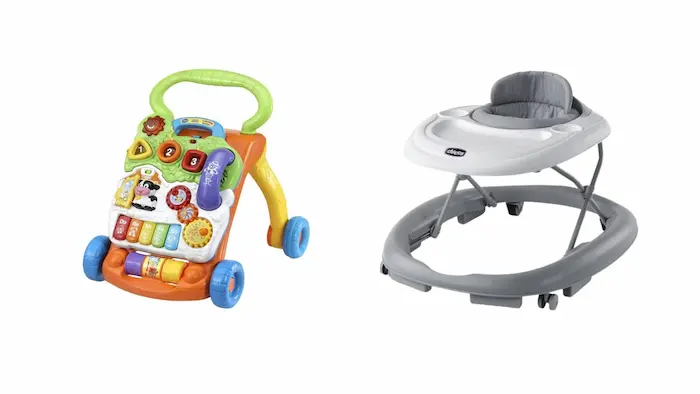
- Baby Walkers (Sit-In Circle Walkers): The American Academy of Pediatrics (AAP) strongly discourages their use, and they are banned in Canada. The risks are severe: they allow babies to roll into dangers (hot stoves, pools, stairs) at high speed. Developmentally, they promote toe-walking, impair hip development, and crucially, bypass the strengthening and balance work of cruising, which can delay independent walking.
- Early “Walking” Shoes: Indoors, bare feet are best. The sensory feedback from their soles helps with balance and coordination. Non-slip socks are a good alternative. Shoes are for outdoor protection on rough or cold surfaces only. First shoes should be flexible, flat, and wide-toed.
- Excessive Hand-Holding: While walking with support is fun, doing it for a baby who cannot stand alone teaches them to rely on your balance, not develop their own. It can also encourage an unnatural, forward-leaning gait. Let them lead the way in developing independent stability.
- Rushing the Milestone: Walking is a neurological achievement. Placing a baby in standing positions they cannot get into themselves, or pushing them to walk before their balance systems are ready, can instill fear and create compensatory, poor movement patterns.
Part 5: Recognizing Readiness & When to Seek Guidance
How do you know when your cruiser is ready for true independence? Look for these signs of walking readiness:
- Can stand alone for 10-20 seconds without support.
- Cruises confidently along furniture and can change direction smoothly.
- Uses a push walker (a wheeled toy they walk behind) appropriately—pushing it forward while walking upright, not leaning heavily into it for support.
- Shows a repeated desire to let go of support and “launch,” even if they quickly sit down.
When to Talk to Your Pediatrician:
Consult your doctor if you observe:
- Asymmetry: Consistently pulling up using only one side of the body, or cruising exclusively in one direction.
- Persistent Toe-Walking: Walking on tiptoes most of the time when cruising or standing, not just occasionally.
- Lack of Progression: No attempts to pull to stand by 12 months, or no cruising or standing with support by 14-15 months.
- Significant Stiffness in Legs or Floppiness (Low Tone).
- Loss of previously acquired motor skills.
Your Pre-Walking Questions, Answered
Q: Are push walkers or activity carts safe to use?
A: Yes, push toys (like a cart or wagon a baby walks behind) are different from sit-in walkers and can be beneficial when used correctly. Ensure it’s stable and heavy enough not to tip over when they pull up on it. The child should be walking behind it, not sitting in it or leaning over it.
Q: My baby stands on tiptoes in their crib. Is that normal?
A: Occasional toe-standing, especially when excited or in a crib where they grip the rail, is common. Persistent toe-walking during the day when cruising or standing on flat surfaces is worth mentioning to your pediatrician.
Q: How can I help my baby learn to sit back down from standing?
A: Practice during diaper changes on a soft surface. Gently guide them through a controlled bend at the hips and knees, showing them how to lower their bottom. Place a tempting toy on the floor between their feet when they’re standing at a stable surface to encourage the movement.
Q: What are the best first shoes for walking outside?
A: Look for shoes that are: Flexible (you should be able to bend the sole easily), Flat (no heel lift), Wide (room for toes to splay), and made of Breathable material. The goal is protection with minimal interference.
Q: My child is a bottom scooter and skipped crawling. Will they still cruise?
A: Often, yes. Scooting builds core and leg strength differently but sufficiently. They will likely find their own path to pulling up and cruising. The developmental focus is on achieving the strength and balance for upright mobility, regardless of the route taken.
Q: How do I handle falls and bumps during this phase?
A: Stay calm. Your reaction teaches them how to react. Offer comfort if they’re hurt, but avoid an overly dramatic response to minor tumbles, which can increase fear. Ensure their play environment is as safe as possible to minimize serious injury.
Safety & Readiness Checklist
| Do’s ✅ | Don’ts ❌ |
|---|---|
| DO anchor all heavy furniture to walls. | DON’T use sit-in baby walkers. |
| DO encourage barefoot indoor play for balance. | DON’T prop baby in standing position if they can’t get there alone. |
| DO create a safe, continuous cruising circuit. | DON’T use stiff, restrictive shoes indoors. |
| DO practice the squat-to-stand motion during play. | DON’T rely solely on pressure gates at the top of stairs. |
| DO celebrate cruising and standing as major achievements. | DON’T compare timelines; focus on progression. |
The journey from pulling up to walking is a masterclass in persistence, physics, and biological engineering. By providing a safe environment, engaging in strength-building play, and avoiding developmental shortcuts, you are giving your child the strongest possible foundation. Celebrate each wobbly stand, each determined cruise, each controlled squat—these are the true first steps toward a lifetime of confident movement.
References & Further Reading
- American Academy of Pediatrics (AAP). “Baby Walkers: A Dangerous Choice.” HealthyChildren.org. https://www.healthychildren.org/English/safety-prevention/at-home/Pages/Baby-Walkers-A-Dangerous-Choice.aspx
- Centers for Disease Control and Prevention (CDC). “Important Milestones: Your Baby By Twelve Months.” https://www.cdc.gov/ncbddd/actearly/milestones/milestones-12mo.html
- World Health Organization (WHO). “Motor Development Study: Windows of achievement for six gross motor development milestones.” https://www.who.int/publications/i/item/924159343X
- Mayo Clinic. “Infant development: Milestones from 10 to 12 months.” https://www.mayoclinic.org/healthy-lifestyle/infant-and-toddler-health/in-depth/infant-development/art-20047380
- U.S. Consumer Product Safety Commission (CPSC). “Anchor It! – Furniture Tip-Over Prevention.” https://www.anchorit.gov/