Imagine trying to navigate your day after a night of fragmented sleep, unable to communicate your fatigue, and bombarded by overwhelming new sights and sounds. This is your baby’s reality without adequate, well-timed daytime sleep. Naps are not a luxury or a mere convenience for parents; they are a biological imperative for healthy infant development. Yet, deciphering the ever-changing code of nap schedules by age can feel like chasing a moving target.

This guide moves beyond generic sleep charts to explore the why behind nap needs at each stage. It provides a flexible, evidence-based framework to help you interpret your baby’s cues and build a daily rhythm that supports their growth, learning, and mood. For expecting parents, understanding this progression is a key part of preparing for the realities of newborn and infant care. Let’s build a schedule that works with your child’s biology, not against it.
Why Naps Matter: The Developmental Power of Daytime Sleep
Naps serve a critical function distinct from nighttime sleep. During these daytime rest periods, a baby’s brain is exceptionally active.
- Memory Consolidation & Learning: Research indicates that naps help solidify memories and new skills. That morning spent practicing rolling or babbling is literally processed and filed away during the afternoon nap. The World Health Organization (WHO) recognizes adequate sleep as vital for cognitive development in young children.
- Emotional Regulation: A well-rested baby is more adaptable, patient, and resilient. Overtiredness leads to a flood of cortisol (the stress hormone), making babies fussy, hyper-alert, and difficult to soothe—the infamous “overtired wire.”
- Physical Growth: Growth hormone is secreted during both day and night sleep. Consistent, restorative naps support physical development.
- Preventing Nighttime Overtiredness: This is the cardinal rule of pediatric sleep. A good day of sleep begets a good night of sleep. An overtired baby has a harder time falling asleep at bedtime, sleeps more fitfully, and is prone to early morning wakings. Naps protect the night.
The Guiding Principle: Wake Windows Over Rigid Clocks
For the first year, your most useful tool is not the clock on the wall, but the concept of age-appropriate wake windows—the optimal span of time a baby can comfortably stay awake between sleeps before becoming overtired.
Following your baby’s sleepy cues within these windows is more effective than forcing a nap at an exact time. Key cues include: rubbing eyes, pulling ears, zoning out, decreased engagement, and fussiness. Yawning is often a late sign; catching cues earlier leads to easier naps.
The Evolutionary Nap Schedule: A Stage-by-Stage Guide
Here is a roadmap of what to expect and aim for, remembering that individual babies will have their own tempo within these ranges.
Newborn Stage (0-6 Weeks): Survival & Rhythm Finding
- Sleep Need: 14-17+ hours total per 24 hours, chaotic and evenly split between day and night.
- Nap Pattern: 4-6+ naps per day, varying wildly in length (30 minutes to 3 hours). There is no schedule, only a cycle: feed, wake briefly, sleep.
- Wake Windows: Extremely short: 45-60 minutes from the start of one sleep to the start of the next. Keeping wake time brief prevents overtiredness.
- Goal: Don’t schedule. Focus on feeding on demand, offering sleep often, and gently introducing a difference between day (lighter, some noise) and night (dark, quiet).
- Long-Tail Keywords: newborn nap schedule chaos | wake windows for newborn | how often do newborns nap
Infant Stage (2-4 Months): Emerging Predictability
- Sleep Need: 14-16 hours total. The 4-month sleep progression occurs, permanently changing sleep cycles.
- Nap Pattern: 3-4 naps per day. Naps may start to consolidate, with a longer nap (1-2 hours) often emerging in the late morning. The late afternoon nap is usually a short “catnap.”
- Wake Windows: Lengthen to 75-120 minutes. A common pattern: 1.25/1.5/1.5/1.75 (hours between naps).
- Goal: Start observing natural rhythms. A loose “by the clock” schedule may emerge (e.g., nap around 9 AM, 12 PM, 3 PM). Protect the earlier naps in the crib/bassinet for better quality.
- Long-Tail Keywords: 3 month old nap schedule | nap consolidation 4 months | how to drop the 4th nap
Mid-Infancy (5-8 Months): The Solid Two/Three Nap Rhythm
- Sleep Need: 13-15 hours total. This is often the golden age of napping once settled.
- Nap Pattern: 3 naps until 6-8 months, then transition to 2 naps. The 3-nap schedule is often: 9 AM, 12:30 PM, 4 PM (short). The 2-nap schedule is: 9:30 AM, 2:00 PM. Each nap should be 1-2 hours.
- Wake Windows: 2-3.5 hours. A 2-nap schedule requires longer windows (e.g., 2.5/3/3.5 or 3/3/4).
- Goal: Establish consistent, reliable naps in the crib. The transition from 3 to 2 naps is triggered when the third nap is consistently refused or pushes bedtime too late. This transition often involves a temporary earlier bedtime.
- Long-Tail Keywords: *6 month old nap schedule 2 vs 3* | transition from 3 to 2 naps | best nap schedule for 7 month old
Older Infant/Toddler (9-15 Months): The Two-Nap Fortress
- Sleep Need: 12-14 hours total.
- Nap Pattern: 2 solid naps, usually mid-morning and early afternoon. The morning nap is often the longest and most mentally restorative.
- Wake Windows: 3-4 hours. Schedule is key: e.g., Nap 1 at 9:30 AM, Nap 2 at 2:30 PM, Bed at 7:30 PM.
- Goal: Defend this schedule! It provides crucial downtime and prevents overtiredness, which peaks during this active phase of pulling up, cruising, and walking. The American Academy of Pediatrics (AAP) notes that consistent sleep schedules support overall health and development.
- Long-Tail Keywords: 9 month old fighting second nap | 12 month old nap schedule length | is my baby ready for one nap
Toddler (15-24 Months): The Great One-Nap Transition
- Sleep Need: 11-14 hours total.
- Nap Pattern: Transition from 2 naps to 1 nap typically between 15-18 months. Signs: refusing the afternoon nap for over a week, taking very long to fall asleep for morning nap, or the 2-nap schedule pushes bedtime past 8 PM.
- Wake Windows: On one nap, windows are long: 5-6 hours. Schedule: Nap starts around 12:30 PM, lasting 2-3 hours.
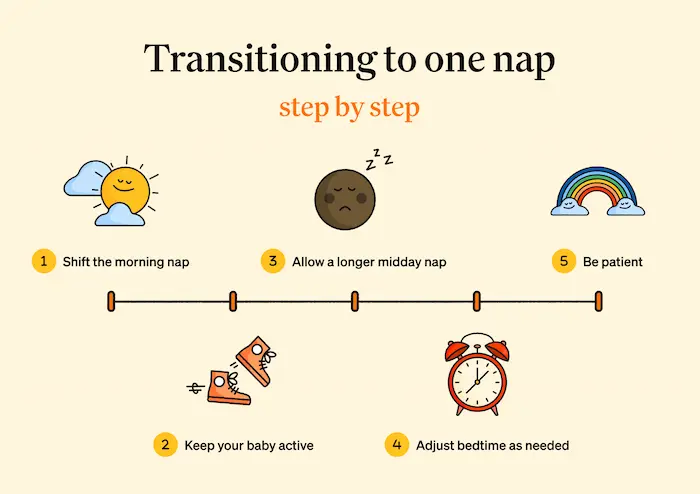
- Goal: Navigate the transition gradually. First, push the morning nap later by 15 minutes every few days until it lands at noon. Offer a quiet rest time in the former afternoon nap slot. Expect some crankiness early on. This single nap becomes non-negotiable for behavior.
- Long-Tail Keywords: when to transition to one nap | 18 month old nap schedule regression | length of nap for 2 year old
Solving Common Nap Dilemmas: A Troubleshooting Guide
Problem: Short Naps (30-45 minutes).
- Cause: This is often a sign of inability to connect sleep cycles during the day, similar to the 4-month night waking. The baby wakes after one sleep cycle and cannot fall back asleep.
- Solutions: Ensure the room is very dark and uses white noise. Practice falling asleep independently at naptime (not reliant on motion or feeding). For younger babies, you can try gently soothing them (patting, shushing) as they rouse to help them bridge to the next cycle.
Problem: Fighting Naps / Crying at Naptime.
- Cause: Usually overtiredness (window too long) or under-tiredness (window too short). Can also be a sign of a needed schedule transition.
- Solutions: Track wake windows for 3 days. Adjust by 15 minutes earlier or later. Ensure you’re catching sleepy cues before full-blown fussiness.
Problem: Nap Strikes & Regressions.
- Cause: Often tied to a developmental leap (learning to stand, language burst) or teething. The brain is too excited or uncomfortable to sleep.
- Solutions: Stick to the schedule even more consistently. Offer extra comfort for pain. Keep the nap routine calm. This is usually temporary. If it persists beyond 2 weeks, re-evaluate schedule needs.
Problem: Naps On-the-Go Only.
- Cause: The baby is accustomed to sleeping in motion (car, stroller), which provides lighter, less restorative sleep.
- Solutions: Prioritize at least one nap per day in the stationary crib/bassinet. Start with the first nap of the day, when sleep drive is highest. Be patient as they adjust to the still environment.
The Prenatal Perspective: Setting Realistic Expectations
For the expecting mother, understanding nap development is a form of empowerment. The American College of Obstetricians and Gynecologists (ACOG) encourages prenatal education on newborn care. Knowing that the first months are rhythm-less can reduce pressure and anxiety. It allows you to plan for a postpartum period focused on observation and response, rather than the futile pursuit of a strict schedule too soon.
Conclusion: Finding Your Child’s Unique Rhythm
Creating an effective nap schedule by age is an exercise in guided flexibility. Use the science of wake windows and sleep needs as your map, but let your baby’s cues be your compass. Some days will be perfect; others will be a mess of short naps and fussiness. This is normal.
Your goal is not robotic adherence to a chart, but to become an expert observer of your own child. When you protect their need for daytime rest, you are directly supporting the complex, beautiful work of their developing brain and body. You are gifting them—and yourself—the rhythm of a more peaceful, predictable, and joyful day.
Sources & Further Reading from Authoritative Organizations:
- American Academy of Pediatrics. Getting Your Baby to Sleep. HealthyChildren.org. [Link to AAP Sleep Guidelines]
- American Academy of Pediatrics. Infant Sleep. Pediatrics Journal.
- Centers for Disease Control and Prevention. Sleep and Health. [Link to CDC Sleep Resources]
- World Health Organization. Infant and young child care: sleep and rest routines. [Link to WHO Care Practices]
- Mayo Clinic. Baby naps: Daytime sleep tips. [Link to Mayo Clinic Nap Guide]
- American College of Obstetricians and Gynecologists. Your Postpartum Checkups. [Link to ACOG Postpartum Care]