Most babies settle head-down before birth, but in about 3 to 4% of full-term pregnancies the baby is breech — positioned bottom or feet first, toward the cervix. Hearing that your baby is breech near your due date can spark a lot of questions. The reassuring starting point: breech is a variation of normal positioning, not something you caused, and you have real options. Here’s what breech means, why it happens, and the full range of paths forward.
Head-Down vs Breech: The Basics
In the final weeks, your baby runs out of room to move freely and settles into a position, with the “presenting part” (whatever is closest to the birth canal) leading the way. About 96% of babies are cephalic (head-down) by 37 weeks — the ideal position for vaginal birth, with the chin tucked. A breech baby is bottom- or feet-first instead. Knowing that breech is simply how your baby has settled — not a complication you caused — is the first step toward calm, informed decisions.
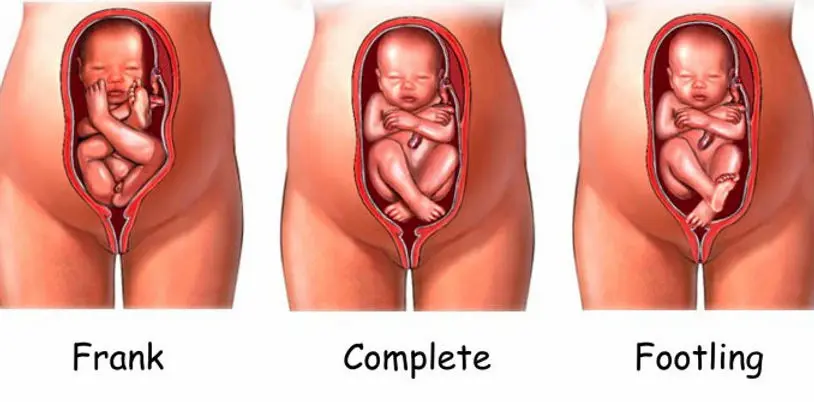
The Three Types of Breech
The specific type can affect your options and risks:
- Frank breech (50–70% of cases) — the most common. Buttocks down, legs straight up in front of the body with feet near the head, like a diver folded in half.
- Complete breech — buttocks down, sitting cross-legged with knees bent and feet near the bottom.
- Footling (incomplete) breech — one or both feet positioned to come out first. The least common at full term.
Why a Baby Might Be Breech
Usually there’s no single identifiable reason — it’s often just how the baby settled, and it’s not caused by anything you did. Some factors make it more likely:
- Uterine shape — a septate or bicornuate (heart-shaped) uterus can limit room to turn.
- Placenta location — a low-lying placenta previa or an anterior placenta can occupy the space where the head would go.
- Amniotic fluid — too much (polyhydramnios) gives too much room to flip; too little (oligohydramnios) restricts movement.
- A multiple pregnancy — with twins or more, limited space makes breech more common.
- Baby-related factors — occasionally a condition affecting muscle tone, or a very large baby.
When Breech Becomes a Focus
Timing matters, because most babies still have time to turn:
- Before 28–32 weeks: babies are small and float freely — breech now is normal and not a concern.
- Around 32–34 weeks: as they grow they tend to settle, and your provider will start feeling your abdomen to check position.
- 36 weeks and beyond: a persistent breech becomes central to birth planning. An ultrasound confirms the type of breech, the baby’s size, and the fluid level.
Your Options for a Breech Baby
A breech diagnosis isn’t an automatic cesarean — it’s the start of a conversation about risks, benefits, and choices, which fall into three main paths.
Turning the baby: external cephalic version (ECV)
This is the usual first-line option near term. An obstetrician uses firm, guided pressure on the outside of your abdomen to encourage the baby to somersault head-down. It’s typically done at or after 37 weeks in a hospital, often with medication to relax the uterus and ultrasound guidance. Success is roughly 50–60%, a little higher if you’ve given birth before. Risks are small (under 1% — things like temporary fetal heart-rate changes, waters breaking, or placental abruption), which is why it’s done where an operating room is immediately available. It can be quite uncomfortable — intense pressure — but it’s usually brief. For most people it’s worth trying: even if it doesn’t work, you can move ahead with your plan knowing you explored it.
Planned vaginal breech birth
This is a specialized option that needs specific conditions and an experienced team. With the right criteria and skilled practitioners, research (including the Term Breech Trial and its follow-up studies) suggests outcomes can be comparable to a planned cesarean when strict protocols are followed. Typical criteria include a frank or complete breech (not footling), a normal-sized baby, an adequate pelvis, the baby’s head flexed (not tilted back), an experienced hospital team, and smooth spontaneous labor. One practical reality: many providers and hospitals no longer offer it, because breech-delivery skills faded as cesareans became standard for breech. If it interests you, have a frank conversation with your provider about their experience and the hospital’s capability.
Planned cesarean section
In many countries this is the most common route for a persistent breech. It avoids the specific risks of a vaginal breech birth, such as head entrapment (the body delivers but the larger head gets stuck) or cord prolapse. For a breech baby, a cesarean is usually scheduled around 39 weeks. Choosing or needing one for a breech baby is a valid, safe, proactive birth — a different path to meeting your baby, not a lesser one.
Gentler Methods to Encourage Turning
Some parents try non-invasive techniques. These aren’t as well-supported by evidence as ECV, so always clear them with your provider first. They include Spinning Babies techniques (maternal positions like the forward-leaning inversion, meant to create space and alignment), moxibustion (a traditional Chinese medicine method burning a mugwort herb near a point on the little toe — some studies suggest it may encourage turning, though the evidence is limited and mixed), and the Webster chiropractic technique (aimed at easing uterine constraint and balancing the pelvis). They tend to work best when a baby is already inclined to turn, and while their true success is hard to measure, they’re generally low-risk and can help you feel proactive.

Working Through the Emotions
A breech diagnosis can bring disappointment, anxiety, or a sense of lost control over your birth plan — all completely normal. If you’d set your heart on a particular birth, allow yourself to feel that. Then shift from emotion toward information: ask your provider what the protocol is, what their experience is, and what the specific risks and benefits are for your situation. Our guide to choosing your delivery preferences can help frame that conversation. The ultimate goal stays the same — a healthy parent and a healthy baby — and the mode of delivery is a pathway to it. Understanding all the pathways is how you keep a sense of agency.
Frequently Asked Questions
It’s possible, but it becomes less likely as the baby grows and space shrinks. Spontaneous turning after 37 weeks does happen, just not in most cases — which is why options like ECV are discussed around then.
The most commonly suggested are positions that open the pelvis and use gravity: spending time on your hands and knees, pelvic tilts, and leaning forward over a birth ball. The idea is to encourage the baby’s heavier head to swing down. Clear any technique with your provider first.
In the large majority of cases, no — a breech baby is typically perfectly healthy, and it’s simply their position. In a small percentage it can be linked to an underlying factor, which is exactly why your provider monitors carefully.
Go to the hospital right away — don’t wait. This is a key reason to have a clear plan. The team will assess you and your baby and proceed with the safest course, which at that point is almost always a cesarean.
Not necessarily. A cesarean for breech is usually a low-transverse incision, which often makes you a good candidate for a VBAC in a future pregnancy with a head-down baby.
For most people, yes. It’s a low-risk procedure with a meaningful chance of success that could open the door to a vaginal birth. And if it doesn’t work, you can move forward with a planned cesarean knowing you gave it a fair try.
The Bottom Line
Finding out your baby is breech is an unexpected turn, but it doesn’t have to be a crisis — it’s an invitation to become a more informed participant in your care. Once you understand the types, the causes, and the full spectrum of options, from ECV to a specialized vaginal breech birth to a planned cesarean, you get to make a genuine, active choice. Work closely with your team, ask detailed questions, and trust that whether your baby turns or not, you’re moving toward a safe birth focused on the well-being of you both.
This article is for general information and is not a substitute for personalized medical advice from your healthcare provider.
References
- American College of Obstetricians and Gynecologists. If Your Baby Is Breech.
- NHS. If Your Baby Is Breech.
- MedlinePlus (U.S. National Library of Medicine). Childbirth.