Introduction: The Choice That Feels Big (Because It Is, and Isn’t)
Let’s paint a picture. You’re standing in the diaper aisle, holding a giant box of disposables. You see the price, and your mind does a quick calculation for the next two years. You think about the overflowing bin at the curb each week, filled with diapers that will outlive your grandchildren in a landfill. A little voice whispers: There has to be a better way.

But then the other voice chimes in, the one fed by images of complicated folds, safety pins, and boiling pots of water on the stove. That voice says: You don’t have time for that. It’s too hard.
Here’s my promise to you, after eight years of guiding thousands of parents through this exact moment: Modern cloth diapering is not your grandmother’s cloth diapering. The learning curve is real, but it’s a short, manageable hill, not an endless mountain. And the view from the top—a significant savings, a dramatically smaller trash footprint, a chemical-free layer against your baby’s skin, and yes, undeniable cuteness—is absolutely worth the climb.
This guide is your friendly mentor. We’re going to strip away the overwhelm and replace it with clarity. We’ll walk through the types, the must-have gear, and most importantly, the simple wash routine that is the heart of success. Consider this your comprehensive modern cloth diapering guide, designed not for the perfect eco-warrior, but for the real, tired, hopeful parent who wants to make a good choice without losing their mind.
The “Why”: More Than Just a Feeling
Let’s ground this in facts, not just guilt. Disposable diapers are the third largest single consumer item in landfills. Each child may use over 6,000 before potty training, and a single diaper can take 500+ years to decompose. They’re made with plastics, super-absorbent chemicals, and trace amounts of dioxin. The financial cost is staggering, often totaling $2,000+ per child.
Cloth diapering, in contrast, is a closed-loop system. A full stash of 20-30 high-quality diapers can be used for one child, then the next, then sold or donated. The lifetime savings are often $1,000-$2,000 or more. You control what touches your baby’s skin—natural fibers like cotton, hemp, and bamboo. And let’s be honest, a baby in a bright, patterned cloth diaper is just about the cutest thing ever. It’s a tangible, daily win for your wallet and your conscience.
Section 1: Demystifying Modern Cloth – Your Guide to the Types
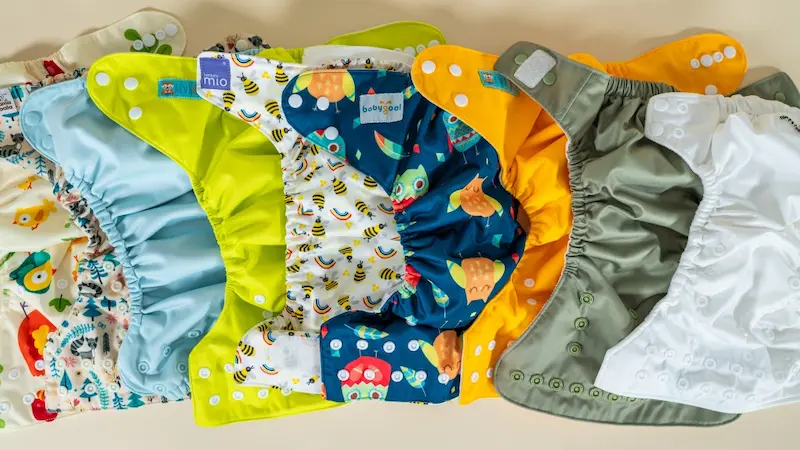
Gone are the days of only flats and pins. Today’s cloth diapers are systems designed for convenience. Think of this as your menu. You don’t need to order everything; you just need to find what looks good to you.
1. Pocket Diapers
- How they work: A waterproof shell (the pocket) with a fleece or suedecloth lining. You “stuff” absorbent inserts into the pocket through an opening in the back.
- Ease of Use: Very easy. Stuff clean ones after laundry, then use like a disposable.
- Cost: Mid-range. You need shells and inserts.
- Drying Time: Inserts and shells dry separately, so relatively fast.
- Best For: Parents who want convenience and customizable absorbency. The gateway diaper for many.
2. All-in-Ones (AIOs)
- How they work: The diaper equivalent of a disposable. The absorbent layers are sewn directly into the waterproof shell.
- Ease of Use: The easiest. No assembly required.
- Cost: Highest per diaper.
- Drying Time: Slowest, because the thick, sewn-in layers take forever to dry.
- Best For: Daycare, dads/grandparents who want zero learning curve, and parents who value ultimate convenience over drying time.
3. All-in-Twos (AI2s) / Hybrids
- How they work: A waterproof shell (cover) and a snap-in or lay-in absorbent insert. The cover can be reused for multiple changes if just the insert is wet.
- Ease of Use: Very easy. Just snap/place the insert in.
- Cost: Can be economical, as you need fewer shells than inserts.
- Drying Time: Fast, as inserts and shells are separate.
- Best For: Eco-conscious parents (less laundry), and those who like flexibility. The great pocket vs all in one diapers debate often includes AI2s as a happy medium.
4. Fitteds & Covers
- How they work: A highly absorbent, shaped diaper (the fitted) made of thirsty fabric like bamboo or hemp. It requires a separate waterproof cover.
- Ease of Use: Moderate. It’s a two-part system.
- Cost: Moderate to high.
- Drying Time: Fitteds dry slowly; covers dry fast.
- Best For: Nighttime, heavy wetters, and parents who prioritize absorbency and natural fibers.
5. Prefolds/Flats & Covers
- How they work: The classic. A rectangular cloth (flat) or a pre-folded, multi-layered rectangle (prefold) is folded, placed on baby, and secured with a Snappi (no pins!), then covered with a waterproof shell.
- Ease of Use: Highest learning curve but very cheap and versatile.
- Cost: Lowest.
- Drying Time: Very fast.
- Best For: How to start cloth diapering on a budget, parents who love the simplicity and control of a truly traditional system.
Section 2: The Essential Toolkit – What You Really Need to Start
You don’t need a Pinterest-perfect nursery. You need a practical stash.
- The Starter Stash (Full-Time): 20-30 diaper changes. For pockets, that’s 6-8 shells and 24-30 inserts. For AI2s, 4-6 shells and 24-30 inserts. For prefolds, 24-30 prefolds and 4-6 covers.
- 2 Large Hanging Wet Bags: For diaper bag changes on the go.
- 1 Diaper Pail Liner: A large, waterproof bag that lines your trash can or dedicated pail.
- A Sprayer & Spray Pal (for later): Once baby starts solids (around 6 months), a sprayer hooked to your toilet is a game-changer for removing poop.
- Optional but Helpful: Reusable wipes (old cotton t-shirts work great!), disposable liners for travel or diaper cream days.
My biggest advice? Don’t buy one of everything at first. Pick one system that appeals to you and get a small stash. You can always add later.
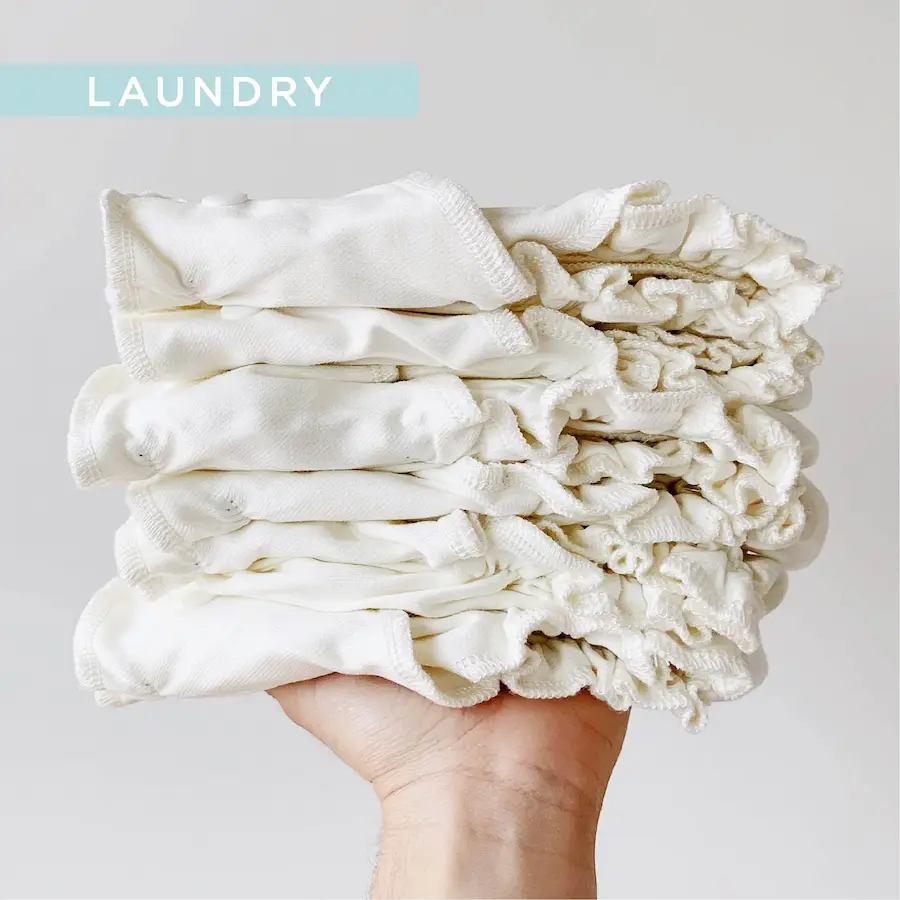
Section 3: The Laundry Routine Decoded – From “Ew” to Easy
This is the linchpin. Get this right, and 90% of your problems vanish. Forget the old lore; this is a simple, scientific process.
Step 1: Storage – The Dry Pail Method.
No soaking! Just toss used diapers (poop scraped/sprayed off once on solids) into a lined pail with a lid. Every 2-3 days, you wash. Simple.
Step 2: The Wash Cycles – The Dynamic Duo.
Your washer should be 2/3 to 3/4 full for the main wash. If your stash is small, add small towels or baby clothes to bulk it up. Diapers need to agitate against each other to get clean. Think “stew,” not “soup.”
[Image Suggestion URL: A diagram of a washing machine drum showing diapers loosely placed (too empty) vs. a drum that is 2/3-3/4 full with diapers agitating in water (just right). Alt text: Diagram showing the correct drum fullness for an effective cloth diaper main wash cycle.]
- Pre-Wash: A short (30-60 min) cycle with cold or warm water and a half dose of detergent. This flushes out the waste.
- Main Wash: A long, heavy-duty cycle with HOT water and a full dose of detergent. This is where the deep cleaning happens.
Step 3: Drying. Line-dry covers/PUL shells (sunlight bleaches stains!) to prolong their life. Tumble dry inserts and prefolds on low or medium.
Subsection: The Great Detergent Debate
Searching for the single best detergents for cloth diapers is a rabbit hole. The truth is, you need an effective cleaner, not a magical “cloth diaper” potion.
- What to Look For: A detergent with sufficient surfactants (cleaning power). Powdered detergents often work better than liquids for hard water.
- What to Avoid: Fabric softeners, dryer sheets, and “natural” soaps like Castile or homemade recipes, which leave a residue that causes repelling and stink.
- The Framework:
- Mainstream Detergents (Tide, Persil, Gain): Often the most effective. They are formulated to handle organic matter (like food and body soil). Don’t be afraid of them.
- “Cloth-Specific” Brands: Many work well, but read reviews. They are not inherently superior.
- The Crucial Variable: WATER HARDNESS. This dictates everything. If you have hard water, you need more detergent and may need a water softener like Borax or Calgon in the main wash. Soft water needs less detergent. A cloth diaper wash routine for hard water is different! Find out your water hardness (test strips or your municipal website).
Section 4: Troubleshooting Clinic – Solving Common Problems
Problem: Ammonia Smell (Sharp, eye-burning smell as soon as baby pees).
- Cause: Urine crystals have built up in the fibers due to incomplete washing.
- Fix: Do a cloth diaper stripping wash guide process: a long, hot wash with no detergent, followed by multiple rinses until water runs clear. Then, reassess your main wash routine—likely more detergent or addressing water hardness.
Problem: Barnyard Smell (Musty, sour smell out of the dryer).
- Cause: Almost always a dirty diaper. The main wash isn’t robust enough (not enough detergent, not hot enough, not enough agitation/bulking).
- Fix: Strip wash (as above), then immediately fix your main wash. Increase detergent, ensure hot water, and bulk the load properly.
Problem: Repelling/Leaking (Liquid beads up and runs off the fabric instead of soaking in).
- Cause: Either detergent/mineral buildup (a waxy coating) or the waterproofing of the cover is failing.
- Fix: For inserts/prefolds, a strip wash will remove buildup. For covers, if repelling persists after a wash, the PUL layer may be compromised and it’s time to replace.
Problem: Diaper Rash with Cloth.
- Cause: Could be sensitivity to a detergent residue (do an extra rinse cycle), moisture (change more frequently), or friction.
- Fix: Use a fleece liner to keep baby’s skin drier. Ensure diapers are thoroughly rinsed. Use a cloth-safe barrier cream (like coconut oil or a zinc cream with a liner).
Problem: Stubborn Stains.
- Fix: SUNNING. This is the miracle. Wash diapers, then hang them wet in direct sunlight. UV rays break down organic stains. For persistent stains, try a paste of blue Dawn and baking soda before sunning.
Section 5: Life with Cloth – Practical Tips & Myth Busting
- Daycare: Many are open to it! Provide a wet bag and pre-stuffed pockets or AIOs.
- Traveling with cloth diapers: It’s doable. Use a large wet bag, and consider disposables for flights or hybridizing.
- Nighttime: Use a heavily stuffed pocket, a fitted with a wool cover (yes, wool!), or add a hemp booster for extra absorbency.
- The Myth: “It’s a part-time job!” The reality? 2-3 extra loads of laundry per week, which you load and forget. The active time is minimal.
Conclusion: You Are More Capable Than You Think
Cloth diapering is a skill, like driving a car or baking bread. It feels foreign at first, but soon it’s just part of your rhythm. You are not just changing a diaper; you’re making a choice that benefits your child, your budget, and the planet they’ll inherit. Start small. Be patient with yourself. Celebrate the wins the first successful wash, the first cute outfit-clad diaper change, the first month without buying a box of disposables.
You’ve got this. And a whole community of us who have been on the laundry room floor, bewildered, are cheering you on.
Frequently Asked Questions (FAQ)
Is the startup cost really worth it?
Absolutely. Even buying brand-new, mid-range diapers, most families break even by month 6-8 and save $1,000+ overall. Buying used or using prefolds saves even more, faster.
How do I handle poop?
For newborn, exclusively breastfed poop: it’s water-soluble, so just toss the whole diaper in the pail—it washes out. Once solids are introduced (or with formula-fed poop), you need to dump/spray/scrape solids into the toilet before storing. A diaper sprayer makes this quick.
Can I use cloth part-time?
100%! Any cloth diaper used is one less in a landfill. Many start with just using cloth at home during the day. There are no rules.
What about wipes?
Reusable wipes are the natural partner! Use a solution of water, a drop of baby wash, and a drop of oil on small cotton cloths. Toss them in the wet bag with the diapers and wash together.
When should I start? Can I start with a newborn?
You can! Many diapers are one-size (8-35 lbs), but they often fit poorly before 10-12 lbs. For a better newborn fit, consider a small stash of newborn-sized diapers or use prefolds.
How do I know my water hardness?
Buy test strips online or at a pet/aquarium store. You can also call your local water municipality. This is the single most useful piece of data for your cloth diaper troubleshooting success.