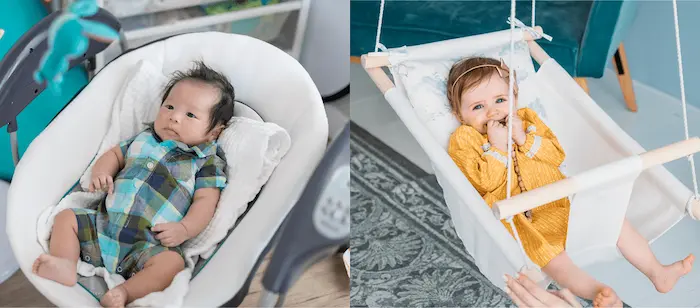
You’ve just fed the baby, changed the baby, burped the baby, and for approximately 90 seconds, the baby is calm. You need to use the bathroom. You need to eat something that requires two hands. You need to remember what it felt like to not be touched for five consecutive minutes.

This is the moment you start eyeing that registry item you weren’t sure about: the rocker, the bouncer, the swing. These devices promise something miraculous: a safe place to put the baby down while you briefly reclaim your humanity.
But here’s the problem. Walk into any baby store or scroll through any parenting forum, and you’ll be hit with a tidal wave of options. There are rockers that vibrate. Bouncers that bounce themselves. Swings that mimic the motion of a car ride or a parent’s sway. The terminology blurs together, the price tags vary wildly, and underneath it all is the nagging question every parent carries: Is this actually safe?
Let’s cut through the marketing noise. As a pediatric health writer, I’m going to help you understand the real differences between rockers, bouncers, and swings. More importantly, I’m going to give you the safety framework you need to use them responsibly, because the most expensive swing in the world isn’t worth a thing if it’s not used safely.
The Most Important Thing You Need to Know First
Before we compare features, before we discuss motion types or price points, we need to have a direct, unambiguous conversation about safety.
In 2022, the Safe Sleep for Babies Act was signed into law, banning inclined sleep products for infants. Why? Because the American Academy of Pediatrics and the Consumer Product Safety Commission have amassed overwhelming evidence that inclined surfaces—anything over 10 degrees—pose a serious risk of positional asphyxiation (aap.org, cpsc.gov).
Here’s what this means for rockers, bouncers, and swings: These are not sleep devices.
Every single product we’re discussing today is designed for supervised awake time only. If your baby falls asleep in a rocker, bouncer, or swing—and they will, because newborns sleep approximately seventeen hours a day and will do so anywhere—you need to move them. Gently pick them up and transfer them to a firm, flat, bare crib or bassinet that meets safe sleep standards.
This isn’t me being overly cautious. This is the law, and it’s grounded in the tragic reality that babies have died in these products when used for unsupervised sleep. The National Institute of Child Health and Human Development emphasizes that the safest sleep space for an infant is a flat, firm surface with no soft bedding (nichd.nih.gov).
Say it with me now: Rockers for rocking. Bouncers for bouncing. Swings for swinging. Cribs for sleeping. Got it? Good. Let’s move on.
The Contenders: Understanding Your Options
Now that we’ve established the non-negotiable safety rule, let’s look at what each device actually does.
The Baby Rocker: Gentle Motion, Grounded Base
A rocker is exactly what it sounds like: a seat, often with a rounded or curved base, that rocks back and forth when you push it or when the baby moves. Think of it as a miniature rocking chair for your infant.
Motion Profile: Rockers provide a gentle, back-and-forth gliding motion. Some are manually operated (you push), while newer models offer powered rocking with different speed settings. Many also include vibration, which is a different sensation entirely—a gentle buzzing that many newborns find soothing.
Typical Features:
- Lightweight and highly portable
- Often foldable for storage or travel
- May include a toy bar with dangling attachments
- Some have adjustable recline positions
- Weight limits typically range from 20-25 pounds
Best For: Parents who want a portable, affordable option they can move from room to room. Rockers are excellent for keeping the baby nearby while you’re making dinner, folding laundry, or sitting on the couch. They take up minimal floor space and are easy to tuck away when not in use.
The Developmental Angle: The WHO emphasizes that infants need opportunities for movement and interaction with their environment (who.int). A rocker allows a baby to observe household activity, which supports visual development and social engagement, all while being safely contained.
The Baby Bouncer: Springs and Movement
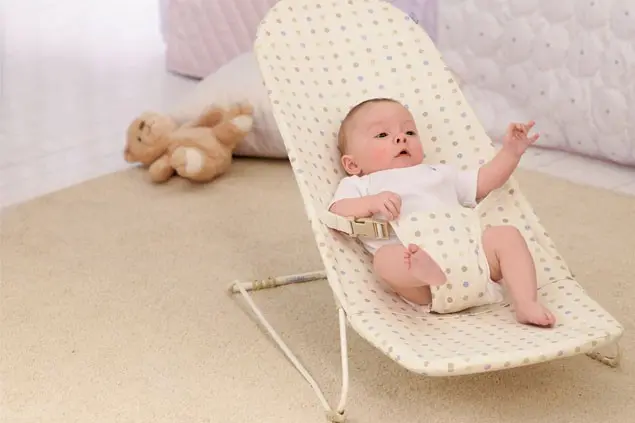
This is where terminology gets tricky, because many people use “bouncer” and “rocker” interchangeably. Technically, a bouncer uses springs or flexible straps attached to a frame, allowing the seat to bounce up and down when the baby moves or when you gently push down on it.
Motion Profile: Bouncers provide a vertical or bouncing motion, rather than a horizontal rocking motion. Some babies find this deeply satisfying, almost like being gently jiggled in your arms. Many bouncers also include vibration as a separate feature.
Typical Features:
- A frame that holds a fabric seat suspended by springs or elastic
- Often very lightweight and portable
- Some have a locking mechanism to turn the bouncing feature off
- May include a toy bar or hanging toys
- Weight limits typically around 20 pounds
Best For: Newborns and young infants who haven’t yet outgrown the weight limit. The bouncing motion can be particularly soothing for babies who seem to need constant movement. The portability makes them ideal for parents who want to keep the baby in the bathroom doorway while they shower (a true luxury in the early days).
The Soothing Factor: The Mayo Clinic notes that rhythmic motion is one of the most effective ways to calm a fussy infant (mayoclinic.org). For some babies, that motion needs to be bouncing rather than rocking. It’s highly individual.

The Baby Swing: Powered Motion, Larger Footprint
The swing is the luxury SUV of the infant soothing world. These are larger, powered devices that provide continuous, automatic motion without any effort from you.
Motion Profile: Swings offer the widest variety of motion types. Some swing side-to-side, others front-to-back, and many offer multiple directions and speeds. High-end models can mimic the motion of a car ride or a parent’s specific swaying pattern.
Typical Features:
- Powered by batteries or a plug-in cord
- Significantly larger footprint than rockers or bouncers
- Multiple speed settings
- Often includes built-in music, nature sounds, or white noise
- Many have removable toy bars and plush inserts for newborns
- Higher weight limits, often up to 25-30 pounds
- Some fold for storage, though they remain bulky
Best For: Parents who need sustained, hands-free soothing. If you have a colicky baby who seems to need motion for extended periods, a swing can be a lifesaver. They’re also valuable for babies who don’t respond to manual rocking or bouncing.
The Exhausted Parent Factor: The American College of Obstetricians and Gynecologists recognizes that parental mental health and physical recovery depend on having moments of respite (acog.org). A swing that can soothe a fussy baby for 20 minutes while you sit nearby with a cup of tea is not a luxury—it’s a tool for maintaining your well-being.
Head-to-Head Comparison: Making Your Choice
Still unsure which one belongs in your home? Let’s put them side by side.
Motion Type and Soothing Potential
- Rocker: Gentle, horizontal motion. Good for calm babies or pre-sleep wind-down.
- Bouncer: Vertical, jiggly motion. Excellent for fussy babies who need more vigorous input.
- Swing: Programmable, consistent motion. Best for babies who need sustained soothing.
Portability and Storage
- Rocker: Highly portable. Many fold flat for storage or travel.
- Bouncer: Extremely lightweight. Easy to carry room to room.
- Swing: Heavy and bulky. Requires dedicated floor space.
Price Range
- Rocker: $40-$100 generally
- Bouncer: $30-$80 generally
- Swing: $80-$300+, with smart swings at the high end
Age Range and Longevity
- Rocker: Birth to approximately 6 months (varies by weight limit)
- Bouncer: Birth to approximately 4-5 months (lower weight limits)
- Swing: Birth to approximately 9 months (higher weight limits, longer use)
Best Use Case
- Rocker: Keeping baby nearby during daily activities
- Bouncer: Quick soothing in multiple rooms, travel
- Swing: Extended hands-free time, soothing difficult babies
Matching the Device to Your Baby’s Needs
Every baby arrives with their own personality, and what works for one may do nothing for another. Here’s how to match the device to your specific situation.
For the Colicky or Fussy Baby
If your baby has periods of inconsolable crying, especially in the evening, a swing may be your best investment. The consistent, rhythmic motion can interrupt crying cycles in a way that manual soothing sometimes cannot. Look for swings with multiple motion options and speeds so you can experiment with what works.
The Mayo Clinic notes that colic affects up to 25% of infants and typically resolves by 3-4 months (mayoclinic.org). A swing is a temporary tool for getting through this challenging period, not a long-term solution.
For the Baby with Reflux
Babies with gastroesophageal reflux often need to remain upright after feedings. Many rockers and bouncers have a more reclined position, which can actually worsen reflux symptoms. If this is your situation, look for a device with a more upright seated position, or consult your pediatrician about the best positioning for your baby’s specific needs.
For the Apartment Dweller
If space is at a premium, skip the swing. A lightweight rocker or bouncer that can be tucked into a corner or closet when not in use will serve you better. Many parents in small spaces also appreciate that rockers and bouncers can be moved to whatever room the parent is in, rather than requiring the baby to be in one designated spot.
For the Multi-Level Home
You need portability. A swing on the second floor does you no good when you’re making coffee in the kitchen. Consider a lightweight bouncer that’s easy to carry, or buy two inexpensive rockers—one for upstairs, one for down. Many parents keep a bouncer in the bathroom specifically so they can shower while the baby is safely nearby.
For the Baby Who Hates Being Still
Some newborns arrive already impatient with the concept of stationary existence. These babies often do well in swings with a wide range of motion options. The ability to switch from side-to-side to front-to-back can keep them engaged longer. Some high-tech swings even connect to apps where you can customize motion patterns.
Safety Features You Must Look For
Regardless of which category you choose, certain safety features are non-negotiable.
The 5-Point Harness
Look for a harness that straps over both shoulders, around the waist, and between the legs. This five-point distribution keeps the baby secure and prevents slumping, which can compromise breathing. The Consumer Product Safety Commission has clear standards for restraint systems in nursery products (cpsc.gov).
A Wide, Stable Base
Tip-overs are a real risk, especially as babies get more mobile. The base should be wide and sturdy. If you can tip it over with a gentle push, don’t buy it.
Weight Limits
Observe them. Strictly. A device used beyond its weight limit can fail catastrophically.
No Soft Bedding
The device should not come with a thick, padded insert or fluffy liner. These are suffocation risks. The seat should be firm, with the harness holding the baby securely.
JPMA Certification
Look for the Juvenile Products Manufacturers Association certification seal, which indicates the product has been tested against established safety standards.
The Critical Warning: Repeats the Dangers of Inclined Sleep
I’m going to say this again because it is the single most important thing you will read in this article, and because the temptation to let a sleeping baby stay in a comfortable device is overwhelming in the middle of the night.
Do not let your baby sleep in a rocker, bouncer, or swing.
When a baby falls asleep in an inclined position, their head can fall forward, chin to chest, kinking their airway. This is called positional asphyxiation. The baby doesn’t struggle or cry. They simply stop breathing.
The AAP’s safe sleep guidelines are unequivocal: infants should be placed on their backs, on a firm, flat surface, with no soft objects or loose bedding (aap.org). Inclined products, even those marketed for sleep, have been linked to dozens of infant deaths, leading to the 2022 federal ban.
If your baby falls asleep in a rocker, bouncer, or swing, move them. Yes, they may wake up. Yes, it’s frustrating. But it is also non-negotiable. The CDC’s injury prevention data underscores that these seemingly innocent moments of convenience can have devastating consequences (cdc.gov).
How Long Can Baby Stay in These Devices?
Even for awake time, limits exist. The general recommendation from pediatric physical therapists is to limit time in any contained device (rockers, bouncers, swings, car seats, etc.) to 20-30 minute increments, with a total of no more than 1-2 hours per day.
Why? Babies need to move. They need to kick, stretch, practice rolling, and experience the world from different positions. The WHO emphasizes that physical activity and unrestricted movement support healthy development (who.int). Too much time in any container can delay motor skill development.
Think of these devices as tools, not habitats. Use them when you need them, but prioritize floor time on a play mat where your baby can move freely.
The Bottom Line: Do You Need One?
Here’s the honest answer: you don’t need any of these devices. Babies survived for millennia without powered swings and vibrating bouncers. Parents held them, wore them in slings, or laid them on blankets on the floor.
But parenting a newborn in the modern world is hard. The sleep deprivation is real. The physical demands are intense. The constant touching can lead to overstimulation and exhaustion. Having a safe place to put the baby down—a place where they are contained, secure, and often soothed—can be the difference between a parent who copes and a parent who crumbles.
So no, you don’t need a swing. But if a swing gives you twenty minutes to eat a hot meal, use the bathroom alone, or simply stare at a wall without being touched, that swing is supporting your mental health. And the ACOG would tell you that parental well-being is essential for infant well-being (acog.org).
Making Your Final Decision
Here’s my recommendation based on thousands of conversations with parents:
- If you buy one device, make it a lightweight, portable rocker or bouncer. It’s versatile, affordable, and will serve you well in those early months.
- If you have space and budget for two, add a swing. Use the rocker for daytime portability and the swing for those witching hours when nothing else works.
- If you live in a tiny apartment, stick with the rocker or bouncer. The swing will frustrate you with its bulk.
- If you have a colicky baby, prioritize the swing. The investment is worth your sanity.
Conclusion: Safety First, Convenience Second
The world of infant gear is designed to sell you on convenience, aesthetics, and features you never knew you needed. But beneath all the marketing, the only thing that truly matters is whether a device keeps your baby safe while making your life marginally easier.
Rockers, bouncers, and swings can all be valuable tools in your parenting arsenal. They can soothe a fussy infant, give your arms a break, and allow you to reclaim small pockets of your day. But they are not substitutes for a safe sleep environment. They are not babysitters. They are not places for overnight or even extended naps.
Use them wisely. Use them safely. And when that beautiful, exhausting newborn finally falls asleep in your arms, cherish the moment—because one day, sooner than you think, they’ll be too big for all of it.