There’s a quiet moment that reveals everything: after a newborn’s cry, when their eyes lock onto yours, searching not just for food or comfort but for recognition. Or the determined, wobbly reach of a four-month-old for a wooden ring, their whole being focused on the task. Traditional parenting often views the infant as a passive recipient of care — to be fed, cleaned, entertained, and put to sleep. But what if we saw them from the start as active, competent, whole people, and our role was less to direct their development than to prepare an environment and a relationship in which their innate capabilities could unfold?
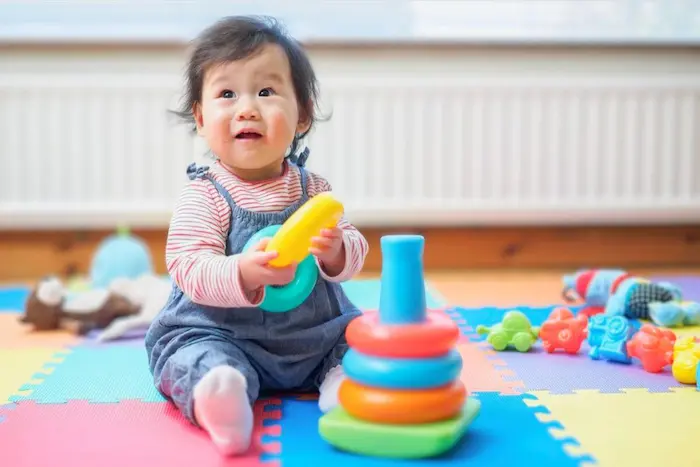
That’s the synergy of Montessori and RIE for infants. Montessori provides the “prepared environment” — a physical space designed for discovery and independence. RIE (Resources for Infant Educarers), founded by Magda Gerber, provides the “prepared relationship” — a framework for respectful, authentic caregiving. Together they ask not “How can I make my baby smarter or happier?” but “How can I create the conditions for my baby to reveal who they already are?”
The Heart of Montessori & RIE
Montessori, founded by Dr. Maria Montessori, emphasizes the “absorbent mind” of the young child. Core tenets include follow the child (observing natural interests to guide what you offer), the prepared environment (a safe, accessible, orderly space that invites exploration), and freedom within limits (choice and movement within clear, consistent boundaries that keep the child safe).
RIE, Magda Gerber’s philosophy, is built on respect — seeing even the youngest infant as a unique human being, not an object. Key principles include respectful caregiving (involving the child in every routine), authentic experiences, a “wants nothing” quality of attention (being fully present without an agenda), and uninterrupted, self-directed play. Montessori prepares the stage; RIE teaches us to be a respectful, observant co-star.
The Foundation: A “Yes Space”
The cornerstone is the “yes space” — a fully safe, infant-accessible area where exploration isn’t just allowed but encouraged. It replaces the constant “No, don’t touch that!” with confident freedom. To create one: choose an area where life happens (a corner of the living room, not an isolated pen); anchor all furniture to the wall (non-negotiable); make the floor the stage with a simple firm play mat; add low, sturdy shelving holding just 4–6 materials so your child can choose their own activity; mount a low, secure mirror at floor level (a classic Montessori tool for self-recognition); and remove all hazards by getting on your hands and knees to see the world from their level. Our crawling guide covers how free movement in this kind of space supports motor development.
Respectful Caregiving: Slow, Connected Routines
RIE reframes caregiving moments — diapering, feeding, bathing, dressing — not as chores to rush but as the primary opportunities for connection, language, and respect:
- Involve the infant. Before you pick them up, announce it: “I see you’re awake. I’m going to pick you up for a diaper change.” Wait for a moment of acknowledgment — a look, a stilling of the limbs.
- Move slowly and narrate. “I’m unbuttoning your onesie. Now I’m lifting your left leg. You feel the cool wipe.” This includes them in what’s happening to their own body.
- Sportscast during play. Sit nearby, present but not intervening, and narrate what you see without praise or correction: “You picked up the bell. You’re shaking it. It’s making a sound.” This says, “I see you, and your work matters.”
- “Wants nothing” time. Spend 5–10 minutes a day simply being with your baby with no goal — not to feed, change, teach, or entertain. Just present and available, which cultivates deep security. Learning to read their signals helps here — see our guide to baby cues.
Fostering Independence & Natural Movement
Independence isn’t taught so much as allowed to emerge by removing obstacles. For an infant, it’s rooted in movement and choice.
Unrestricted movement. Dress your baby in simple, comfortable clothing that doesn’t restrict kicking, rolling, or crawling. Prioritize floor time — the floor is the infant’s gym — with ample tummy time on a firm surface, and avoid overusing containers (swings, bouncers, “sit-me-up” seats) that prop babies into positions they can’t get into or out of on their own and can interfere with the natural sequence of gross-motor development. And trust the process: rather than “helping” them roll, sit, or walk, let them reach each milestone through their own effort, which builds genuine confidence.
The Montessori floor bed. A simple mattress low to the floor in a fully safe room lets a child get in and out independently as they become mobile, following their natural sleep/wake rhythm and extending the “yes space” into the bedroom. If you choose one, it must still follow safe-sleep basics: a firm, flat mattress; babies placed on their back to sleep; no pillows, soft bedding, blankets, or bumpers for a baby under 12 months; and a completely hazard-proofed room. The AAP recommends room-sharing (not bed-sharing) for at least the first 6 months, and many families keep a crib or bassinet early on and only move to a floor bed once the baby is older and mobile — a good question for your pediatrician.
Curated materials, not “toys.” Instead of loud, flashing plastic, offer a small, rotating set of real materials — a “minimal toys” approach. A treasure basket holds a few safe, natural everyday objects (a wooden spoon, a silicone pastry brush, a smooth wooden cup) to explore real-world textures and weights. Add simple grasping objects (wooden rings, silicone teethers, soft cloth balls) and cause-and-effect items (an object-permanence box, a basket of scarves to pull). One safety note: babies mouth everything, so supervise treasure-basket play closely and include only items too large to swallow, avoiding anything small enough to choke on or long enough (like ribbon or string) to wrap around fingers or the neck. Our guide to the best toys by age pairs well with this approach.
Talking With Your Baby, Not At Them
We communicate respect through our words and our listening. Speak in your normal, warm tone with rich vocabulary — instead of “See the doggie?” try “Look at the golden retriever. Her fur looks so soft.” After you speak, pause and look expectantly, giving your baby time to process and respond with a coo, smile, or gesture — this models true conversation. And when they struggle or cry, resist the immediate fix and first acknowledge the feeling: “You’re working so hard to reach that ball and it rolled away. That’s disappointing.” You’re not ignoring them; you’re validating their experience, the foundation of emotional intelligence.
The Parent’s Mindset: From “Doer” to “Observer & Guide”
This is the hardest and most rewarding shift, because our instinct is to entertain, stimulate, and “help.” Instead, practice observation — sit back and watch what your baby looks at, what their hands gravitate toward, how they solve the problem of a toy just out of reach; observation tells you what they’re ready to learn. Resist the urge to jump in: if they’re focused on getting a ring onto a post, biting your tongue is an act of love, since interrupting breaks their concentration and quietly suggests their efforts aren’t enough. And trust the timeline — in a prepared environment with a respectful relationship, your child will unfold in their own unique way, and comparison only steals the joy.
Frequently Asked Questions
Only if the room isn’t fully child-proofed. The mattress sits directly on the floor, so a “fall” is an inch or two onto a soft surface, but the room must be free of cords, unstable furniture, and small objects, and the bed must follow safe-sleep basics (firm flat mattress, baby on their back, no soft bedding under 12 months). Many families start with a crib or bassinet and transition once the baby is mobile. It takes meticulous preparation — and it’s worth checking with your pediatrician.
Usually the opposite. Too many toys lead to overstimulation and shallow engagement, while a few carefully chosen, open-ended materials allow deep, sustained concentration — the foundation of learning. Rotating the small set keeps things fresh, and a little boredom can spark creativity and problem-solving.
Communicate in advance and stay flexible: “We’re giving him lots of floor time to move freely — is there a clear spot where we could put a blanket?” Bring a travel crib for sleep. The goal is to keep your respectful approach where you can, not to control every environment, and it’s a natural chance to model and explain your choices.
Respectful parenting isn’t permissive parenting. The “yes space” is itself a limit — total freedom within it — and you still set clear, consistent boundaries around safety and caregiving. By acknowledging feelings and involving children in routines, you tend to reduce power struggles: children who feel heard often escalate less, because they don’t have to fight to be seen.
The difference is intention and presence. This approach actually requires more engagement of a different kind — mindful observation, deliberate preparation of the environment, and focused, undistracted connection during caregiving. It’s the active work of stepping back so the child can step forward, which is the opposite of disengagement.
The Bottom Line
Adopting Montessori and RIE ideas isn’t about creating a “perfect” child or following rigid rules — it’s an invitation to a relationship built on respect, observation, and trust. It asks us to slow down and see the extraordinary in ordinary moments, turning diaper changes into conversations, floor time into expeditions, and frustration into chances for emotional coaching. You’re not building a better baby; you’re providing the safe, respectful ground in which their unique self can take root. The result is often not just a capable infant, but a calmer, more connected, more confident parent — and it begins with a single respectful pause.
This article is for general information and is not a substitute for personalized medical advice. Always follow AAP safe-sleep guidance for infant sleep.
References
- Resources for Infant Educarers (RIE). RIE Basic Principles.
- American Montessori Society. What Is Montessori?
- American Academy of Pediatrics (HealthyChildren.org). A Parent’s Guide to Safe Sleep.