Forget the aisles of flashing, beeping plastic. The most sophisticated learning tool in your home isn’t a gadget—it’s play. To a child, play is not a frivolous break from learning; it is the very work of childhood. It is through play that babies, toddlers, and preschoolers wire their brains, constructing the neural architecture for future thinking, problem-solving, creativity, and emotional resilience. Choosing the right toys isn’t about entertainment; it’s about being a thoughtful architect of your child’s cognitive development.
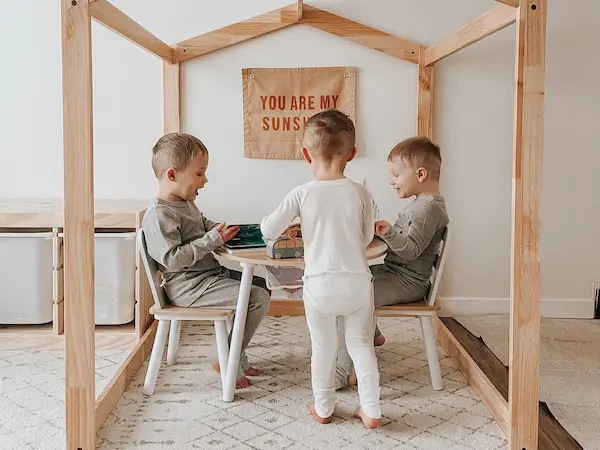
This guide moves beyond generic lists to connect specific types of play and toys directly to the remarkable developmental milestones unfolding in your child’s mind. We’ll cut through the clutter, address common parental dilemmas, and provide an evidence-based, age-by-age roadmap to selecting toys that truly matter. The goal is not to fill a playroom, but to empower you with the knowledge to foster a rich, stimulating, and joyful learning environment from infancy through the preschool years.
The Science of Play: More Than Just Fun
When a baby bats at a mobile, a toddler stacks a block tower, or a preschooler pretends a cardboard box is a spaceship, their brain is firing at an astonishing rate. Play is the primary vehicle for cognitive development, serving as a full-brain workout. It strengthens neural pathways through a process called synaptic pruning—”use it or lose it” for the brain—where frequently used connections become permanent, and unused ones fade away.
This process builds critical foundations:
- Executive Function: The mental skills of working memory, flexible thinking, and self-control are honed through games with rules, turn-taking, and complex pretend play.
- Sensory Integration: The brain learns to process sights, sounds, touches, and movement together. Sensory play with sand, water, or textured balls is fundamental for this integration.
- Social-Emotional Intelligence: Cooperative and parallel play teach empathy, negotiation, and understanding social cues.
- Problem-Solving & Creativity: Figuring out how a puzzle piece fits or inventing a new use for a blanket fosters innovative thinking and resilience.
In short, play releases neurotransmitters like dopamine, which not only makes learning enjoyable but also enhances attention and memory formation. It is the biological imperative for growth.
Beyond the Toy Box: You Are the Ultimate “Toy”
Before we delve into objects, a crucial principle: the most powerful catalyst for baby brain development through play is you. Human interaction is irreplaceable. The back-and-forth of peek-a-boo teaches object permanence. Narrating your day builds language circuits. Singing songs with gestures links movement to memory. A loving, responsive caregiver who engages in playful interaction provides the secure base from which all exploration springs. No toy can replicate this. Consider any item you purchase as a tool to enhance this primary relationship.
The Age-by-Age Guide to Brain-Building Play
Newborn to 6 Months: Building Sensory Awareness
In these first months, your baby’s brain is rapidly mapping the new world of sensations. Vision is blurry, but hearing and touch are key learning channels.
Cognitive Milestones in Focus:
- Developing visual tracking and focus (especially on high-contrast patterns).
- Learning cause and effect (“I cry, and I am fed/comforted”).
- Discovering their own body and senses (bringing hands to mouth).
- Recognizing familiar faces and voices.
Play Principles for This Stage:
The world is the toy. Focus on sensory stimulation and reinforcing the security of their bond with you. Mouthing is learning—it’s a primary way infants explore texture, shape, and temperature.
Toy Recommendations & Why They Work:
- High-Contrast Cards & Mobiles: Black, white, and red patterns are easier for developing eyes to see, stimulating visual pathways and encouraging focus.
- Mirrors (Baby-Safe, Unbreakable): Babies are fascinated by faces. A safe mirror promotes self-recognition and visual tracking.
- Soft Rattles & Grasping Toys: Easy-to-hold textures encourage the palmar grasp. The sound they make introduces early cause and effect.
- Play Gyms/Activity Mats: These encourage reaching, batting, and eventually rolling, integrating motor planning with visual and auditory stimuli.
Safety & Selection Tips:
- Ensure all toys are large enough not to fit through a toilet paper tube (a standard choke test).
- Check for secure seams, non-toxic materials, and no loose parts.
- Avoid overstimulation; one or two simple items at a time are sufficient.
A Key Question Parents Ask: “Do we need flashy, electronic toys for stimulation?”
Not necessarily. While babies are drawn to lights and sounds, overly complex electronic toys can be overwhelming and often do the “thinking” for the child. Simple toys that respond directly to the baby’s action (a rattle that sounds when they shake it) are more effective for learning cause and effect. The American Academy of Pediatrics (AAP) emphasizes that hands-on exploration and human interaction are superior for early learning.
6 to 12 Months: Mastering Cause, Effect, and Problem-Solving
Mobility changes everything! As your baby learns to sit, crawl, and possibly cruise, their play becomes intentional and experimental. Their brain is now keenly focused on figuring out how the world works.
Cognitive Milestones in Focus:
- Stronger understanding of cause and effect (press a button, something happens).
- Object permanence solidifies (things exist even when hidden).
- Beginning of problem-solving (figuring out how to get a out-of-reach toy).
- Imitation of simple actions.
Play Principles for This Stage:
Support their new mobility and curiosity. Toys that reward their actions build a sense of agency. Introduce simple problems to solve.
Toy Recommendations & Why They Work:
- Stacking Cups & Nesting Bowls: These teach size relationships, object permanence (hiding a smaller cup inside), and are fantastic for bathtub or sandbox play.
- Simple Shape Sorters: This classic is a powerhouse for problem-solving, introducing spatial awareness and shape discrimination.
- Push/Pull Toys: Once crawling or walking, toys to push (like a cart) encourage gross motor development and coordination.
- Activity Cubes with Dials, Doors, and Buttons: These offer multiple cause and effect experiences in one toy, promoting fine motor skill development and persistent exploration.
Safety & Selection Tips:
- Continue vigilant choke hazard checks as everything goes in the mouth.
- Ensure push/pull toys are stable and won’t tip over easily.
- Avoid toys with sharp edges or pinch points.
A Key Question Parents Ask: “Are baby walkers safe and beneficial?”
The AAP strongly recommends against the use of infant walkers. They are a significant safety hazard, responsible for thousands of injuries annually. Crucially, they do not help babies walk sooner and can actually hinder proper muscle development and walking mechanics. Safer alternatives include stationary activity centers (used for limited periods) or sturdy push toys for a child who is already pulling to stand.
1 to 2 Years (Toddlers): Exploring Independence and Symbolic Thought
The toddler brain is a whirlwind of connections. Language explodes, symbolic play (pretending) emerges, and their physical prowess allows for more complex manipulation.
Cognitive Milestones in Focus:
- Explosive growth of vocabulary and understanding.
- Emergence of symbolic play (a block becomes a phone).
- Solving more complex problems (multi-step tasks).
- Understanding simple categories and sequences.
Play Principles for This Stage:
Embrace the mess! Sensory exploration is key. Offer open-ended toys for toddlers that have no single “right” answer. Foster their budding imagination.
Toy Recommendations & Why They Work:
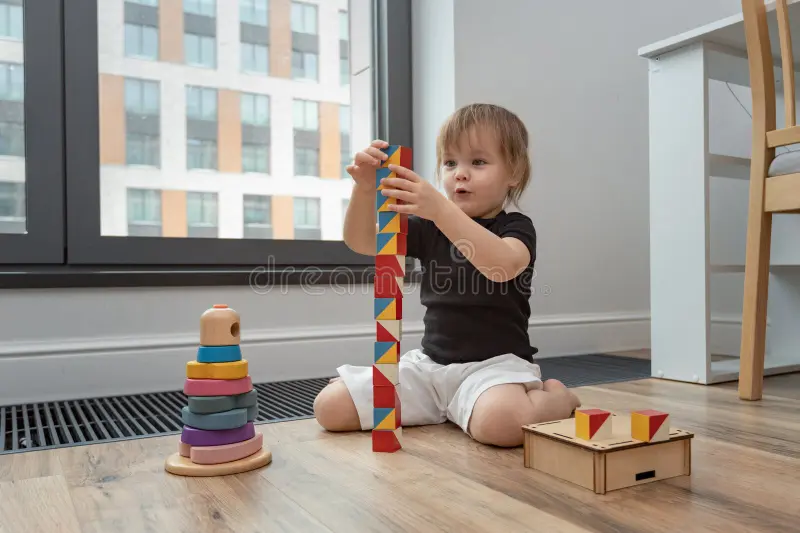
- Basic Building Blocks (Large, Wooden): The ultimate open-ended toy. They teach gravity, balance, spatial reasoning, and become symbols for anything in pretend play.
- Simple Puzzles (with Knobs): Puzzles with 2-12 pieces build visual-spatial skills, hand-eye coordination, and patience.
- Pretend Play Sets: Toy phones, baby dolls, kitchen items, and tool sets allow toddlers to imitate the world around them, a critical step in cognitive and social development.
- Sensory Bins: A container filled with dried beans, rice (supervised), water beads, or sand, with cups and spoons, provides endless tactile exploration and fine motor practice.
Safety & Selection Tips:
- Be mindful of small parts from puzzle pieces or play food.
- Ensure sensory bin materials are non-toxic and supervision is constant to prevent mouthing.
- Choose sturdy toys that can withstand throwing and banging.
2 to 3 Years: The Dawn of Complex Pretend Play and Rules
This is the golden age of imagination. Your child’s play becomes more narrative-driven and social. Their brain is now capable of holding complex ideas and following simple rules.
Cognitive Milestones in Focus:
- Complex, multi-scenario pretend play.
- Understanding of counting and basic number concepts.
- Ability to follow simple 2-3 step instructions.
- Beginning to play cooperatively with peers.
Play Principles for This Stage:
Support their storytelling. Introduce toys that encourage role-playing and cooperation. Begin simple games with rules.
Toy Recommendations & Why They Work:
- Dress-Up Clothes & Props: These allow for full immersion in symbolic play, building narrative skills, empathy, and self-expression.
- More Advanced Building Systems (Large LEGO DUPLO, Magna-Tiles): These foster engineering thinking, creativity, and understanding of magnetic/structural principles.
- Play-Dough or Modeling Clay: Excellent for strengthening hand muscles (pre-writing skill), creativity, and sensory regulation.
- Simple Board Games: Games like “Candy Land” or “First Orchard” teach turn-taking, rule-following, color matching, and how to handle winning/losing—all key executive function skills.
Safety & Selection Tips:
- Avoid costumes with long, loose ties or flammable materials.
- Continue to monitor for small parts in building sets.
- Ensure art supplies are non-toxic and washable.
3 to 5 Years (Preschoolers): Refining Skills and Abstract Thinking
The preschooler is preparing for the academic world. Their play becomes more elaborate, rule-based, and reflective of real-world logic.
Cognitive Milestones in Focus:
- Mastering early literacy and math concepts (letters, numbers, patterns).
- Sophisticated problem-solving and logical reasoning.
- Advanced cooperative play with assigned roles.
- Understanding time sequences and planning.
Play Principles for This Stage:
Provide tools for their projects. Encourage games that involve strategy, memory, and collaboration. Answer their endless “why” questions through exploratory play.
Toy Recommendations & Why They Work:
- Construction Sets with Smaller Parts (LEGO, train tracks): These require advanced planning, fine motor precision, and persistence—key toys that promote problem solving in preschoolers.
- Art Supplies for Creation (Scissors, Glue, Assorted Materials): Open-ended art projects foster creativity, planning, and a sense of mastery.
- Dramatic Play Centers (A full play kitchen, doctor’s office, market stand): These facilitate complex social negotiation, role-playing, and language development.
- Memory/Matching Games & Strategy Games: Games like “Guess Who?” or “Zingo” boost memory, attention to detail, and deductive reasoning.
Safety & Selection Tips:
- Teach safe scissor use and supervise.
- Be mindful of small parts if there are younger siblings in the home.
- Choose games with age-appropriate complexity to avoid frustration.
The Dangers of “Over-Toying” and Digital Play
More is not better. Studies suggest that too many toys can overwhelm a child, reduce attention span, and stifle creativity—a phenomenon known as playroom clutter. When faced with excess, children engage more superficially and struggle to focus deeply.
Digital Play & Screen Time: The AAP provides clear guidelines: avoid digital media (other than video chatting) for children under 18-24 months. For ages 2-5, limit high-quality programming to 1 hour per day, co-viewing to help them understand. Crucially, passive screen time does not provide the same rich, multi-sensory, physically active feedback as hands-on play. It cannot replace the cognitive development fostered by manipulating 3D objects, feeling textures, and interacting with people. Prioritize screen-free activities for cognitive growth.
Creating a Brain-Boosting Play Environment
- Rotate Toys: Keep a small selection (8-10 items) accessible and store the rest. Rotate them weekly to maintain novelty and interest.
- Create “Play Stations”: Have a defined area for reading, building, pretend play, and art. This helps organize the child’s thinking.
- Follow Their Lead: Observe what your child is drawn to and build on that interest. Are they lining things up? Introduce patterning. Obsessed with dinosaurs? Provide books, figurines, and materials to create a dinosaur land.
- Embrace Boredom: Boredom is the precursor to creativity. Resist the urge to constantly entertain. It is from boredom that the most imaginative, self-directed play often emerges.
Red Flags & When to Consult a Professional
While children develop at their own pace, consistent lack of interest in play or social interaction can be a sign to seek guidance. Consult your pediatrician or a child development specialist if by 18 months your child:
- Does not engage in any pretend play.
- Shows no interest in playing with toys or other children.
- Has extreme difficulty with changes in play routine or exhibits very repetitive, inflexible play patterns.
- Does not try to copy your actions or engage in simple interactive games.
Early intervention is key. Trust your instincts and use resources like the CDC’s Developmental Milestone checklists as a guide.
Conclusion: The Heart of the Matter
Choosing the best cognitive development toys is less about buying the latest trend and more about understanding the remarkable learner in front of you. The optimal toy is one that matches your child’s developmental stage, challenges them just enough, and invites interaction—with the world and with you. It is open-ended, safe, and, above all, fun.
Remember, a cardboard box can be a castle, a spaceship, or a race car in the hands of a child whose imagination has been nurtured. By focusing on the principles of play—safety, simplicity, and responsive interaction—you are not just filling a toy box. You are thoughtfully stocking the workshop where your child’s mind, creativity, and confidence are built, one joyful, brain-building moment at a time.
References & Authoritative Sources:
- American Academy of Pediatrics. (2023). The Power of Play: How Fun and Games Help Children Thrive. HealthyChildren.org. https://www.healthychildren.org/English/ages-stages/toddler/fitness/Pages/Caution-Walkers-Are-Dangerous.aspx
- American Academy of Pediatrics. (2018). Media and Young Minds. Pediatrics. https://publications.aap.org/pediatrics/article/138/5/e20162591/60321/Media-and-Young-Minds
- Centers for Disease Control and Prevention (CDC). (2023). Developmental Milestones. https://www.cdc.gov/ncbddd/actearly/milestones/index.html
- Zero to Three. (2024). The Importance of Play in Early Childhood. https://www.zerotothree.org/resource/the-importance-of-play-in-early-childhood/
- Mayo Clinic. (2022). Infant development: Birth to 3 months. https://www.mayoclinic.org/healthy-lifestyle/infant-and-toddler-health/in-depth/infant-development/art-20048012